Three generation of Bohr's in one frame✍️
Niels Bohr (left) – along with his son Aage Bohr (center) – and his grandson Tomas Bohr (bottom) – currently Professor of Physics at the Technical University of Denmark (DTU).
@AbdulbaqiMd 2/2 and steady life with a high amount of predictability. Whereas some want challenges and a higher reward for those challenges. One has to choose wisely. Because sometimes higher reward comes with a higher risk and burnout effect as well.
@AbdulbaqiMd Thanks for such a detailed account on the differences.
I think so that it is the personal choice. The main difference is how one wants to lead one’s life. A social welfare economy and a capitalist economy treats differently to the individuals.
Some people want a peaceful 1/2
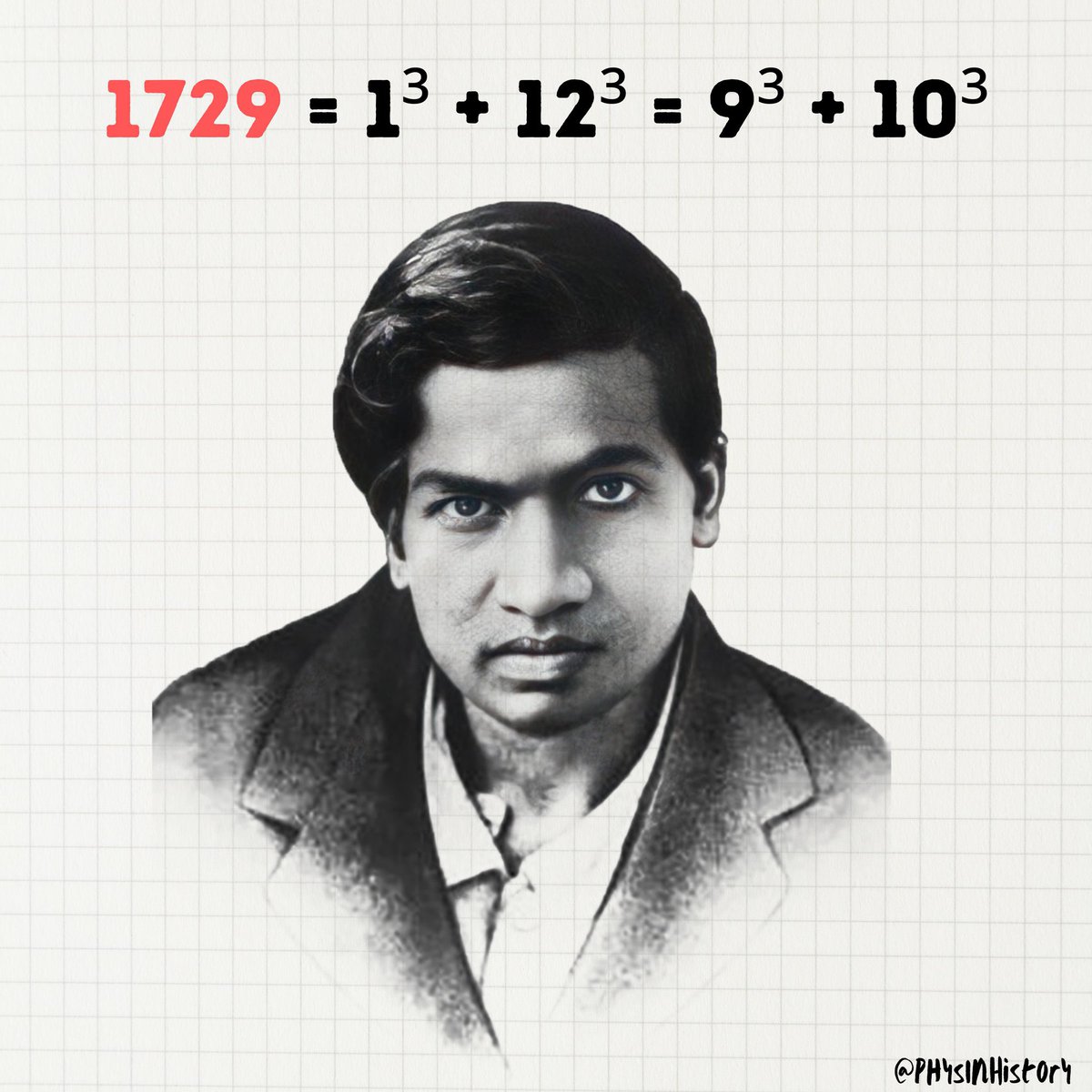
Renowned British mathematician G.H. Hardy once took a taxi to visit his collaborator, Indian mathematician Srinivasa Ramanujan, in the hospital.
Hardy noted that the taxi's number, 1729, seemed "rather dull," which prompted Ramanujan to respond that on the contrary, it was "very interesting" because it was the smallest number that could be expressed as the sum of two cubes in two different ways:
1729 = 1³ + 12³ = 9³ + 10³.
Numbers that can be expressed in this way have since been known as "taxicab numbers."
Whenever they tell you it can't be done in the modern age, show them Dresden.
What's been achieved in Dresden is the most inspiring architectural feat for decades. Everything you see in the bottom image was built, from scratch, in the last 20 years.
The city was a gem of German Baroque architecture, completely levelled by Allied bombings during WW2 - more than 80% of the buildings in the historic city center were either damaged or totally destroyed.
Heartbreakingly, the wonderful Frauenkirche (Church of Our Lady) lay in rubble for decades, under the East German communist regime which refused to rebuild it. It was left in a pile as a "memorial against war" for 50 years. When the Berlin Wall finally fell, the people endeavored to bring it back.
Work began in 1993 to piece the church back together, brick by brick; every stone in the pile was sorted and carried off to be analyzed. Except for the brand new dome, it was reconstructed using as much original stone as possible, to the exact specifications of the original (as much as could be pieced together from old photographs).
The work took 11 years, and in 2005, the Frauenkirche was reconsecrated - rising like a phoenix from the ashes. It was finished one year ahead of schedule and just in time for the city's 800-year anniversary celebrations.
In a remarkable gesture, the gilded orb and cross atop the new dome were crafted by an English goldsmith - whose father partook in the bombing of the city in 1945.
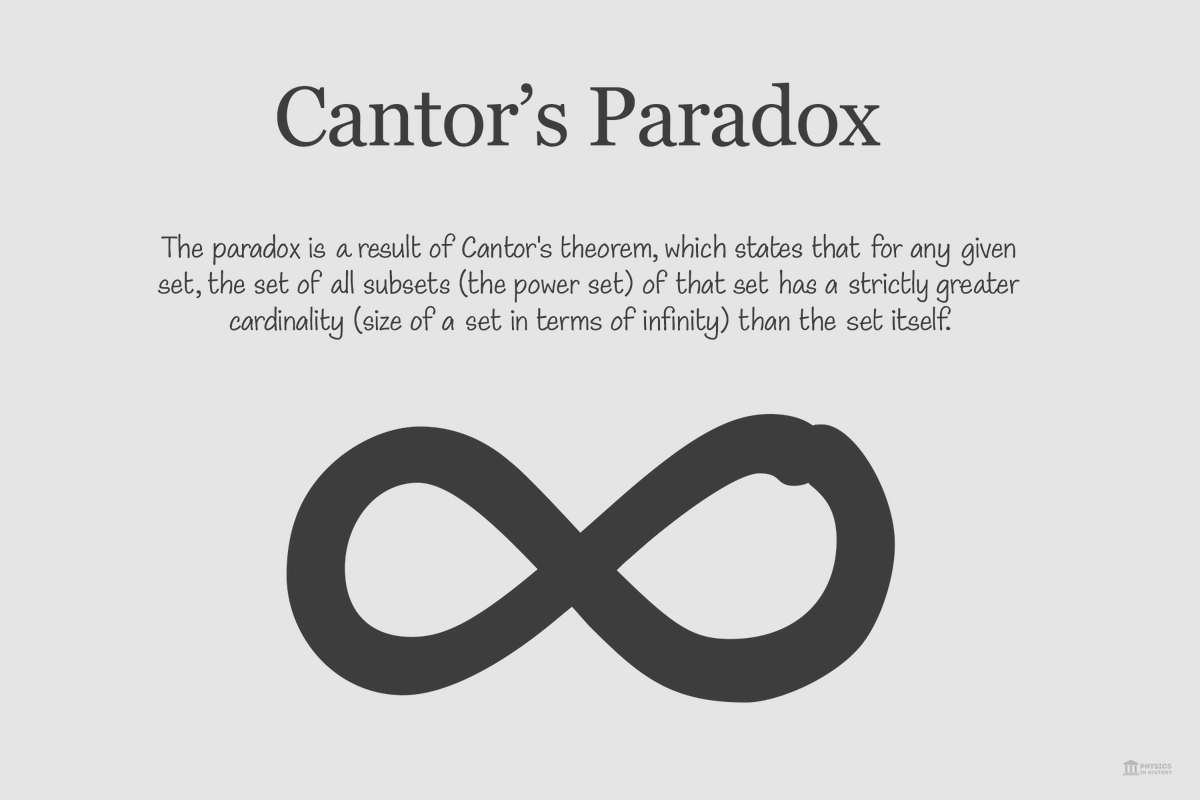
There is a famous paradox called Cantor’s paradox that shows that there is no largest type of infinity. The paradox is based on the idea that for any set, the set of all its subsets is bigger than the original set. For example, the set {1, 2} has four subsets: {}, {1}, {2}, and {1, 2}. Therefore, the set of all subsets of {1, 2} is bigger than {1, 2}.
However, if we apply this idea to the set of all types of infinity, we get a contradiction. The set of all types of infinity is itself a type of infinity, but the set of all its subsets is bigger than it, which means that there is a type of infinity bigger than the set of all types of infinity.
@kaleem_ranjhaa Indeed we have no other option. As we are not the vigilantes who are going to wear a robe and become Robbin Hood or Batman. 🤓
But the system is corrupt to its core and government machinery is making its worst just to achieve their own vested interests.
The image below is what the Pyramid of Khafre looked like right after it was completed in 2560 BCE. The original was encased in white limestone, and the peak was made of solid gold.
For thousands of years, the pyramid stood nearly unchanged. However, in 1303, a powerful earthquake struck the area, dislodging much of the limestone. This earthquake also triggered tsunamis that caused severe damage and loss of life in Crete and Alexandria.
The local inhabitants used their rudimentary tools to take apart the limestones, which were now easier to pull out due to the damage they had sustained from the earthquake.
The limestones that were stripped from the pyramid were used to build mosques and fortifications on the order of a local Sultan. The gold cap at the peak of the pyramid was also taken away, never to be seen again.
With the absence of its white limestone shell, the pyramid was no longer able to reflect the sun, making it visible from miles away.