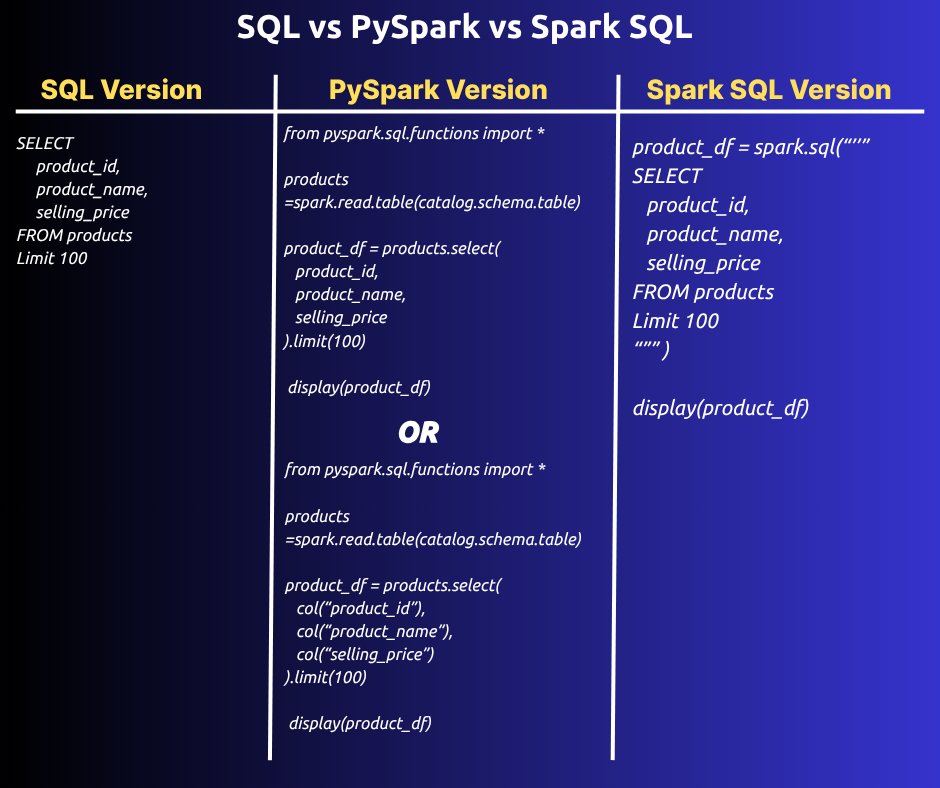
Adding Limit | SQL vs PySpark vs Spark SQL
Selecting and limiting data is one of the most common operations in data engineering and data processing workflows.
The example shown compares how the same operation can be written in SQL, PySpark, and Spark SQL to retrieve product
✅ Builds stronger foundations for scalable data engineering
Whether you prefer SQL syntax or PySpark DataFrame operations, both approaches ultimately achieve the same business goal. Transforming data into actionable insights. #SQL#PySpark#SparkSQL#DataEngineering#BigData
It’s a powerful command that should be used carefully, as once executed, the data and structure are permanently removed.
Understanding how to safely manage and modify database structures is an essential part of becoming a confident data professional.
#SQL#DataEngineering
SQL Series 7 | Understanding the DROP Command in DDL
In this edition of the SQL Series, we explore one of the key Data Definition Language (DDL) commands, the DROP statement.
The DROP command is used to delete database objects such as tables, views, or indexes.
✅ Data Investigation – Digging deep to uncover trends and anomalies.
✅ Programming (Excel, SQL) – Building analytical solutions through code.
These skills together empower you to uncover insights, communicate clearly, and influence strategic decisions across any organization.
✅ Data Exploration – Understanding and profiling your data.
✅ Data Visualization (Tableau) – Turning numbers into visual stories.
✅ Data Storytelling – Communicating insights that inspire action.
✅ Presentation Skills – Effectively sharing findings with stakeholders.
Becoming an exceptional Data Analyst goes beyond just knowing how to work with data. It’s about transforming raw information into actionable insights that drive business decisions.
Here are some of the must-have skills that form the foundation of a great Data Analyst:
Becoming a successful Data Engineer goes beyond writing SQL or building pipelines. It’s about understanding how data flows, transforms, and powers business insights.
Here are key areas every aspiring or practicing Data Engineer should master:
Mastering DDL helps ensure flexibility and precision in database management, essential skills for anyone working with data at scale.
hashtag#SQL hashtag#DataEngineering hashtag#Analytics hashtag#DataAnalytics hashtag#DatabaseDesign hashtag#LearningSQL hashtag#AnalyticsInstitute
Data engineers and analysts often need to modify existing database structures; that’s where Data Definition Language (DDL) comes in.
In this part of the series, we focus on the ALTER command, a key SQL statement that enables you to modify table structures without having to make.
It allows you to create database objects such as tables, databases, views, and indexes ,the backbone of all data systems.
At Analytics Institute, we make complex data concepts simple and beginner-friendly, one SQL command at a time. 🚀
#SQL#DataEngineering#DataAnalytics
Understanding how to structure your database is the foundation of becoming an effective data professional.
DDL (Data Definition Language) helps you define, modify, and manage the structure of your database using commands like:
CREATE, ALTER, DROP, and TRUNCATE.