1/2 Despite our macros, net foreign flows to India have disappointed. In two @BSIndia pieces, I explore why.
Part 1: The domestic surge into equities has created an exit door for FPI/FDI and fewer entry points. We need better tax-adjusted savings options.
https://t.co/ODfSqIYuT1
Watch this episode of #TheGrowwingIndiaPodcast with @ananthng as a masterclass in understanding the relationship between low interest rates and the rupee.
The impact financial repression has on investor choices.
And do not miss the last part where we discuss @Polymarket and a first-principle approach to markets for future prices and events.
https://t.co/Fw0CmJ3LCA
In collaboration with @_groww
'The combined net profit (adjusted for exceptional gains & losses) of listed companies grew at a much faster pace of 15.1 per cent year-on-year (Y-o-Y) in Q4FY26, as compared to 9.2 per cent Y-o-Y growth in the year-ago period. Q4 was the 3rd consecutive quarter of double-digit profit growth for India Inc, and was also the first in 12 quarters to see double-digit revenue growth'
https://t.co/TBfHLyvQ1z
@monikahalan@SEBI_updates@ananthng One of the best, @ananthng@monikahalan
Despite being a long 1 hour, it got me glued with attention.
While the focus was on the impact of top end of the pyramid, it would have been complete if some time was spent on the impact for the common man, the worst hit!
Next time!
Awesome interview ! A must watch. Addressed all my queries on the current equity markets, Rupee depreciation and taxation and their interplay ! Thank you @monikahalan
https://t.co/LG78G8eYMT
Ananth makes a good point re taxation for FPIs. We need to move from source-based taxation to residence-based taxation as is the global norm. It’s this taxation anomaly which is one of the reasons that’s reducing post-tax returns for FPIs and making India far less attractive.
Is the humble Indian SIPper causing the Rupee to decline?
Ex-WTM @SEBI_updates@ananthng debunks this narrative.
The story of the Rupee falling and lack of FDI goes way beyond trying to break the confidence of the Indian retail investor - like some 'experts' are doing.
Ananth calls for an asset-allocation approach with periodic rebalancing.
Also don't miss the section on @Polymarket and prediction markets.
https://t.co/EQId3yCTAT
In partnership with @_groww
Is the humble Indian SIPper causing the Rupee to decline?
Ex-WTM @SEBI_updates@ananthng debunks this narrative.
The story of the Rupee falling and lack of FDI goes way beyond trying to break the confidence of the Indian retail investor - like some 'experts' are doing.
Ananth calls for an asset-allocation approach with periodic rebalancing.
Also don't miss the section on @Polymarket and prediction markets.
https://t.co/EQId3yCTAT
In partnership with @_groww
Enjoyed a wide-ranging conversation with the one and only @monikahalan on how currency, interest rates, taxes and equities are interconnected, and shape savings, capital flows and the economy. We also discussed investing, regulation and market outlook. https://t.co/Z7GDOlfqAu
As per @ananthng, the former whole-time SEBI member, India’s rupee weakness isn’t just a currency story. It’s also a sign that the policy mix needs a rethink, especially when inflation, rates, liquidity, and capital flows are not moving in sync.
“Banks are borrowing 3-month money at 225 bps over repo - the last time that happened was in a crisis period"
Amit Tripathi of Nippon MF tells @_prashantnair why India’s debt-market plumbing needs urgent attention..
@NipponIndiaMF@india_bonds#BankNifty#RBI#Rupee
India world's largest GCC hub: 2,100 centres employing 2.36 million people, generating $100 billion in revenue.. firms continue to expand as Indian depth of talent is hard to match. "There are not too many alternatives." Demand for AI/ML skills is outstripping supply (Reuters.)
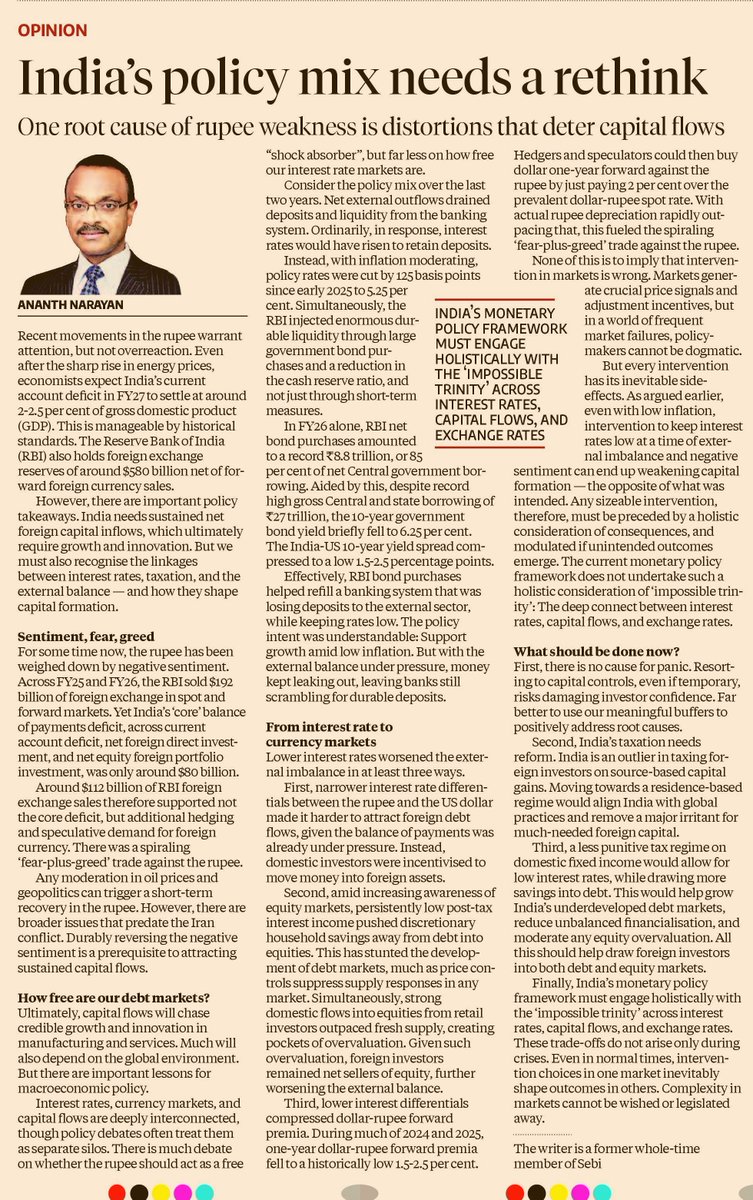
In my latest @bsindia piece, following an Indianomics discussion with @latha_venkatesh and Mridul Saggar, I argue that while sharpening and articulating India’s growth story is critical, policy and market distortions may also have amplified negative sentiment around the INR and deterred capital flows.
Key points:
• No cause for panic: INR weakness warrants attention, but India’s external deficits remain manageable and RBI's buffers are substantial.
• The deeper issue: India’s prolonged struggle to attract sustained net foreign capital amid persistent negative sentiment on the rupee.
• Policy silos: Interest rates, liquidity, taxation, capital flows, and currency markets are deeply interconnected, though policy debates often treat them in silos.
• Unintended consequences: Interventions to suppress interest rates, alongside tax frictions, may have unintentionally weakened capital inflows and lowered the cost of speculative positioning against the rupee.
• Distorted savings: Distortions in taxation and markets have also stunted debt market development, pushing discretionary savings disproportionately into equities.
• Navigating the Trinity: The answer is not avoiding intervention, but engaging more holistically with the “impossible trinity” linking interest rates, exchange rates, and capital flows.
• The structural fix: Rather than introducing capital controls or fresh distortions, responses should aim for deeper debt markets, balanced taxation, and a globally competitive framework for foreign capital.
The piece argues against both panic and rigid orthodoxy, in favour of a more integrated approach to monetary, currency, and fiscal policy.
https://t.co/ud4pLWvj2Q
#Opinion | #Rupee pressure, #RBI interventions, falling rates and shifting capital flows point to deeper links between interest rates, exchange rates and external balance. @ananthng argues #monetarypolicy must account for these interconnected trade-offs.
https://t.co/3OsE38lwbg