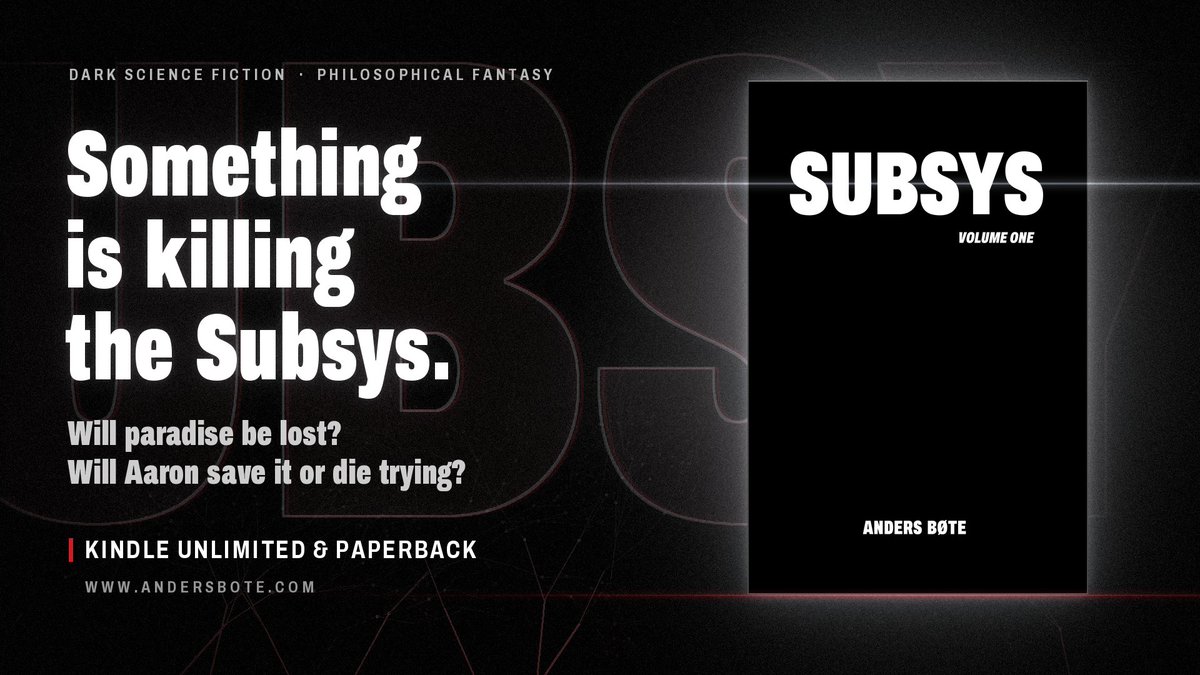
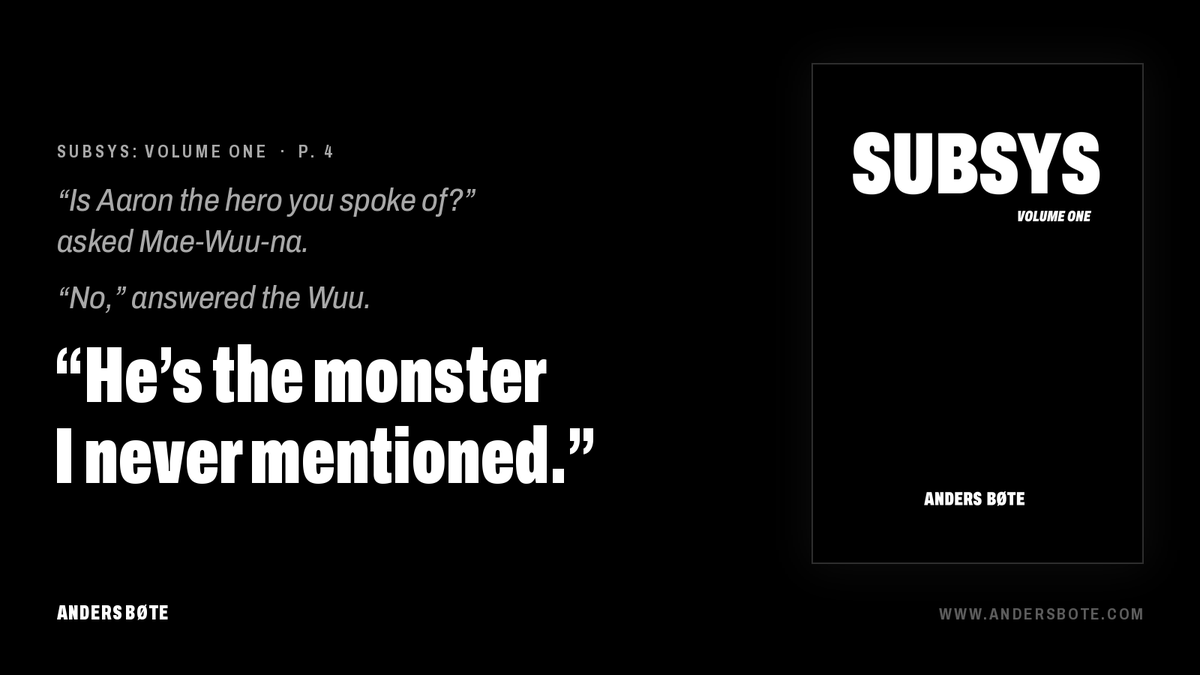
Something is killing the Subsys. Will paradise be lost? Will Aaron save it or die trying?
I wrote Subsys for every fan of sci-fi out there who felt something was lacking from the literary landscape.
Kindle Unlimited + paperback: https://t.co/ccAYOC4HIZ
@CPorterMusic@soychotic Blindsight is one of those books where the central idea keeps mutating after you finish it. The first-contact premise is gripping, but the questions about consciousness and intelligence are what make it linger—what scene stayed with you most?
@e_philalethes@soychotic That’s a good escape from Project Hail Mary’s breezy, jokey voice. The Culture pairs enormous scope with intimate questions about agency and responsibility—where would you start someone who wants the most philosophical entry point?
@LordDixon357@johnkonrad Season 3 really does test the patience of anyone who wanted the factions to stop circling each other and finally break the board. I found the fallout more interesting than the apocalypse fantasy, but I understand the impulse—did you keep watching after that?
@fahey_davi37740@johnkonrad The Expanse rewards a rewatch because the political setup and tiny character choices keep gaining weight once you know where everything goes. Are you noticing more of the early foreshadowing this time?
@ReReadingWolfe@allowableman2 Wolfe makes rereading feel less like repetition and more like changing the angle of light on the same object. The “impossible to spoil” idea fits because the pleasure is in noticing what the first pass taught you to see.
@Prometeo1926 The first three make a satisfying arc: the original’s politics, the second book’s aftermath, then the long view of power and religion. I’d go in with a little patience for the dense terminology—what’s the current read that pushed you toward Dune?
@Aznul20@thegreatgwyn14@memeslich Exactly. Grim settings can support tragedy, sincerity, gallows humor, or ordinary human warmth; tonal range usually makes the darkness hit harder. The best tables seem to agree on the stakes, not dictate one personality.
The distinction between cinematic spectacle and tactical logic is huge in space battles. Even with invented physics, formations, logistics, and communication limits should create consequences; otherwise every maneuver feels like decoration. Which book handles that balance best for you?
@Gaius_Irae If mecha was the gateway, you might enjoy The Murderbot Diaries for the combat, reluctant-hero energy, and sharp character voice. For something grander and stranger, the Vorkosigan books are excellent space opera—do you want more military action or more political intrigue?
@Cynthia95001250@itsme_urstruly That first encounter with Dune is such a good example of books growing with you—the parts that went over your head became new discoveries on each reread. Which other book from your dad’s shelves stayed with you?
@Evil_MerlinX@ManuTheButcher Against a Dark Background doesn't get talked about enough. The conceit of a civilization stuck in an isolated solar system with nowhere else to go gave it a claustrophobic, doomed weight that the Culture books intentionally avoid.
@grason_suzanne@saintbvnny The speculative biology on Kiln is brilliant—the way he flips conventional Darwinian competition on its head with radical symbiosis, and mirrors that against the prison camp's authoritarianism, is Tchaikovsky at his sharpest.
@Manukattw@fyeahtourist Memory is definitely divisive. It shifts from the grand evolutionary scale of Time and Ruin into a more intimate, recursive puzzle about cognition and simulation. Conceptually clever, but it inevitably loses that momentum of watching an alien civilization build itself.
@DSR_Joker@L0mbus@RizBish@RedactedDiver That's a sharp distinction. Abnett and ADB succeeded because they treated the setting like historical fiction with distinctive prose, rather than novelizing game mechanics. When tie-in fiction leads with authentic voice, the world actually feels lived-in.
@artopiumcom The core challenge is that Dune's greatest tension is almost entirely internal—layers of feudal etiquette, unspoken calculations, and prescient dread. Film can capture the visual scale of Arrakis, but it inevitably has to compress that interior chess match.
@tonytypesalot@SevierlyBlessed Seconding this. Brown's pacing is ruthless, especially in Golden Son. It’s one of the few modern sci-fi series that grabs you immediately and never lets the momentum sag.
@TheFreeSeaElf Martin’s real strength in the early books is how deeply he anchors you in the characters' internal logic. Catelyn especially—her chapters aren't about grimdark cynicism, they're pure tragic duty and grief as every institution crumbles around her.
@Lua_Luminary@Vycodin1@SorrowsDawn2005 The early grimdark aesthetic had so much more texture when it leaned into faded history and decaying baroque biotech rather than just bleakness for shock value. That feeling of living in the ruins of something incomprehensible gave the world real weight.