What actually happens on social media when users get access to integrated AI?🤖
In our new preprint, we present a controlled experiment testing the impact of generative AI (4 treatments + control) on a social media platform, using a representative sample of 680 U.S. participants.
What actually happens on social media when users get access to integrated AI?🤖
In our new preprint, we present a controlled experiment testing the impact of generative AI (4 treatments + control) on a social media platform, using a representative sample of 680 U.S. participants.
We find a clear duality between the usage of AI tools and participants’ perception of the content. All that and much more on our blog and in the paper:
🧠 Blog: https://t.co/PiSbuyjDFG
📄 Arxiv: https://t.co/Ut2cTlNJ9l
New tool to estimate the level of participation in collective action expressed in natural language.
Applied to social media, it can produce large-scale and granular estimates of behavior change wrt collective action.
Check it out: https://t.co/MXHpxNS60F
@Carlsbergfondet@ITUkbh
Excited to share the tool @lajello & I built to predict social media participation in collective action! It moves beyond keywords, tracking activism stages across topics. See it in action with climate activism on Reddit 🌱
Check it out: https://t.co/LOiM8gz56Y
Please consider submitting to this initiative.
We plan to fund at least a 4-5 students from the Global South to travel to Copenhagen and attend ICWSM
If you know anyone who might be interested please forward.
Lots of folks listen to podcasts—an estimated half of Americans do monthly!—but there's been limited data to study what happens on them. What do they talk about? Who are the guests? Who is influencing whom?? This new dataset is our attempt to bring light to an important medium
At #EMNLP2024 we will present our paper on LLM values and opinions!
We introduce tropes: repeated and consistent phrases which LLMs generate to argue for political stances.
Read the paper to learn more! https://t.co/179IfiN4Kl
Work done @CopeNLU & @AiCentreDK
We wrote an article on the perils and challenges of using LLMs to simulate humans or social interactions: https://t.co/eSEIWKEtqm It's a part of a special issue of Sociologica (check it out!). Our main point is that, while tempting, using LLMs
Us at @nerdsitu are organizing a session today @ #D3A called "Networks, Data, Society, and AI" (hall D).
Our workshop brings together interdisciplinary speakers talking about how/if computational techniques can be used to understand some of the biggest issues society faces today
Tomorrow (Oct. 22nd) starts the Danish Digitalization, Data Science and AI 2.0 (D3A) Conference in Nyborg 🇩🇰 The @nerdsitu group has organized a nice little workshop - “Networks, data, society, and AI”.
🤷🏼♂️ Why go there?
We have a great lineup of speakers talking about intersting things. Simple.
1️⃣ Incredible data and AI journalist at @version2dk, Therese Moreau (@ThereseMoreau) - if you follow AI in Denmark, you’ve probably read something from her or maybe seen her on DR Deadline.
2️⃣ Associate professor Pantelis Pipergias Analytis from @SyddanskUni, who does research within mathematical and computational models to study individual and aggregate human behavior.
3️⃣ CEO and founder of @ElectricityMaps, Olivier Corradi (@corradio). Electricity Maps provides real-time data and forecasting of electricity signals to enable data-driven solutions to decarbonize electricity consumption.
After individual presentations, we will have a panel discussion moderated by Vedran Sekara (@vedransekara).
🙋🏼♀️ Who is this for?
This workshop is for practitioners, policymakers, researchers, and everyone who loves to see data science applied to real-world problems, has an interest in computational social science, networks, AI, and wants to understand social and human behavior.
⏰ When and where?
Tuesday, October 22, 13:30 - Sal D.
Come check it out and say hi!🤙🏼
✨I’m on the academic job market!✨
I'm a CS Postdoc at Stanford in the @stanfordnlp. I develop AI and causal inference to tackle societal issues like online civility, racial justice, sustainability, and more.
Check out the thread for details!
Website: https://t.co/KbTJevMIYh
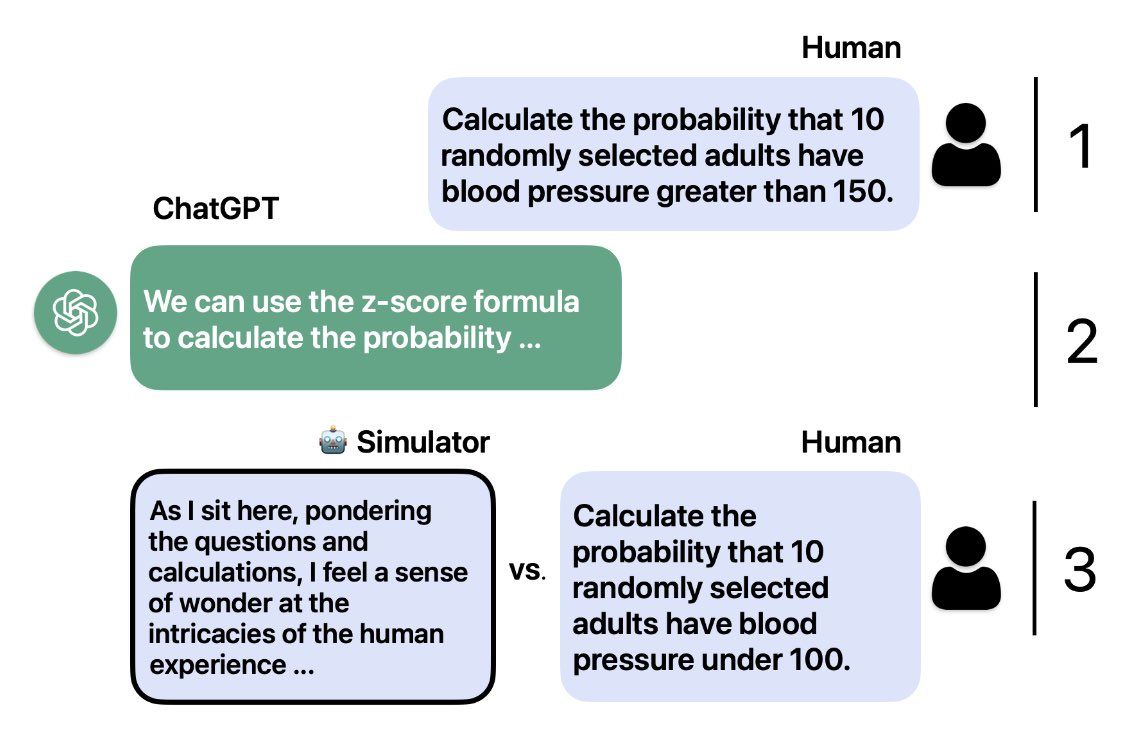
👩🏼💻 Real or Robotic? 🤖 Can LLMs accurately simulate qualities of human responses in dialogue?
Human conversations with LLMs are great for assessing the capabilities of LLMs. But having lots of folks chat with LLMs is challenging (💰⏳🕵️). Could we have another LLM *simulate* being a human talking to an LLM as a substitute?
In our new preprint, we test whether models can roleplay as the human in human-LLM conversations. Using the WildChat dataset and 100K+ simulations we test how well these LLM responses actually mimic with human ones. Our study spans 🇬🇧 English, 🇨🇳 Chinese, and 🇷🇺 Russian, using 21 linguistic metrics like lexical, semantic, syntactic, and stylistic features.