Spent last week with #oilseed leaders from 6 countries at the International Oilseed Producers Dialogue. Different farms and governments, same headaches: fertilizer costs, trade uncertainty, biofuels, food production. Good to host this one at home. #IOPD#CdnAg
You can't have food security without food producers. Simple as that. Worth a read from @GrainFarmersON and @uofg on what Canada's national strategy needs to get right. https://t.co/WasNb1mSLn #cdnag
Last week, CCGA's Senior Manager, Transportation & Trade Policy, Brittany Wood, participated in a panel on the Clean Fuel Regulations, biofuel policy, and the value of biofuels to Canadian canola farmers.
Read more below. #CdnAg
Last week directors and staff from CCGA, @canolacouncil, and Canadian Oilseed Processors Association were on Parliament Hill to discuss with government officials and Parliamentarians how advancing Canadian biofuel policy can benefit #canola farmers and the broader industry. We appreciate all who took the time to meet with us.
#CdnAg #CdnPoli
Are you a farmer who’s thinking about applying for a cash advance? Or you’re just hearing about this low- & no-interest financing for the first time?
Check out CCGA’s website for all the details about advances and how you could benefit. And don’t miss our FAQ page for even more answers and short, helpful videos: https://t.co/d85pcBqOqO
#CdnAg #westcdnag #AAFC_APP
Minister MacDonald announces interest-free limit under the Advance Payments Program will be set at $250,000 for 2026, for all non-canola advances, to help #CdnAg producers access additional cash flow and interest savings. https://t.co/DogF0ZzqZ4
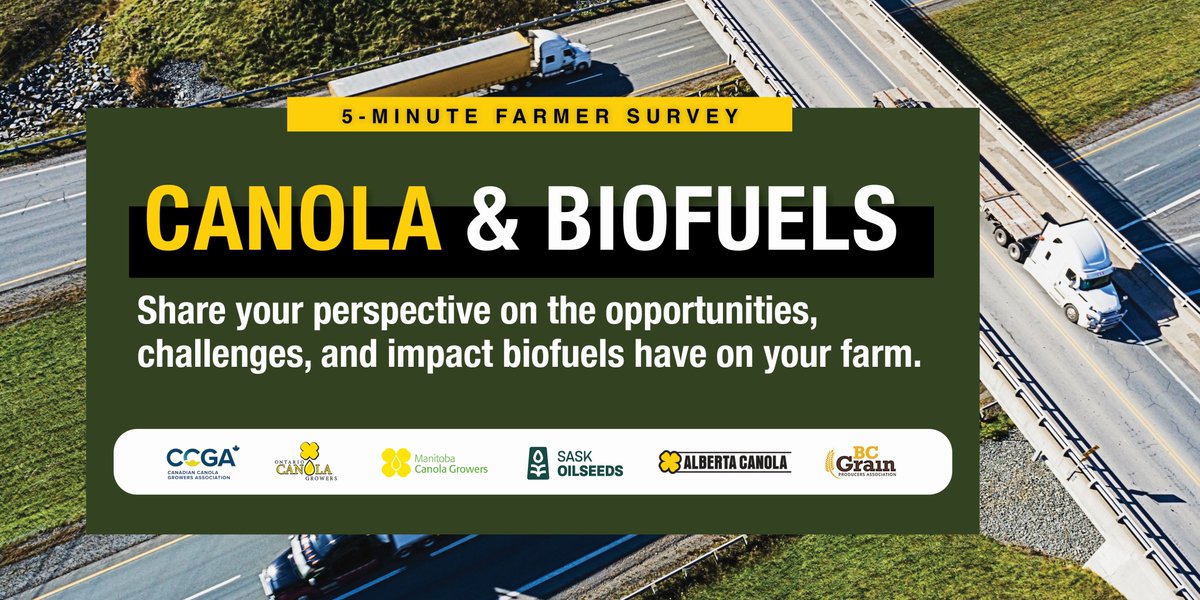
What do biofuels mean for your canola crop?
Help your farmer associations understand your perspectives by taking a short, anonymous survey.
🔗https://t.co/BRYfaA5aZn
#CdnAg#CdnPoli
The national and provincial #canola farmer associations want to hear from you!
Help us better understand canola farmers’ views and perceptions about the biofuels market. Take this quick 5-minute survey:
https://t.co/BRYfaA5aZn #CdnAg#CdnPoli
Press Release: CCGA Launches 2026 Cash Advance Applications
Starting today, farmers can apply for up to $1 million, including:
➡️Up to $100,000 interest-free on more than 50 eligible commodities; &
➡️Up to an additional $400,000 interest-free on canola only; +
➡️An interest-bearing advance rate of prime less 0.25%.
Read more: https://t.co/qAUDwGV9bT
#CdnAg #WestCdnAg #AAFC_APP
Today, China announced it will be suspending 100 per cent tariffs on Canadian canola meal and peas, and 25 per cent tariffs on lobster and crab imports, effective March 1.
Fantastic news for Canada's agriculture and seafood sectors.
https://t.co/FouN8Kt55L
Dear Fellow Albertans,
This letter is written not as a partisan, but as an emergency physician who has cared for more than 100,000 Albertans, a former MLA, and someone who has devoted a working life to this province.
Across Alberta, the strain is obvious. Housing is scarce. Emergency rooms are overcrowded. Schools are stretched. The cost of living weighs heavily on families. Anxiety about the future is real and justified. This is not anger. It is concern, because moments like this demand leadership.
When people are under pressure, leadership is not just about solutions, but about direction: an honest explanation of what is actually going wrong, and reassurance about who we are as a society while we fix it.
In recent weeks, Alberta’s challenges have been framed by the Premier, Danielle Smith, in a way that has left many people angry, not at systems or long-standing policy failures, but at immigrants and other governments. That is deeply troubling.
The frustration people feel is understandable. But much of that anger is being misdirected at immigrants. With the exception of Indigenous peoples, all Albertans come from families that arrived here seeking opportunity.
Immigrants did not break Alberta’s healthcare system or tear up family doctor contracts. They did not close hospital beds or cancel planned hospital capacity. They did not under build housing, assisted living, long-term care, or schools. They did not dismantle community care. Politicians did.
Every day in emergency departments, the consequences are visible: acute-care beds occupied by patients who should be at home or in long-term care; ERs functioning as inpatient wards; and population growth encouraged without matching investments in primary care, continuing care, and hospital capacity.
In 1992, Alberta had approximately 11,700 hospital beds. Today, with nearly double the population and a much older demographic, we have roughly 8,800. This is not an Ottawa or immigration problem. It is a planning and capacity problem.
Many of the people caring for seniors, staffing hospitals, and holding the healthcare system together today are newcomers themselves. Blaming them delays real solutions and divides communities.
That lesson is personal. Growing up as a newcomer involved violence, black eyes and broken bones, and learning early what happens when fear is tolerated and adults look away. Home was not always safe either, shaped by alcoholism and domestic violence. Those experiences leave marks.
What mattered most was a mother who taught that anger shrinks a life, while forgiveness, discipline, and service strengthen it, and that opportunity carries an obligation to give back. That belief led to decades in emergency medicine, the training of thousands of doctors, and public service at personal cost.
Those experiences lead to a clear conclusion. Albertans deserve leadership that lowers the temperature, not raises it. Leadership that fixes systems, not finds scapegoats. Leadership that takes responsibility for planning failures and invests in capacity to match growth.
For these reasons, Alberta needs a change in direction and ultimately, a change in leadership, so the province can unite around practical fixes rather than division.
This is not about racism. It is about judgment, competence, and the ability to govern responsibly during difficult times. Alberta needs leadership that brings people together and focuses on solutions, not blame.
Premiers Lougheed, Klein and Stelmach have led through very difficult times and would not take our province to this sharp edge.
Albertans are much better than this.
I am a Canadian, an Albertan and I am an immigrant.
God bless Alberta.
Dr. Raj Sherman
@ABDanielleSmith@nenshi@FreeAlbertaRob@PfParks@NightShiftMD@Alberta_UCP@UCPCaucus@albertaNDP@TheBreakdownAB@ryanjespersen@cspotweet
#yeg #yyc #ABleg #cdnpoli
For generations Albertans have made astonishing sacrifices to build Canada, to defend it, and even to die for our country as the truth North strong and free.
But some rich Canadians who spend half the year sunning themselves in Arizona are going to take a break from their regular golf-and-happy-hour routine to drop by and sign a petition, in a foreign land, to tear apart the country built by their ancestors.
For shame.
Lorne Gunter: Uncertainty rising with threat of referendum on Alberta separatism
The provincial government’s search for a major private investor to build a pipeline to the West Coast is reportedly stalled by the uncertainty surrounding a potential separatism referendum this fall.
https://t.co/2UzKWq67Td