Congratulations to all the Romanian teams for this incredible achievement at the world robotics championship in Houston / Texas! 🇷🇴🤖
The first 4 places were won by Romania:
🥇 1st place – Velocity from Braila
🥈 2nd place – Heart of Robots from Buzau
🥉 3rd place – Quantum Robotics from Bucharest
🏅 4th place – AICitizens from Focsani
Massive respect to all the students, mentors and teams involved.
Romania keeps proving that talent, intelligence and hard work can compete with anyone in the world.
150 commits per developer. #3 in the entire blockchain industry.
New rank coming from Chainspect_app for every ecosystem by productivity. Not team size. Not total commits. Output per engineer.
───
2.7x Ethereum. 2.4x Bitcoin. 3.5x Aptos. Solana isn't in the top 25.
Three weeks ago I posted about 171,000 total commits. That got us to #6 by volume. This metric is sharper. It strips away headcount and measures velocity.
A team of 50 shipping 150 commits each tells you something different than a team of 500 shipping 15.
───
What those commits produced in the last 20 days alone:
xMoney (XMN) live on Binance Alpha. Regulated stablecoin payments infrastructure, now on the world's largest exchange.
Over 100 security submissions poured in from the community during Battle of Nodes. They didn't find toy bugs. They found real protocol-level edge cases that no amount of internal testing could surface. The kind of findings that led to two live mainnet upgrades and multiple network-level fixes before Supernova even reaches mainnet. One finding was critical enough to require a hard fork on testnet. Detected, patched, recovered within hours. Cross-shard latency behavior under adversarial conditions was identified and corrected. Transaction pool handling at sustained 120,000 TPS exposed patterns that only emerge when hundreds of real validators on real hardware push a network built from mainnet-equivalent state to its limits. Including nodes running on Raspberry Pis. One billion transactions processed. Not on a clean testnet. On a battle-hardened proving ground.
Most chains test in private and ship hoping nothing breaks. We opened the gates, invited the community to break it, and came out with a stronger protocol on the other side.
Six agentic commerce protocols now live on one chain combining MCP, UCP, ACP, MPP, x402, AP2. The organizations behind them: Google, Stripe, OpenAI, Anthropic, Visa, Shopify, Linux Foundation.
MvX SC MCP shipped. AI agents building and deploying smart contracts natively on MultiversX.
───
This is what a small, focused team compounding through a bear market looks like.
Shipping. Every week. Every commit. Every protocol integration.
The data is public. The code is open. The infrastructure is live.
───
This is MultiversX. This is $EGLD.
A Bet We Made in 2018
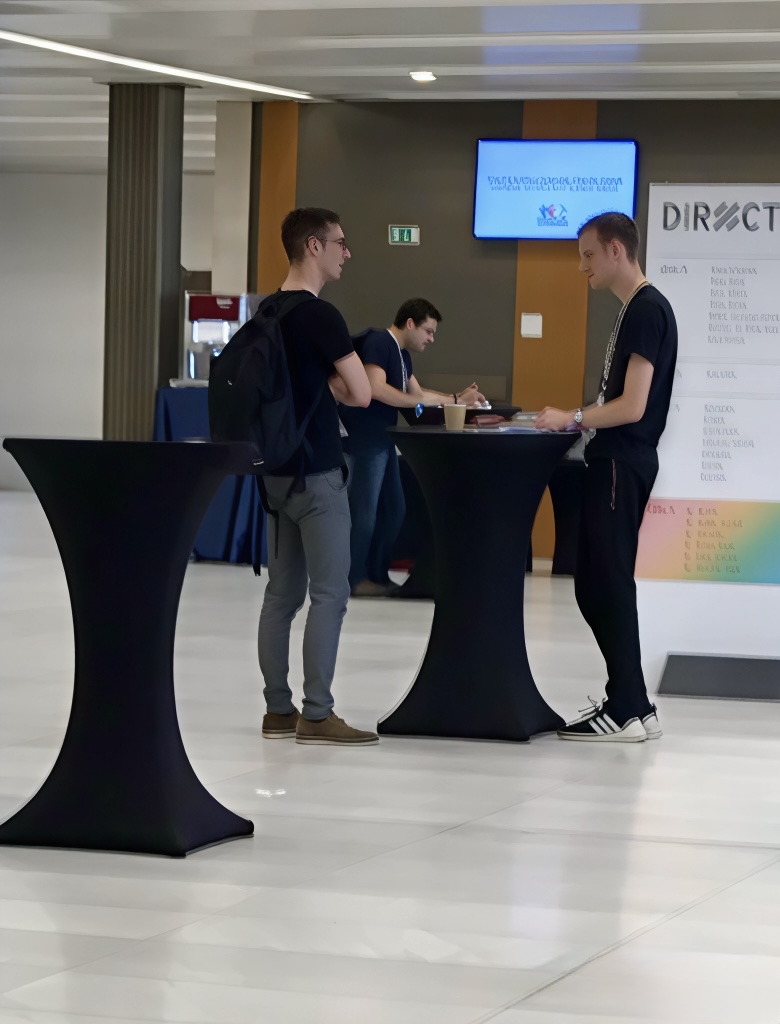
This is me and Vitalik in 2018. ETH Devcon.
We were at a table talking about sharding and how blockchains could actually scale by running execution in parallel.
At the time, Ethereum and Elrond had the same thesis. Both believed execution sharding was the path forward.
Since then, Ethereum changed direction multiple times. Sharding gave way to rollups. Rollups gave way to "we need to scale L1 again." The roadmap shifted, the promises changed, the technical approach pivoted more than once.
And through all of it - the Ethereum community stayed. They gave the team the space to find the right path. They didn't kill the project when the roadmap changed. They believed the builders would figure it out.
That patience is what kept Ethereum alive. Not the technology. The community.
───
We made a different bet. We bet on execution sharding from day one and we never left that path.
Adaptive state sharding shipped on mainnet in 2020. Three execution shards plus a metachain. State, network, transactions - all sharded from genesis.
Supernova shipped this year. Consensus decoupled from execution. 600ms blocks. achieved 88ms finality. 120,000 TPS burst mode on the same validator hardware. 3,200+ validators on consumer-grade machines.
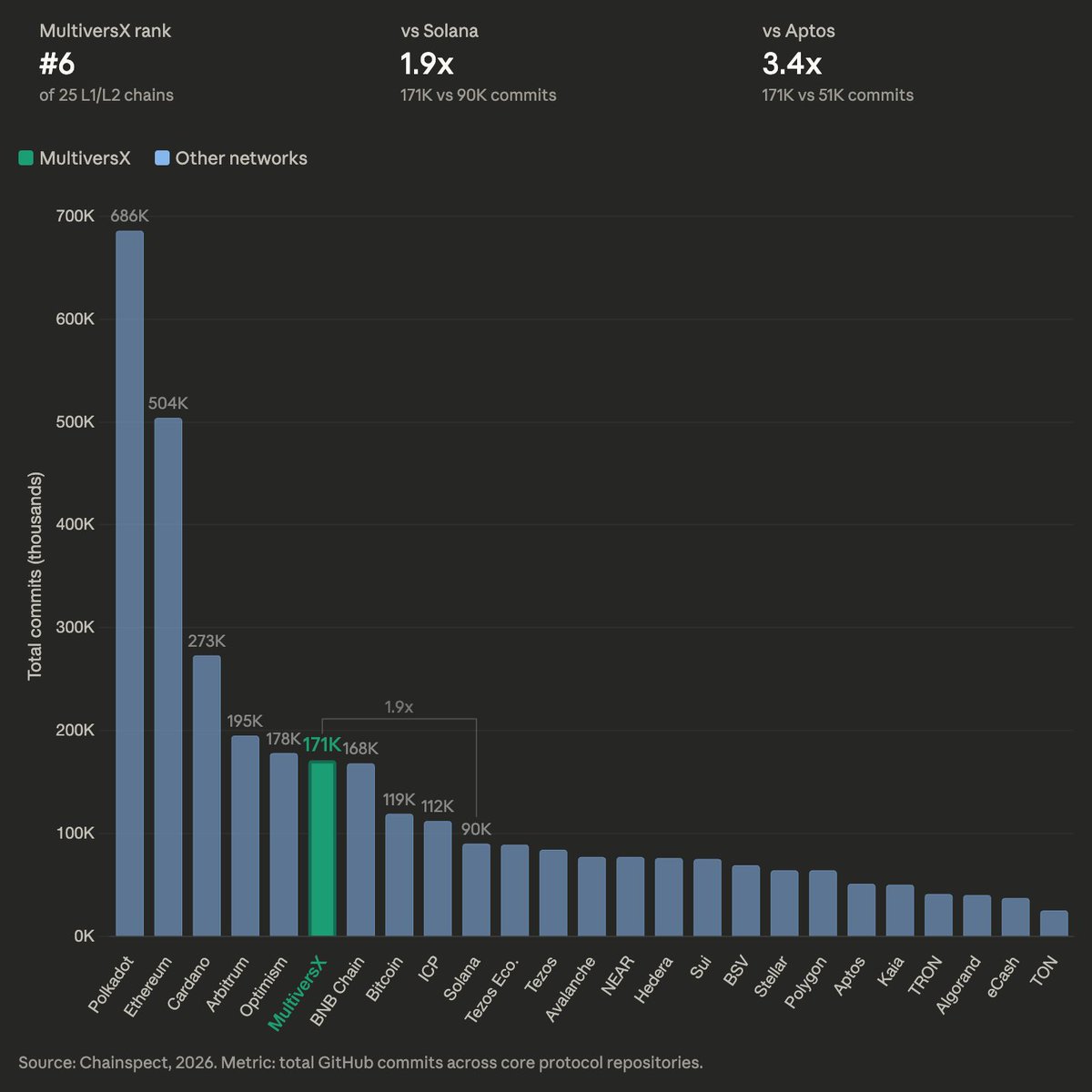
171,000 commits. #6 in the entire industry. Ahead of Solana, Avalanche, Sui, Polygon, Aptos, and TON.
Tier-one infrastructure providers on board, distribution partners like Cointelegraph are running validator nodes. Stripe's Machine Payments Protocol is settling on MultiversX. EGLD is named in an Arizona state strategic reserve bill. The agentic commerce stack - x402, MPP, MX-8004, UCP, ACP, MCP - is live on one chain. xMoney is building regulated stablecoin issuance under MiCA.
The infrastructure underneath has never been stronger.
───
And yet the market prices EGLD like none of this exists.
Every blockchain community is going through the same thing right now. EGLD is down. ETH is down. SOL is down. The market doesn't differentiate between chains that shipped paradigm-shifting infrastructure and chains that shipped a landing page.
But here's what's different about right now.
Bitcoin survived 2014. Ethereum survived 2018. Solana survived 2022. In each case, the community stayed long enough for the technology to matter. In each case, the community that held wrote the next chapter.
And in each case, the ones who fractured, who turned on their own builders, who let the loudest voices - the ones who already sold - define the narrative? Those communities don't exist anymore. You don't remember their names.
The perception of value has been distorted. By cycles. By speculation. By narratives that reward noise over engineering. And by us - divided when we should be united. Turning on each other instead of building forward together.
Look at what's underneath. Not the chart. The infrastructure.
88ms finality. 120K TPS. #6 in developer activity globally. Tier-one infrastructure partners. Stripe settling on-chain. EGLD in US state legislation. Regulated stablecoins under MiCA. An agentic commerce stack that Visa, Coinbase, and Mastercard are racing to replicate.
This is not a project searching for relevance. This is a project that shipped the relevance and is waiting for its community to match it.
If this fails, it won't be because the technology wasn't good enough. It will be because we weren't united enough to carry it forward.
I've been here since 2018. That table with Vitalik. Every pivot, every cycle, every doubt. Still here. Still building.
Now it's your turn. Not to believe. To show up.
Who's Actually Building?
171,000 commits. #6 in the entire blockchain industry.
Ahead of Bitcoin. Ahead of Solana. Ahead of Avalanche, NEAR, Sui, Polygon, Aptos, and TON. Almost 2x Solana. Nearly 3.5x Aptos. The data is public.
I'm not writing this to flex. I'm writing it because the people doing the real work deserve to see it reflected somewhere other than a Git log.
───
Building through a market like this is brutal.
The price bleeds. Liquidity gets extracted by professionals who've never deployed a contract. Narratives rotate every two weeks. The projects that survive aren't the loudest, they're the ones that refuse to stop shipping.
We shipped Supernova while the market did everything it could to make us irrelevant. 150,000 lines of new protocol code. 20 months. A complete rearchitecture of how consensus and execution interact.
88ms block finality on 600ms slots. The block finalizes before the round ends. 120,000 TPS burst mode on the same validator hardware. 3,200+ nodes. Full sharding intact.
We didn't build this because the market asked for it. We built it because it was the right thing to build.
───
The market rewards narratives. It rewards projects that rename themselves to match whatever's trending.
It doesn't reward the team that designed inclusion proofs so blocks finalize before execution completes. It doesn't reward 171,000 commits. It barely notices.
But here's the thing, infrastructure doesn't need the market's permission to work. Over 500 million transactions processed. 3,200+ validator nodes across four continents. And now, sub-second finality on every transaction type.
───
People ask: "What's left for blockchain when AI takes over everything?"
Wrong question.
AI agents need to transact autonomously. They need identity. They need programmable money that settles in milliseconds. They need micropayments at scale without a human clicking "approve."
Credit cards can't do this. Bank wires can't do this. These rails were built for humans, not machines.
This is where the entire stack is converging. Look at what happened in the last 90 days:
Visa launched agentic payment tools. Mastercard acquired BVNK for $1.8B. Coinbase is pushing x402 hard. Circle is racing for stablecoin dominance. Stripe built ACP with OpenAI.
They're all building pieces of the same stack:
identity, payments, settlement, stablecoins.
We built the whole thing. On one chain.
x402 for autonomous agent payments. MX-8004 for on-chain agent identity. UCP, ACP, AP2, MCP for agent communication and commerce. xMoney for regulated stablecoin issuance and fiat-to-crypto connectivity under MiCA. Relayed v3 for gasless transactions so agents don't need to hold tokens to start.
Six protocols. Regulated stablecoins. Fiat rails. One network.
The stack that Visa, Stripe, and Coinbase are assembling from separate pieces, we shipped as a unified layer.
───
And the community.
Every validator who kept running through the drawdown. Every builder who deployed when nobody was watching. Every staker who stayed.
171,000 commits. Supernova. Battle of Nodes. Cointelegraph joining as a validator. EGLD named in an Arizona state strategic reserve bill.
The signals are there. The infrastructure is live. The convergence between AI, payments, and blockchain isn't five years away. It's happening now.
The teams that built through the hard part don't need to pivot when the opportunity arrives. They're already there.
We're already there.
Even Darkness Must Pass
Every morning I wake up with one very simple Idea in mind: is there something we can do, I can do, to help clear out the corridor for Supernova? To help the team, in any simple way, get a slight bit closer.
Sometimes the answer is pretty clear, there's some piece that can unlock the next milestone and that's what we all focus on. Like a particular component that is missing, or a particular bug that is hunting us like a ghost in the machine. But sometimes, it's not as simple, you just need to perform a whole range of meticulous tweaks and chaotic testing scenarios, gradually discovering and ironing out more and more edge cases.
This has been my mind for the past months. In fact, this has been what Adrian and the protocol / infra / api / tooling teams have been asking and pushing on, every single day for the past months.
The really good part, is we are now a few days away from having, for the first time, a more reasonable, ehm, [the word that shall not be named], deadline. Once this is out, the mood will swing fast.
Sometimes nights are tough. If you ask people who've been through a storm, people who've been through a war, or people who've been through hardocre difficulties, they’ll tell you. There's a sense that the night with its darkness will never end. And that right there, can drive us mad.
And yet, the most ecstatic and joyous moment for all those people who’ve been through a hard night, is to see the morning dawn arrive. That moment, when it happens, almost feels like a wonder.
And yet, there's strength in reminding ourselves of this simple truth: however dark the night, even darkness must pass. And a new morning dawn shall come.
That morning dawn is SUPERNOVA.
Once the current testing rounds clear out, with just enough stabilization in place, we are ready for the next public update and a real deadline. I think I speak for all of us here when I say, I really can't wait for that. :)
First for Battle of Nodes, then for the new dawn we call SUPERNOVA.
------------------------
Overall progress update:
█████████░ 98%
------------------------
“Sell everything. Walk away. Declare it dead.”
That’s the easy take. Building is harder.
That’s usually how it sounds right before something important happens.
While the noise is loud, the protocol engineering team just pushed a real breakthrough:
~80ms block finality, running full sharding, live.
That’s an order-of-magnitude improvement in speed, at internet scale, without compromising decentralization.
-----
Building something truly new in tech, from scratch, at this scale, is brutally hard.
Building something that has never existed before means constantly rethinking fundamentals, technical and operational.
Engineering is not the only place where iteration happens.
Organizations must evolve too.
As part of this evolution, we are restructuring parts of the organization.
We are simplifying, refocusing, and increasing execution efficiency across the board.
Fewer distractions. Clearer ownership. More energy where it compounds the most.
This is about going deeper on what truly matters.
That’s what real focus looks like.
-----
None of this diminishes the value of the work done so far, quite the opposite.
I want to express deep gratitude and respect to everyone who contributed, experimented, built, and pushed boundaries during this chapter.
What exists today is only possible because of that effort.
-----
The goal remains unchanged from day one:
to build a protocol that redefines what is possible at internet scale.
Markets move in cycles. Narratives come and go.
But execution compounds.
We will continue to redesign, refactor, and push forward, with renewed focus, and absolute commitment to finishing what we started.
-----
If this feels uncomfortable, it’s because progress usually is.
Adapt, adjust, and push harder.
Lucian
When the chain does not scale, all new apps are looking at faster execution, better UX, seamless experiences.
The research has remained behind, this is what you get.
When you have systems where transactions costs 0.1$ and you get all your transactions executed almost instantly, you do not go back to something with 12s block times and tens of dollars in cost.
And still, a lot of Ethereum maxis are on their high horses and nothing else is good. No research/development/innovation which comes from outside the inner circle is deemed to be good. Especially by the KOLs.
Ethereum used to be the center of innovation, but there is actually no space for that anymore. It got in a position like our beloved Bitcoin, still no VM there, still no scaling, still insanely hard to use with block times in minutes.
And it was but funny and sad to read/hear that Ethereum is for the long game, and not the short time scaling. There are methods of scaling which are for the long term by design, it is called SHARDING.
Do you want to innovate?
Come and try building on MultiversX, literally, with new VM, countless of features, insane SpaceCraftSDK, built in security for users and developers.
And we never stop innovating.
Some things just go perfectly together.
An exchange designed with global ambitions and a currency built for global adoption.
@RevolutApp’s crypto exchange enables easy $EGLD trading.
💱 https://t.co/gJiQPeD17Q
Recession after FED cuts? - It's about the WHY
This is will be for my Romanian follower because there was/is a lot of talks and noise about Recession in our communities, so I will give my opinion on the matter: 🧵👇
24/ Am cumparat primul BTC al acestui ciclu cand a trecut de 21k, deci n-am prins bottomul. Pe altcoins am devenit bullish din Oct 2023, la fel si pe SP500.
Voi ramane bullish atat timp cat pretul confirma pe structurile saptamanale.
Like & retweet daca ti-a placut 🫡
Onepager: @MultiversX
🔹MultiversX is an advanced blockchain protocol, utilizing sharded architecture and Secure Proof of Stake to facilitate scalable, secure, and efficient transactions.
🔸The platform’s emphasis on scalable parallelism, sovereign chains, and versatile execution offers robust solutions for developers, enhancing scalability, resilience, and cross-shard transactions.
$EGLD
Falling Wedge - $EGLD Potential Target: $78
After forming a bottoming pattern around $25, EGLDUSDT is now testing a confluence of resistance at the $32-$34 area.
A daily close above the $38 intermediary resistance would open up targets at the $46 and $54 areas, confirming a breakout to the upside.
If there were ever a time for the #EGLDSqueeze army to show their presence, now would be that time.
Unlock the Power of Fast EV Chargers: How Do They Work?
Ever wondered how you can charge your electric vehicle (EV) in a fraction of the time? Thanks to the fast EV chargers, also known as the DC fast chargers. These chargers are game-changers, significantly cutting down charging times compared to standard AC chargers. Let’s take a look at how they work:
Direct DC Supply: unlike traditional AC chargers, which convert alternating current (AC) to direct current (DC) within the vehicle, fast chargers supply DC power directly to the EV’s battery. This bypasses the slower onboard AC-to-DC converter, allowing for much quicker charging. Essentially, the fast charger acts as a powerful external battery, delivering a high flow of energy directly to your EV.
High Power Delivery: fast chargers are capable of delivering a wide range of power outputs, typically from 50 kW to 350 kW. The more power, the faster the charge! For instance, a 150 kW charger can add hundreds of km to your EV’s range in just 20-30 minutes. That’s perfect for quick stops and long trips alike.
Smart Communication with the Vehicle: these chargers are smart! They communicate with your EV’s Battery Management System (BMS) to determine the best charging rate. This ensures that the charging process is not only efficient but also safe, preventing issues like overheating or overcharging.
Modular Design: Many fast EV chargers use a modular design, where each module typically provides around 30 kW of power. This setup offers numerous benefits:
- Scalability: Need more power? Just add more modules!
- Reliability: If one module fails, the others keep working, ensuring you’re not left stranded.
- Cost-Effectiveness: Modular systems are often more affordable to maintain and upgrade.
- Ease of Maintenance: Individual modules can be serviced or replaced without shutting down the entire system.
The technology for DC ev chargers is evolving to provide fast, efficient, and safe charging wherever you go. Whether you’re commuting or planning a road trip, these chargers make it easy to keep your EV powered up and ready for the road.
Let's Go Charge ⚡️
@Rainmaker1973 It''s great living in Romania! 100 years back, still loving it! Nice areas, nice food, friendly people (most of them), you can easily still find peacefull, lonliness when you want to!


![beniaminmincu's tweet photo. Even Darkness Must Pass
Every morning I wake up with one very simple Idea in mind: is there something we can do, I can do, to help clear out the corridor for Supernova? To help the team, in any simple way, get a slight bit closer.
Sometimes the answer is pretty clear, there's some piece that can unlock the next milestone and that's what we all focus on. Like a particular component that is missing, or a particular bug that is hunting us like a ghost in the machine. But sometimes, it's not as simple, you just need to perform a whole range of meticulous tweaks and chaotic testing scenarios, gradually discovering and ironing out more and more edge cases.
This has been my mind for the past months. In fact, this has been what Adrian and the protocol / infra / api / tooling teams have been asking and pushing on, every single day for the past months.
The really good part, is we are now a few days away from having, for the first time, a more reasonable, ehm, [the word that shall not be named], deadline. Once this is out, the mood will swing fast.
Sometimes nights are tough. If you ask people who've been through a storm, people who've been through a war, or people who've been through hardocre difficulties, they’ll tell you. There's a sense that the night with its darkness will never end. And that right there, can drive us mad.
And yet, the most ecstatic and joyous moment for all those people who’ve been through a hard night, is to see the morning dawn arrive. That moment, when it happens, almost feels like a wonder.
And yet, there's strength in reminding ourselves of this simple truth: however dark the night, even darkness must pass. And a new morning dawn shall come.
That morning dawn is SUPERNOVA.
Once the current testing rounds clear out, with just enough stabilization in place, we are ready for the next public update and a real deadline. I think I speak for all of us here when I say, I really can't wait for that. :)
First for Battle of Nodes, then for the new dawn we call SUPERNOVA.
------------------------
Overall progress update:
█████████░ 98%
------------------------](https://pbs.twimg.com/media/G_xpWClXsAAcf5G.jpg)