🇵🇹 A raw take on Roberto Martínez and Portugal’s World Cup exit against Spain. The culmination of three and a half years of incompetence, bootlicking and disrespect towards a country and players who deserved far better.
Free to read on my Substack👇
https://t.co/NegkC84EN6
A utilização de Rui Silva na construção é uma das chaves desta primeira parte do Sporting. Os Leões convidam o Alverca a pressionar, atrasando a primeira fase de construção, e usam o guarda-redes como +1 quando os avançados do Alverca se dividem para saltar aos centrais.
Alverca prefere manter uma linha de 4 atrás em vez de passar para pressão individual, e vê-se constantemente um dos alas a dividir a atenção entre dois jogadores do Sporting, muitas vezes #6 + lateral ou extremo interior + lateral. O Sporting consegue sair por esse lado.
O Sporting continua a mostrar alguns problemas defensivos: erros de referência, mas sobretudo uma aparente falta de vontade ou compromisso da primeira linha de pressão difícil de explicar.
Flávio Gonçalves sem papel defensivo claro. Meio-campo pouco compacto, e decisão de formar momentaneamente uma linha de 5 atrás quando Catamo segue o lateral, obriga o Flávio a proteger passes interiores e deixar espaço para passe ao lateral largo. Zalazar, tudo menos confortável nesta equipa.
Classic 4-2-4 out-of-possession problem, with Hull City finding the free man behind United’s winger (Dorgu in this case) a few times. The double pivot, Andrey Santos and Tielemans, prefer to protect the centre, while Shaw is sometimes pinned or simply too far away to jump out.
Coventry were quite rigid in possession. A few times, Yerinkiy could have overlapped but chose to stay deeper, leaving Tchaouna 2v1 or more. The players’ relationships don’t seem quite there yet. The same happened on the opposite side. Curious to see if we’ll see more off-ball runs in the second half.
I go into these issues in more detail in my full analysis on Substack👇
https://t.co/p56N3U8bPD
Sporting CP is clearly still transitioning towards a more explosive style of football, but I wouldn’t be as categorical as some in claiming that they will be unable to “control” games with the current squad. A few tactical adjustments will be needed, though.
Sporting CP still have some issues with when to press and when to sit in a more passive block, partly due to the major midfield overhaul this summer. Sporting started the sequence in a somewhat loose 4-4-2. Vitória SC make 2 attempts to play down the right, and Sporting’s back 4 reacts well, stepping out man-to-man in a coordinated way.
As the play shifts sides, Catamo drops to track back João Mendes and prevent a dangerous switch of play. He is then in the perfect position to step out when Mendes receives.
The ideal reaction would be Zalazar → LCB, Doumbia → #6, Ioannidis → RCB, Inácio → #8, Flávio → RB. A coordinated man-to-man press to suffocate Vitória.
Instead, nobody follows Catamo’s movement.
Sporting’s midfield line becomes too narrow to deal with Maga’s width on the opposite side, while also becoming completely disconnected, opening 2 dangerous central passing lanes.
The right side is exposed too, as Flávio Gonçalves has to stay inside to cover the pass into Camara.
Half of Sporting’s block is simply too passive and doesn’t share the same intentions as the deeper players.
It’s fine to lower the tempo when 2-0 up, but it’s better to do it together and much safer with the ball rather than out of possession. Something Rui Borges’ side still needs to improve on this season.
Um erro de Rochinha e um remate desviado colocaram o Benfica numa posição muito confortável, mas o Casa Pia é uma equipa bastante engraçada. Quatro jogadores a gerir a construção em 3-1-6: Ofori entre os centrais Goulart e David Sousa, Seba Pérez como pivot à frente. Muitas vezes, forma-se até um quadrado, com os dois médios mais avançados e os centrais a abrirem para permitir a participação de André Gomes como líbero. Tentam aproveitar a qualidade de passe longo do guarda-redes.
Pressão individual bem desencadeada, com a equipa a aceitar a igualdade numérica na última linha. O problema é que depois só conhece um ritmo e não está confortável a defender num bloco compacto e mais recuado. Há trabalho a fazer no timing das saídas na pressão e nas responsabilidades individuais. Vêem-se médios a saltar antes de os avançados o fazerem, deixando Rafa sozinho na zona central. Azarados nos golos sofridos, mas também um retrato das lacunas da equipa.
Um erro de Rochinha e um remate desviado colocaram o Benfica numa posição muito confortável, mas o Casa Pia é uma equipa bastante engraçada. Quatro jogadores a gerir a construção em 3-1-6: Ofori entre os centrais Goulart e David Sousa, Seba Pérez como pivot à frente. Muitas vezes, forma-se até um quadrado, com os dois médios mais avançados e os centrais a abrirem para permitir a participação de André Gomes como líbero. Tentam aproveitar a qualidade de passe longo do guarda-redes.
Pressão individual bem desencadeada, com a equipa a aceitar a igualdade numérica na última linha. O problema é que depois só conhece um ritmo e não está confortável a defender num bloco compacto e mais recuado. Há trabalho a fazer no timing das saídas na pressão e nas responsabilidades individuais. Vêem-se médios a saltar antes de os avançados o fazerem, deixando Rafa sozinho na zona central. Azarados nos golos sofridos, mas também um retrato das lacunas da equipa.
🧵 Manchester City’s pressing problems against Arsenal
As everyone on the TL knows, Manchester City showed plenty of problems in their pressing against Arsenal earlier in the Community Shield. In fact, we saw flaws that were already apparent in pre-season with this pressing approach of inverting the wingers and leaving the #9 and #10 managing the opposition pivots – flaws that Arsenal were able to exploit.
First, let’s understand the ideal scenario for this pressing structure (which never materialised against the Gunners). The idea is to invert the wingers and have them step out onto the opposition CBs from out to in, while the full-backs back up the press by stepping onto the opposition FBs. The CBs then shift across to pick up the wide players. Meanwhile, the #9 and #10 manage the opposition pivots.
It’s supposed to provide a transition into a man-oriented press through wide triggers.
It can work, as we saw in pre-season, but it also has some clear weaknesses that Arsenal managed to exploit.
A closer look at the nature of these problems, and whether they will be difficult to fix.
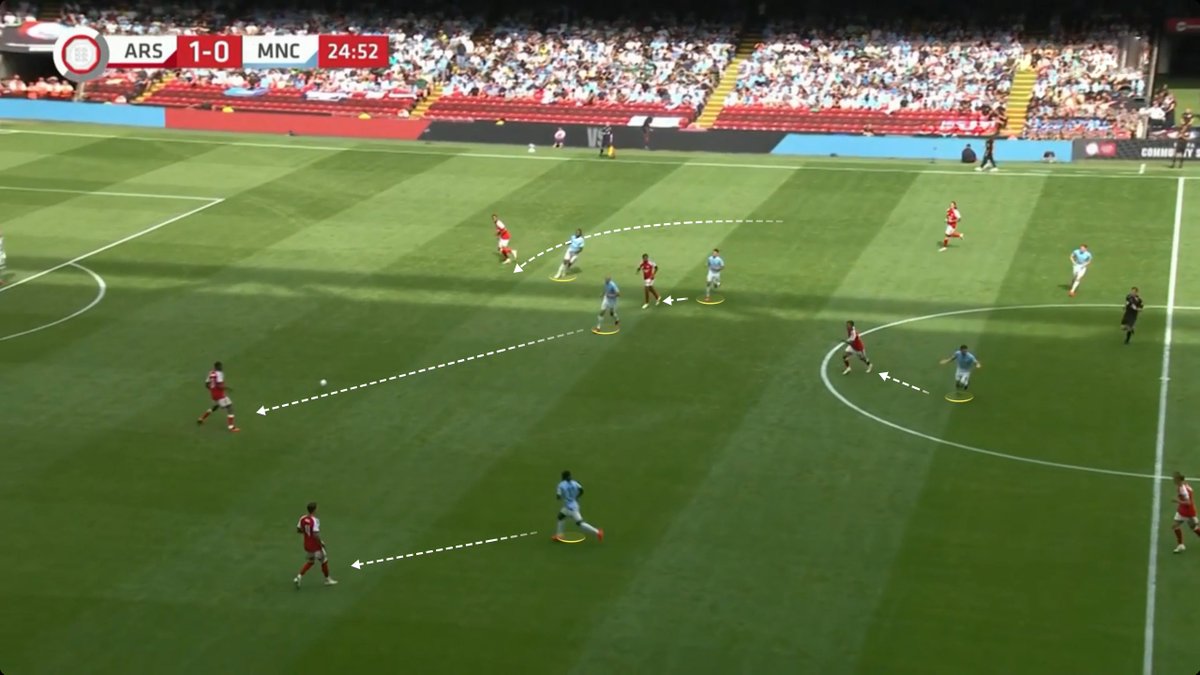
Situations like the first example happened repeatedly during the game, and each time I felt it would have been more interesting for City to have Haaland press over a longer distance. He could continue his run towards the RCB while closing the passing angle back to the goalkeeper, allowing Doku to stay on White.
That would reduce City’s reliance on O’Reilly backing up the press when he was constantly pinned by Madueke. Haaland probably not fit enough for that yesterday, but I’m curious to see whether he makes these runs going forward.
Scouting Report: Morgan Rogers - Analysing the £117 million package
Pleased to share that my 6000+ word scouting report on Morgan Rogers is live right now on @Medium. Link attached below.
Poured a lot of time and effort to writing this article. It provides a holistic and detailed analysis of Rogers. For those who prefer shorter pieces of analysis, you can still check out the article as there are summarised thoughts at the end of each section and a docket attached. Would be keen to know what you all think.
Finally, it's worth noting that Haaland didn’t play a single minute in pre-season, so he wasn’t fully fit and didn’t have much time to learn his role, or for Maresca to decide exactly what that role should be.
You can also feel that there are still a lot of automatisms missing between the players.
The problems I’ve highlighted here are not unsolvable, but City’s performance was a reminder of some of the flaws we saw in Maresca’s Chelsea, while also exposing squad weaknesses that have been there for a long time: the lack of a left-footed right winger and a natural right-back.
Guardiola managed to turn some of these limitations into strengths. I’m not sure Maresca will be able to do the same with this level of positional rigidity.
🧵 Manchester City’s pressing problems against Arsenal
As everyone on the TL knows, Manchester City showed plenty of problems in their pressing against Arsenal earlier in the Community Shield. In fact, we saw flaws that were already apparent in pre-season with this pressing approach of inverting the wingers and leaving the #9 and #10 managing the opposition pivots – flaws that Arsenal were able to exploit.
First, let’s understand the ideal scenario for this pressing structure (which never materialised against the Gunners). The idea is to invert the wingers and have them step out onto the opposition CBs from out to in, while the full-backs back up the press by stepping onto the opposition FBs. The CBs then shift across to pick up the wide players. Meanwhile, the #9 and #10 manage the opposition pivots.
It’s supposed to provide a transition into a man-oriented press through wide triggers.
It can work, as we saw in pre-season, but it also has some clear weaknesses that Arsenal managed to exploit.
A closer look at the nature of these problems, and whether they will be difficult to fix.
Another good example of City’s pressing problems.
Here, Semenyo scans behind him a couple of times to understand whether the situation is optimal for him to step out onto Gabriel. In other words, whether Anderson is in a position to manage Calafiori. It is, so he steps out.
We said that the role of the #9 and #10 in this pressing structure is to manage the two opposition pivots. But what happens when there is only one #6 to manage when the press is triggered? The answer is that the #9 and #10 can end up pressing the same player.
That’s the case here, with Haaland and Foden both close to Lewis-Skelly. This forces Kovacic to follow the second #6, Guimaraes, to prevent him from receiving freely. But it also gives Odegaard the opportunity to overload the midfield by dropping.
Once again, Kovacic’s arms out show that he is unsettled by an Arsenal player being free in a dangerous area.
Incidentally, the distance the winger has to cover to press the CB when the press has been triggered on the opposite side is also too large, giving the opposition CB too much time on the ball. Since the instruction is for the wingers to press the CBs, Doku mirrors Semenyo’s aggression and steps straight onto Mosquera, but he logically arrives too late.
The most effective solution here would probably be for Haaland to be the one pressing Mosquera after Semenyo’s initial run. The key to Arsenal’s build-up here is the huge amount of time Mosquera has on the ball, and Haaland is the only player well positioned to reduce that time.
A City CB could then step out from the back line to follow Odegaard, because there would no longer be a natural spare man. Alternatively, you could imagine Foden switching onto Guimaraes, Semenyo onto Lewis-Skelly and Kovacic onto Odegaard.
The problem with defending with wingers inverting to press the centre-backs is that Haaland and Foden can sometimes end up marking the same player inside. With Kovacic and Anderson already occupied, a third Arsenal player (Ødegaard usually) can drop and receive freely inside.
If the centre is covered, the space opens up wide instead, as explained in the quoted tweet.
Madueke staying wide prevents Nico O’Reilly from stepping out to Ben White and following Doku’s press on Mosquera. Same pattern on the Opodo side at moments.
Please, stop playing the offside line so low up the pitch.