$ASTS: AST SpaceMobile discussed in investor newsletter this AM. Seems like others are picking up on the future we're seeing:
BREAKING: SpaceX's $1.5 Trillion IPO Confirmed
I bought my 5-year-old son a telescope for his birthday last week.
When we take it out, he'll see something I never saw as a kid: thousands of satellites, streaming across the night sky like a slow-motion meteor shower.
What he won't see is what's really happening up there.
Three hundred and forty miles above us, satellites the size of tennis courts are generating 100 kilowatts of power each. They’re busy running AI and machine learning algorithms, making millions of autonomous decisions per second, and optimizing their own operations in real-time.
The space AI revolution isn't coming. It's already here…
And this morning, it just became official.
The $1.5 Trillion Confirmation
This morning, Bloomberg broke the news: SpaceX is moving ahead with plans for a 2026 IPO that would raise more than $30 billion at a valuation of approximately $1.5 trillion.
If executed, this would be the largest IPO in history—surpassing even Saudi Aramco's $29 billion offering in 2019.
Just last week, we were analyzing Musk's careful non-denial of a 2026 timeline when The Wall Street Journal reported an $800 billion secondary sale valuation.
The actual number? Nearly double that.
SpaceX's management and advisers are targeting mid-to-late 2026, according to multiple sources familiar with the matter who spoke to Bloomberg, Reuters, and TechCrunch.
But here's what matters more than the valuation: what SpaceX plans to do with the capital.
The Space Datacenter Vision Gets Real
Last week, responding to Cathie Wood's valuation model, Musk outlined his vision for space-based AI infrastructure:
"Satellites with localized AI compute, where just the results are beamed back from low-latency, sun-synchronous orbit, will be the lowest cost way to generate AI bitstreams in <3 years."
He specified: "100 kW per satellite... 1 megaton/year of satellites yields 100 GW of AI added per year with no operating or maintenance cost, connecting via high-bandwidth lasers."
According to Bloomberg's reporting, proceeds from the IPO are expected to fund exactly this: a new generation of space-based data centers, extending Starlink's role from connectivity provider into core infrastructure for cloud and AI workloads delivered from orbit.
This isn't speculation anymore. It's the stated use of capital for the largest IPO in human history.
The Company Already Building 100 kW Satellites
While Musk describes his vision for 100-kilowatt AI satellites launching in a few years, one American company has been mass-producing 100-kilowatt-class satellites with intelligent algorithms over the past year:
AST SpaceMobile, Inc. (ASTS).
Yes, the same ASTS we've covered as a SpaceX/Starlink buyout candidate.
The company is building the world's largest commercial communications arrays in low Earth orbit.
CEO Abel Avellan has stated that their BlueWalker 3 prototype generated 20 kilowatts. Their next-generation BlueBird Block 2 satellites—launching this coming Monday from India—feature much larger 2,400-square-foot arrays.
Scale that up and you get roughly 100 kilowatts per satellite peak performance.
The AI You Didn't Know Was There
Now, here's where things get really interesting, and where I need to be clear: ASTS has never publicly discussed pivoting to space datacenters.
This is me connecting dots based on their technology.
Their current BlueBird satellites use FPGAs—reprogrammable chips that run machine learning algorithms for autonomous resource management, real-time anomaly detection, and dynamic beamforming optimization.
The next-generation satellites use a custom ASIC called the AST5000, with 10 GHz of processing bandwidth and AI algorithms hard-wired into silicon.
In other words: these are satellites with localized compute, where just the results are beamed back.
ASTS calls it "telecommunications infrastructure."
But the technical architecture—high power generation, AI/ML-enabled compute, autonomous operations, thermal management for high-power electronics in a vacuum—starts to look really similar to the specifications Musk just described for space datacenters.
The only difference? ASTS runs signal processing algorithms. Musk wants to run LLMs. But the platform requirements are very similar.
Why This Matters
Could ASTS pivot to space datacenters?
They're focused on their SpaceMobile network, potential Golden Dome defense contracts, and establishing themselves in direct-to-device communications.
But consider what they've already done:
Achieved 95% vertically integrated manufacturing across 500,000 square feet in Texas
Built capacity to produce 6 satellites per month by year-end
Developed custom ASIC design capability (the AST5000)
Run operational satellites demonstrating everything works
Have 3,800+ patents
And they are the only company building 100+ kilowatt satellites at scale in America.
The Plays
Here’s how I see things playing out…
The 2026 SpaceX IPO: Now confirmed. Retail investors still can't buy in directly during the IPO allocation (though they'll be able to trade once it's public). Meanwhile, our backdoor plays remain positioned:
STMicroelectronics NV (STM) - satellite communications ground equipment.
Advanced Micro Devices, Inc. (AMD) - Versal AI chips in Starlink satellites.
Both benefit from SpaceX's massive capital deployment into space infrastructure.
ASTS: BlueBird 6 launches December 15th. With a $1.5 trillion SpaceX IPO now confirmed and space-based AI infrastructure moving from concept to funded reality, the market is dramatically undervaluing what ASTS has built.
They're trading as a speculative telecom stock. They might actually be strategic space infrastructure.
When SpaceX confirms it's spending $30+ billion on the exact technology architecture your company has already deployed and proven... that changes the game.
One More Thing
My son is 5. By the time he's 10, those satellites won't just route phone calls. They'll run AI models powering his education and entertainment. By the time he's my age, the space economy will be larger than today's tech industry.
The infrastructure is being built right now, 340 miles above his telescope.
The question isn't whether this happens. It's who builds it—and whether we're positioned before the market figures it out.
Disclosure: Ray owns shares of AST SpaceMobile, Inc. (ASTS).
To a bright future,
Ray Blanco
Senior Analyst, Altucher's Investment Network
Another day, another successful broadband connection from space! Together with our strategic partner @Bell , we have achieved Canada’s first-ever space-based 4G VoLTE voice call, broadband data connection, and video streaming using everyday smartphones 📶📱
With rollout planned for 2026, the successful demonstration in New Brunswick brings us closer to delivering reliable, high-speed mobile broadband for Canadians everywhere, even in the hardest-to-reach areas 🍁🫎
https://t.co/XS1gHnWqvF
#ASTSpaceMobile #DirecttoCell #Bell #ConnectingtheUnconnected
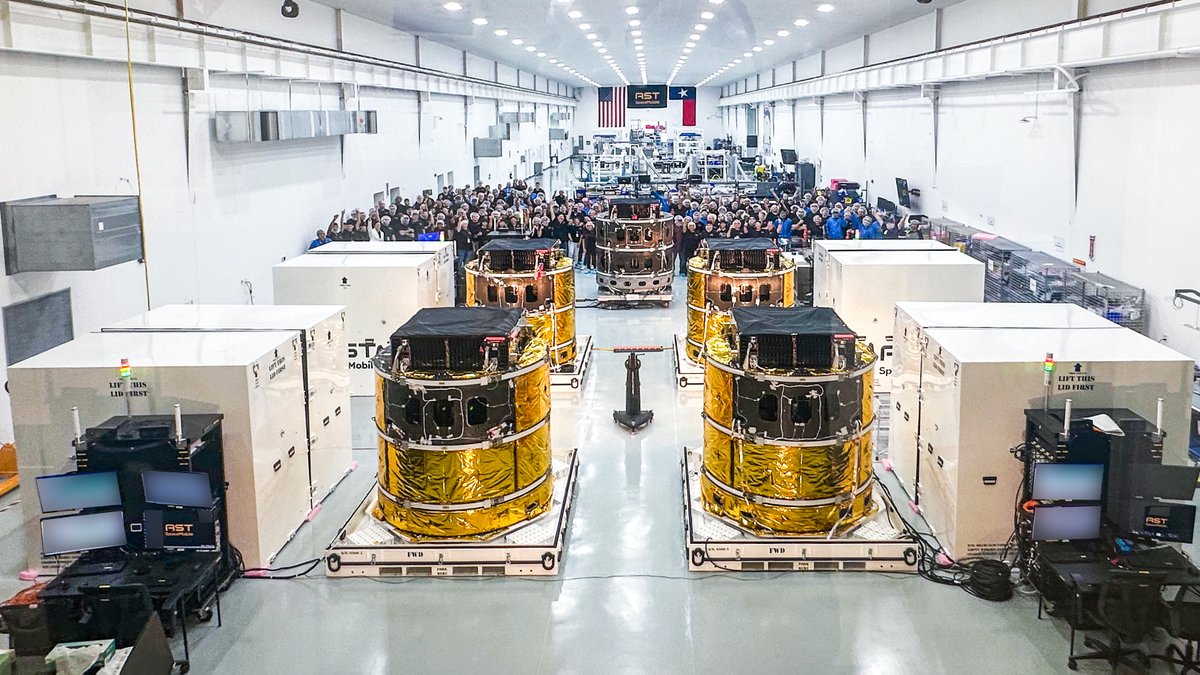
AST SpaceMobile Announces First Five Commercial Satellites Completed Final Assembly and Ready for Shipment the First Week of August https://t.co/FFuehTWlUp
AST SpaceMobile Announces First Five Commercial Satellites Completed Final Assembly and Ready for Shipment the First Week of August https://t.co/FFuehTWlUp
IT’S HERE AND IT’S AMAZING! 🎞️
From debuts to retirements, we’re bringing YOU an exclusive behind the scenes of our electric last game of the season. Behind the Battle: Full Circle PREMIERS RIGHT NOW!
�� https://t.co/nyyVfavBhh
@PNCBank | #CBJ