Bringing our original https://t.co/o6LtM33jAN creations to life.
The Workflow: Custom trained LoRA, Midjourney + Nano Banana + @grok Imagine.
From static design to cinematic motion all in support of our brand's vision.
#GenerativeAI#Cinema#SocialMediaMarketing #storytelling #FashionTech #Grok @xai
This is a status update, what’s important: the video.
Name found? For now, temporary. But we run with this philosophy: https://t.co/7KyNx9OqtL
I was recently working on this PoC, built on opensource, human enhanced, and focused on privacy. We achieve this by running a serverless, zero data retention architecture.
One full generation: 2min
From PoC to MvP: Almost there…
Planning this as a research project. Will launch anyway, testing in production 🙂
Meanwhile, I present to you: the first sketch of this app video showcase
What do you think, am I getting there?
#design #genai #build #vibecoding #datavis
For the past couple of weeks, I’ve been working on a Proof of Concept (PoC) and personal research project to assess the current boundaries of open source LLMs for coding and advanced product building.
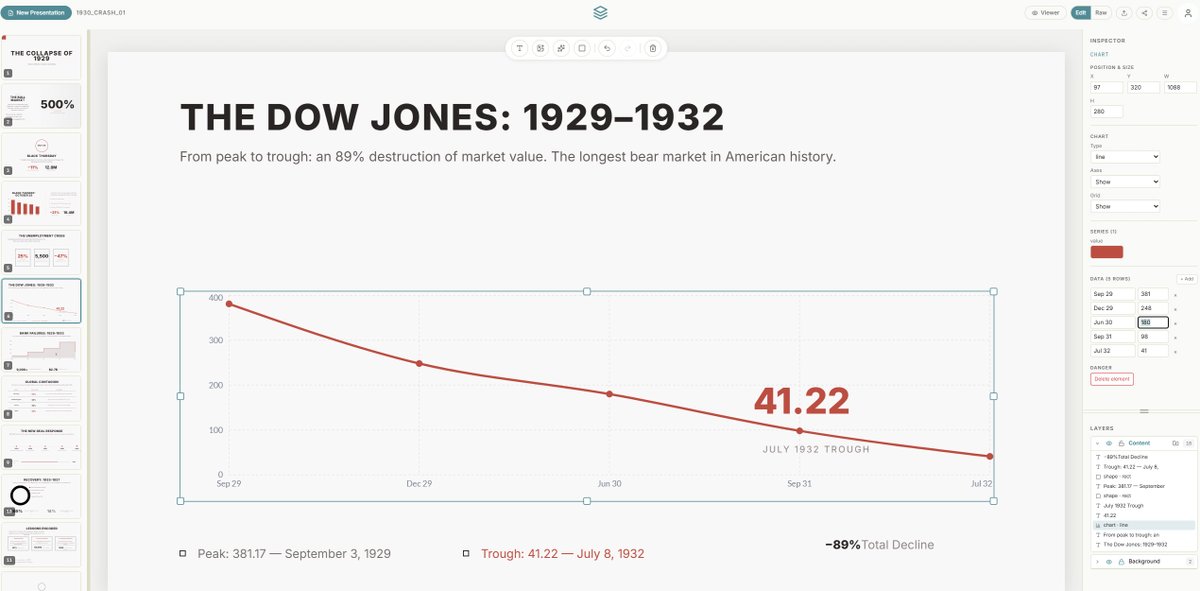
My focus? Build a design web app and editor for text2presentations.
Recently there was a lot of buzz with the launch of Claude Design in this space.
Other industry giants like Adobe, Canva, Google together with dozens of other start-ups have highly optimized generative AI slide deck builders. However, the tradeoff usually falls between slow, high token cost premium models or fast, heavily templated alternatives that lack true design finesse.
So my initial product brief was simple: build an application that generates great looking, creative diverse presentations in under 2 minutes, using a fraction of the token budget of frontier models on open source LLM’s infrastructure. Also, use all available open source and frontier models on the project to assess their cost and viability.
The results from the initial PoC exceeded my expectations.
By leveraging a custom orchestration layer that is the "secret sauce" constraint engine (“the harness”) that I designed around the models, I was able to get the app running on just 50k tokens using serverless cloud hosted models like MiniMax 2.7, generating high-quality, fully editable presentations in under 120 seconds.
To test the true limits of vibe coding and local infrastructure, I ran a local setup on an RTX 4090 - 24GB VRAM using llama.cpp and opencode web UI, handling the bulk of the early architecture with Qwen 3.6 27B running at 40 tk/s with a 200K context window made possible by Turboquant.
The beauty of this architecture is that the entire generation pipeline can run locally with 100% privacy on high-end GPUs.
I treated this as a rigorous multi-model research experiment on development efficiency (cost vs performance):
Orchestration & Code Base: Primarily built utilizing open source models like DeepSeek V4 Pro/Flash, GLM, Qwen and MiniMax via Ollama.
Frontier Model Comparison: Used Claude Code with Opus 4.7 and Gemini 3.1 Pro for roughly 10-15% of the codebase to see how these models compare with the open source ones.
The whole journey is a massive learning experience and it feels incredibly fun building things in a way that was never possible before.
Once the core generation engine was stable, I put my Product Manager hat on to move toward a launch ready MVP.
Over the past week, I focused heavily on system resilience, security, and user data flows.
Brand Guidelines via Vision
Users can upload reference images or documents to establish custom branding guidelines and automated asset summaries.
WYSIWYG & Canvas State
Workspace management system where past decks can be stored, shared via public links, exported to disk, or tweaked directly in a live editor.
System Hardening & Security Audit
Built comprehensive guardrails against attack vectors inherent to prompt-driven apps, including aggressive prompt injection and various code injections.
Scalable Cloud Architecture
Architected a 3-Tier setup, completely decoupling the presentation canvas, the orchestration logic, and the data layer. To ensure high availability and keep database transactions lightning-fast, I decoupled the primary metadata database from an S3 object storage bucket (used for storing heavy slide assets). This is paired with a serverless routing model for LLM calls that completely discards prompt inputs to preserve absolute user privacy.
The most important takeaway from this sprint? In just a few weeks I was able to cover a lot of ground in terms of app building, as my main focus was to see how far I can go in developing a full fledged working app using mainly open sourced models.
We are entering a world where I see local LLMs rising to compete head to head with frontier models, as this project revealed.
They are surely at least 95% percent of the way there.
If AI replaces humans, we are in for a dystopian future.
If AI empowers people, we are heading towards a revolution.
AI can do both.
It only depends on what WE prompt it to do!
Very well said 🥳
I had arrived at a similar conclusion a couple of weeks ago:
"We don’t yet have all the means of expression using generative AI at our disposal in the same way we have them in cinema. Because they are not yet discovered. In order to discover them, we need to be the pioneers who can make it happen." - https://t.co/lOTk7tWwLs
Gen AI might not replace cinema, but maybe it can evolve its own branch in parallel.
In the early years of cinema, the art form was very limited. For a few decades, it wasn’t seen as an art form at all. Merely a distraction, burlesque entertainment for the masses usually associated with country fairs, cheap laughs and seen as a new type of circus.
Progress was slow. For years, even decades, there was no meaningful way to move the camera, edit the shots, light them with intent in a controllable way or use sound. All of this while shooting only in black and white for half a century.
Pioneers dedicated their lives to the art and craft of cinema and so, one by one, decade by decade, they overcame all these obstacles and gave cinema all the pillars needed to give birth to a new form of art.
20 years ago I entered film school in Bucharest. For my admission exams I shot stills in BW 35mm film. I shot all my student films in 16mm and 35mm film stock BW and color, but when I graduated in 2010 my thesis paper spoke about the digital revolution and how the new Canon 5D would revolutionize the way films would be made.
I have never shot anything on film stock since. The same is true for perhaps 99% of the industry.
In the meantime, the medium has changed a lot as well. Enter social media feeds, streaming service, and so cinema theatres slowly lost their place.
To me, AI does not seem like the disruptor anymore, as the disruption happened way earlier than this by the changing habits of media consumers.
AI is just here to capitalize on the enormous changes that have already happened.
So, I now believe that there is a huge potential for AI to evolve in the same way that cinema did.
I think we are just in the early stages, in the burlesque era, where the real power of this new way of generating visuals has not yet been tamed.
We don’t yet have all the means of expression using generative AI at our disposal in the same way we have them in cinema.
Because they are not yet discovered.
In order to discover them, we need to be the pioneers who can make it happen.
@icreatelife This! It's been like this before AI and it will not change now.
The need for authenticity will only increase as AI will create a massive vacuum for real, human, relatable storytelling.
@bri_guy_ai@EHuanglu Generating exiting IP simply hurts the public opinion on AI.
Human intent should always strive towards originality.
Without it there is no future for Gen AI.
#generativeAI is threatening human developers as much as it threatens artists, arguably, even more.
Yet, what I see the developer community discussing regarding their use of AI is always focused on the outcome, not on the process and certainly not on the training.
Rarely have I seen an #antiAI dev looking down on vibe coders with moral outrage.
Instead, I’ve seen practical arguments on why various vibe coding tools are not yet production ready or how much importance falls on having strong programming knowledge in order to use code generating tools with success.
I also saw great arguments on why the whole AI landscape might grow to be a bubble or why it’s not yet clear how Gen AI companies turn their efforts into profit.
Developers are looking at Gen AI as a tool and are actively discussing the hidden costs and tons of drawbacks that using generated code might bring, the risk of slim comprehension of complex systems, how to orchestrate your AI agents for better results, and many other great discussions around how to achieve better serving output from Gen AI.
Almost all the developers that I know are embracing some sort of vibe coding ranging from tools like Cursor or Claude Code to one prompt wonders like Lovable or Replit.
But they all agree on one thing: The seniority of the human using these tools is paramount.
They position themselves as tamers of the AI. They embrace it while demonstrating their utmost importance as thinking, intent driven human beings in the mix.
Meanwhile, my fellow artists…
They do what they know best: Try to appeal to emotions.
Unfortunately, for any visual creator, the future is already set, and no emotion, no matter how big, will change the tides back to the old ways.
Markets move forward and embrace AI based solely on cold, hard facts, and no amount of emotional outcry is going to change that.
I believe the best course of action is to start thinking more like our fellow developers and approach Gen AI as a tool that needs our expertise in order to be of any use to the people holding the budgets.
And in order to do that we must return to the essence of any great art: curiosity.
#SoftwareDevelopment #CreativeIndustry #FutureOfWork #VibeCoding