The Market Is About to Discover Whether Capital Is Infinite
The market is transitioning from a debate about growth toward a debate about the cost of growth, with inflation and real rates becoming increasingly important drivers of price discovery.
There are weeks when markets trade economic data. There are weeks when they trade earnings. There are weeks when they trade central banks. Then there are weeks like the one ahead, when multiple narratives that have been developing independently suddenly collide at the same intersection, forcing investors to confront a much larger question.
Who is going to pay for all of this?
That may sound like an odd question at a time when the economy remains remarkably resilient, corporate earnings continue to expand, and the artificial intelligence boom shows few signs of slowing. Yet it sits at the center of almost every major market story unfolding today. Investors are financing the largest AI infrastructure buildout in modern history.
Governments continue issuing debt at a breathtaking pace. Equity valuations remain elevated. A new generation of trillion-dollar companies is preparing to enter public markets. And now, just as the largest IPO in financial history approaches, inflation is beginning to stir once again.
For most of the past two months, markets have displayed an almost supernatural ability to ignore risk. Rising oil prices, geopolitical flare-ups, expanding Treasury issuance, stretched valuations and periodic spikes in bond yields have all been treated as little more than temporary inconveniences.
That mindset has produced a remarkable rally. The S&P 500 has surged from its March lows. Artificial intelligence has become the gravitational center of global capital flows. Momentum has become self-reinforcing.
Yet beneath the surface, something important is beginning to change.
The market is gradually moving away from a world where investors debate growth and toward a world where they debate the cost of growth.
That distinction may end up defining the second half of the year.
The immediate focus next week will be inflation. Headline CPI is expected to accelerate toward 4.2%, the highest level since 2023. At first glance, that appears to be a simple inflation story. In reality, it is a story about the price of money.
Inflation ultimately determines how expensive capital becomes. The higher inflation moves, the harder it becomes for central banks to justify easier policy. The higher inflation moves, the more difficult it becomes for markets to finance future growth at today’s valuations.
The deeper issue is that monetary policy may already be becoming easier without the Federal Reserve cutting rates at all. Real interest rates continue falling as inflation accelerates. The Taylor Rule one of the most influential frameworks in monetary policy already suggests that the appropriate Fed funds rate sits above the current policy rate in several versions.
The irony is impossible to ignore. The economy is strong because money has been relatively easy. Yet the stronger the economy becomes, the harder it becomes to justify keeping money easy. That paradox sits at the heart of everything markets will confront next week.
The global economy continues benefiting from one of the largest investment cycles seen in decades. Artificial intelligence is no longer merely a technology story it has become an economic story. Yet every gold rush eventually encounters the same problem.
Somebody has to provide the capital.
That is what makes the SpaceX IPO so important. It becomes one of the clearest stress tests of risk appetite we have seen in years a referendum on whether investors still possess the same urge to buy risk regardless of valuation, regardless of price, and regardless of rising funding costs.
More importantly, it becomes a test of whether markets can continue financing multiple gold rushes simultaneously while the price of money may be moving higher rather than lower.
The Bottom Line for Professionals growth.
At Kelleners Capital, we monitor these liquidity, inflation, and real-rate dynamics closely because they directly shape how we construct portfolios for professionals. In environments where capital is becoming more expensive and inflation pressures are re-emerging, we prioritize real assets, commodities, gold, and tactical strategies designed to protect purchasing power and deliver real yield after inflation.
If you’re a professional investor concerned about how rising funding costs and persistent inflation will affect your capital, DM me the word YIELD. I’ll send you a quick overview of our current portfolio strategies and how we’re positioning for this exact environment.
This is something traders are watching closely: Japan's return to 1.00% rates would mark the highest policy rate in more than three decades.
For years, ultra-low Japanese rates helped support global liquidity and carry trades. As rates rise, investors are increasingly debating whether that liquidity tailwind is fading.
Are markets underestimating the impact of Japanese monetary policy?
This is something traders are watching closely: Japan's return to 1.00% rates would mark the highest policy rate in more than three decades.
For years, ultra-low Japanese rates helped support global liquidity and carry trades. As rates rise, investors are increasingly debating whether that liquidity tailwind is fading.
Are markets underestimating the impact of Japanese monetary policy?
BREAKING:
🇯🇵 Japan is expected to RAISE interest rates to 1.00% tomorrow at 11 PM ET.
A level not seen in over 30 years.
Prediction markets are now pricing the move at a 99% probability.
EVERY RATE HIKE SINCE 2024 IN JAPAN HAS BEEN FOLLOWED BY A 20%+ DUMP IN $BTC.
This could have broader implications: investors are rushing back into risk assets.
After weeks of geopolitical and inflation concerns, buyers appear willing to look beyond the headlines and focus on improving sentiment, lower oil prices, and easing uncertainty.
Is sidelined cash finally coming back into stocks?
This could have broader implications: investors are rushing back into risk assets.
After weeks of geopolitical and inflation concerns, buyers appear willing to look beyond the headlines and focus on improving sentiment, lower oil prices, and easing uncertainty.
Is sidelined cash finally coming back into stocks?
This is worth watching because labor markets often deteriorate beneath the surface before it becomes obvious in the unemployment rate.
Since March 2023, this group has grown by roughly 1.2 million people. As a share of total employment, the figure is approaching levels historically associated with economic slowdowns and recessions.
Are investors paying enough attention to labor market cracks?
This is worth watching because labor markets often deteriorate beneath the surface before it becomes obvious in the unemployment rate.
Since March 2023, this group has grown by roughly 1.2 million people. As a share of total employment, the figure is approaching levels historically associated with economic slowdowns and recessions.
Are investors paying enough attention to labor market cracks?
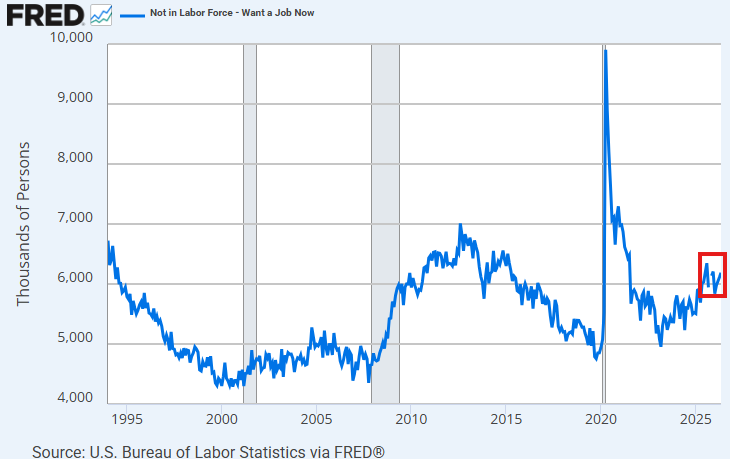
Americans can't find jobs.
The number of Americans not in the labor force who currently want a job rose +76,000 in May, to 6.2 million, the 3rd-highest since July 2021.
These are people who are not officially part of the labor force, meaning they are not actively looking for work, but say they want a job.
This marks the 4th consecutive monthly increase, totaling +349,000.
Since March 2023, this figure has surged by +1.2 million people and is now above 2008 Financial Crisis levels.
As a % of total employment, this metric is up to 3.8%, the 2nd-highest since October 2021.
By comparison, the 2001 recession and the 2008 peaks were 3.6% and 4.3%.
Labor market conditions are deteriorating beneath the surface.
@LeslieRich57684@RightScopee I think the bigger issue is that most people graduate without learning how money, investing, taxes, debt, and asset ownership actually work. Financial literacy should be a core life skill.
A detail many investors ignore: "overbought" doesn't necessarily mean "about to crash."
Technical indicators measure the speed and magnitude of a move, not its ultimate direction. Some of the strongest bull runs in history have remained overbought for extended periods as fundamentals continued improving.
Does overbought automatically mean sell?
A detail many investors ignore: "overbought" doesn't necessarily mean "about to crash."
Technical indicators measure the speed and magnitude of a move, not its ultimate direction. Some of the strongest bull runs in history have remained overbought for extended periods as fundamentals continued improving.
Does overbought automatically mean sell?
This may be more important than it appears: housing affordability remains one of the biggest economic challenges facing households.
California still dominates the list, but million-dollar starter homes are spreading rapidly across New York, New Jersey, and other states. The trend highlights how housing costs continue to outpace income growth in many regions.
Is homeownership becoming a luxury in parts of America?
This may be more important than it appears: housing affordability remains one of the biggest economic challenges facing households.
California still dominates the list, but million-dollar starter homes are spreading rapidly across New York, New Jersey, and other states. The trend highlights how housing costs continue to outpace income growth in many regions.
Is homeownership becoming a luxury in parts of America?
$1M STARTER HOMES SPREAD ACROSS US CITIES
Zillow says 242 US cities now have starter homes priced at $1M+, up from 226 last year. While the average starter home is ~$198,649, affordability remains strained despite slight improvement. California leads with 105 cities. New York and New Jersey are growing fastest, and 26 states now include at least one million-dollar starter-home market.
Investors should keep an eye on corporate Bitcoin demand.
While many companies still treat Bitcoin as a speculative asset, Strategy continues to buy aggressively, signaling strong conviction in BTC's long-term value proposition.
Will more public companies follow Strategy's playbook?
Investors should keep an eye on corporate Bitcoin demand.
While many companies still treat Bitcoin as a speculative asset, Strategy continues to buy aggressively, signaling strong conviction in BTC's long-term value proposition.
Will more public companies follow Strategy's playbook?
This is something markets are watching closely: a deal of this size would be one of the largest economic reconstruction programs in modern history.
Reports vary on the structure, with some describing it as a reconstruction package and others as an international investment fund that would be facilitated if a final agreement is reached.
Could economic normalization reshape the Middle East energy market?
This is something markets are watching closely: a deal of this size would be one of the largest economic reconstruction programs in modern history.
Reports vary on the structure, with some describing it as a reconstruction package and others as an international investment fund that would be facilitated if a final agreement is reached.
Could economic normalization reshape the Middle East energy market?
A key detail: the market is treating this as an energy story first and a geopolitical story second.
The framework agreement would reopen the Strait of Hormuz and restore a critical global oil corridor, but key issues surrounding Iran's nuclear program remain unresolved and will be addressed in future negotiations.
Will lower oil prices be the biggest winner from this deal?
A key detail: the market is treating this as an energy story first and a geopolitical story second.
The framework agreement would reopen the Strait of Hormuz and restore a critical global oil corridor, but key issues surrounding Iran's nuclear program remain unresolved and will be addressed in future negotiations.
Will lower oil prices be the biggest winner from this deal?
US and Iranian officials said they had reached an agreement to end their war and reopen the Strait of Hormuz, a preliminary pact that sent oil prices falling but leaves the fate of Tehran's nuclear program to further negotiations https://t.co/eGUNMO4fWB
Here's why this caught our attention: some of the largest software companies are no longer building everything in-house.
Instead, they're paying billions to acquire category leaders. Salesforce's decision to buy Fin signals that customer-facing AI agents are becoming strategically important across the enterprise software landscape.
Will AI agents become as essential as CRM software?
Here's why this caught our attention: some of the largest software companies are no longer building everything in-house.
Instead, they're paying billions to acquire category leaders. Salesforce's decision to buy Fin signals that customer-facing AI agents are becoming strategically important across the enterprise software landscape.
Will AI agents become as essential as CRM software?
We’re excited to share that we just signed an agreement for @salesforce to acquire @fin_ai for ~$3.6B. The transaction is expected to close in the fourth quarter of Salesforce’s fiscal year 2027.
Fin started as Intercom 15 years ago. We changed our name to cap our transformation just weeks ago. We were a darling of the SaaS era and invented so many of the patterns you see in software today. Nearly four years ago, in need of a reboot, we jumped on weeks-old modern LLMs to create and define the category we know as Customer Agents today.
Salesforce invented modern software and SaaS. And @benioff is like the final boss of tech founder CEOs. In seat for 27 years, he’s one of the last of his era. Still pushing, pivoting, placing big bets. It’s a privilege for @destraynor and I to get to partner with him and join forces with Salesforce upon close at this most fascinating time. And will be very fun to get their help bringing Fin to magnitudes more consumers.
To our customers: Over the past few years we’ve been shipping intensely. Including recently our groundbreaking model, Apex, and our paradigm-defining internal agent, Operator. With the resources of Salesforce this will only accelerate. And yet little will practically change. I’ll still be CEO, Des will still be running R&D, we’ll both still be committed to continuing to lead this category. Thank you very sincerely and deeply for your belief in us.
To all of our friends, our families, and our employees, past and present: While this is not the end, it is a major, pivotal, special, and emotional moment for us. From the bottom of our hearts, thank you. For everything.
To my cofounders, my exec team: Look what we built. Four young lads with a dream and nothing to lose. And a home grown exec team who pulled off the greatest and arguably only late stage software company pivot to AI, and invented one of the most important categories in AI. Thank you for sticking through all of this with me.
And now, time to get back to work. See you at our next product launch in a couple weeks. (:
Markets are paying attention to the scale of this move.
Nearly $1 trillion in market value was added across major Asian indexes in a single session, with the Nikkei and KOSPI leading the charge. When capital flows reverse this aggressively, sentiment can shift very quickly.
Is this the start of a global risk-on rally?