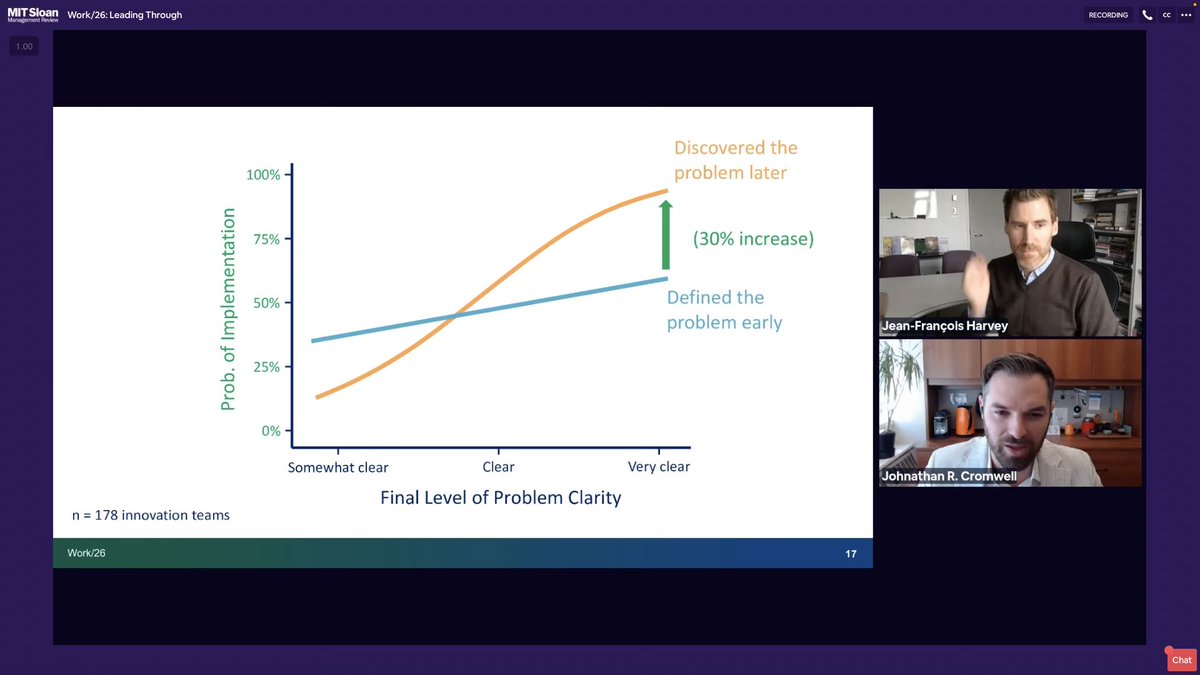
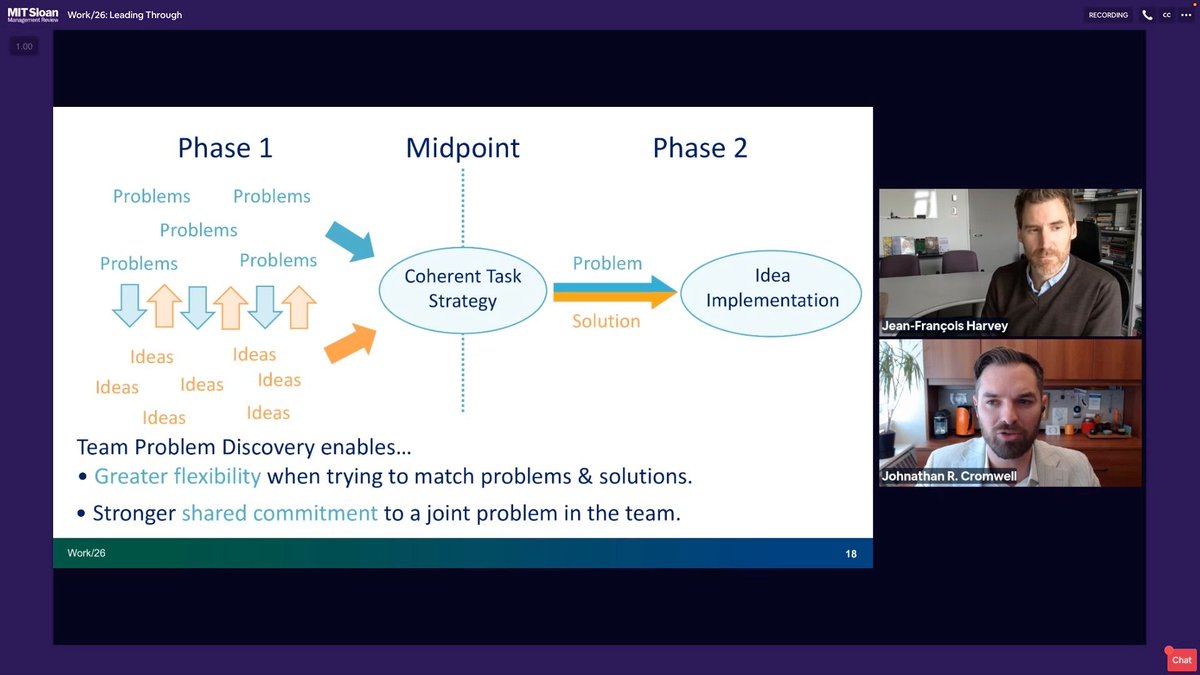
Mining nuggets at the MIT Sloan Management Review Work/26 conference! How shared leadership helps teams make clearer decisions, take ownership, and sustain energy without losing performance. https://t.co/oT5tfblg15
#futureofhumanwork#ai#innovation#leadership#strategy
Research shows new tech rarely leaves work unchanged. Instead, it changes the composition of the work. Some jobs might go away, but most evolve… https://t.co/4nVHNGO47a #human#ai#workforce#development
During the walking tour of the Institute, we were introduced to the smoot, a unit of measurement developed there. Now, the klein, a new unit, was just introduced to rival it. #mit#seagrant#sonar#tech#ihtfp https://t.co/txq1DjiiDV
Three Modern Lessons on Successful AI Pivots
Leaders must not lose sight of organizational purpose.
Understand shifts in how value is delivered & Embrace technology to realize a new occupational identity.
https://t.co/GNGumJnGGu #futureofhumanwork#changemanagement#strategy
This is the shift that matters. “Which work should humans continue to own, which work should AI accelerate and which workflows should be redesigned entirely now that AI exists?” https://t.co/JPpQ2Vw8Ll
#futureofhumanwork#ai#innovation#strategy#changemanagement
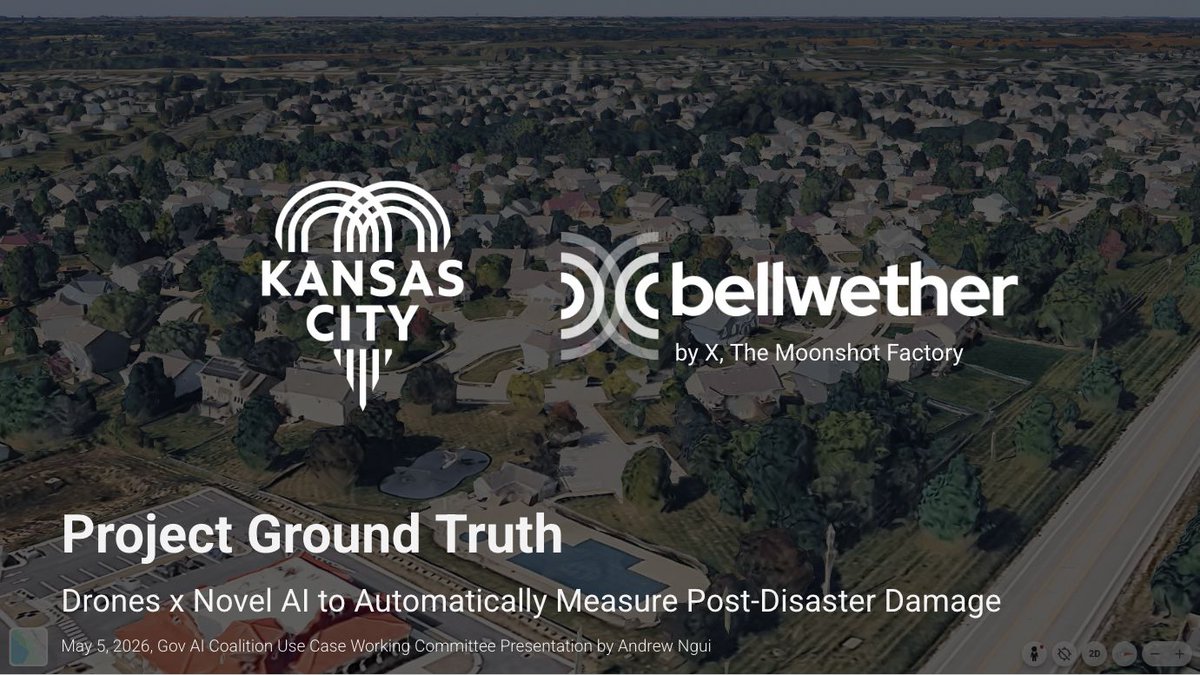
Earlier this week, we shared how the City of Kansas City, MO, & Bellwether at X, The Moonshot Factory, have leveraged AI to advance FEMA preliminary damage assessment. Here's the recap in case you missed it… https://t.co/HCN3BzhQgA
#emergencymanagement#ai#innovation#strategy
Hangzhou court says it is illegal to fire humans due to AI, yet workers are also expected to contribute to the discourse & technological progression by adapting as work trends shift… https://t.co/9PvLhCcRpa #futureofhumanwork#ai#changemanagement#innovation#strategy#china
Jensen Huang just told the world something nobody wants to hear.
AI is not coming for your job.
It is coming for the part of your job you mistakenly believe IS your job.
Huang: “The purpose of your job and the tasks that you do in your job are related but not the same.”
That one sentence is the fault line between the people who thrive in the next decade and the people who vanish from it.
Huang used himself as proof.
Reduce the CEO of Nvidia to his raw outputs and his entire career is typing and talking.
Both have been automated to superhuman levels.
Huang: “Typing and talking have both been automated to a superhuman level by AI. And yet, I’m busier than ever.”
The man building the infrastructure that automates human labor has never worked harder.
That should stop you cold.
We look at a profession and see the tasks. The motions. The mechanical friction.
We never see the intent underneath.
And when AI arrives, we panic. Because we confuse the task with the job.
The task was never the job.
It was always the bottleneck between a human and their actual purpose.
Now the bottleneck is dissolving.
Years ago, the experts declared radiology dead. The algorithm could read a scan better than any human.
A generation of medical students listened. They walked away from the field.
The result was catastrophic.
Huang: “We need more radiologists than ever, and we don’t have enough.”
The algorithm did not replace the doctor. It armed the doctor.
Suddenly the department could see more patients. Catch more anomalies. Generate more revenue.
The hospital did not fire the radiologists. It tried to hire more.
And could not find them.
Because we terrified an entire generation out of a career with a prediction that landed exactly backwards.
Now the same hysteria is consuming software engineering.
The timeline is screaming that coding is dead.
Meanwhile, inside the very company building the hardware that automates code.
Huang: “The software engineers that know how to use AI, know how to work with agentic systems, are the most popular and the most successful.”
The tool did not replace the architect. It replaced the shovel.
This is the pattern nobody wants to confront.
AI does not eliminate the human. It eliminates the friction that made the human slow.
And when the friction disappears, demand for the human explodes.
But only if the human shows up.
The ones who defined themselves by the mechanical act of writing code are fading.
The ones who defined themselves by what the code was meant to build are now the most valuable people on the planet.
That is not a nuance. That is the entire dividing line.
The machine will write the script. Read the scan. Draft the brief.
It will never possess the reason any of it needed to exist.
The task was never the job.
And nobody who figures that out last gets the privilege of figuring it out twice.
🇸🇬There’s a take I keep seeing that Singapore doesn’t produce founders. The standard reasons given are that LKY was the ultimate founder so no one else has to be, that the system is too homogenous, and that the market is too small and fragmented (South East Asia). I’ve read and produced versions of this argument for years. I’m not going to re-litigate it today.
I’d rather share what I actually see working. Singapore has produced tech founders. Razer. Creative. Sea. Peng Ong co-founded https://t.co/GO61fvQzuQ out of here. It’s not a long list and no one pretends otherwise, but the list exists, which means there's precedent.
In non Singaporean fashion, I want the discourse to shift from the 1,000 reasons singapore can’t produce founders, to the reasons singapore could produce great founders and how to make that work.
If @ycombinator managed to crack the code 21 years ago to generate 10,000x times the number of founders and changed the mindset of the entire silicon valley, I do know that Singapore and the broader ecosystem will have its own way of achieving some outcome here. YC normalized failure as a young founder imo, it wasn't as hot and sexy to start your own company then.
There are green shoots - a new cohort of Singaporeans abroad quietly building real companies. Jeffrey Tiong from @Patsnap. Desmond Lim from @workstream_us. Thomas Li from @Daloopa1. It takes 10 plus years for these success stories to grow and reach the mainstream in Singapore.
How can singapore founders combine the best and brightest and most hardworking Singaporeans with the abundance of global opportunities available in this new age of ai disruption? A lot of this having the mindset to sell globally from day 0. And of course one of the biggest markets in the world is USA. Is this easier said than done, yes. but is this definitely doable? yes.
At @AlliumLabs, we have a Singaporean core founding team (@lchylch@potaypaul@gohchaa) incorporated in US. We benefited greatly from having a Singapore office from nearly day one. HQ in the US, usually New York or San Francisco, because that’s where the deepest pool of capital and the largest customers actually sit. I do think combining the best of both worlds is a viable path forward and a template that one can expand and scale on.
We actually ran this pros & cons (in typical singaporean pragmatic engineer fashion)
1. Are there critical and core parts of our work embarassingly parallel? Output of one team is not blocked by the output of another.
2. Did we get 24/7 coverage SLAs for our customers because "the sun never set" on Allium? Yes. This allowed us to service the biggest institutions in the world at a much younger stage in a leaner fashion.
3. Can we get access to top tier problem solvers who have great work ethic? YES.
We mitigate the timezone piece by having the Singapore team log in ~10pm-11pm SGT Monday to Thursday for more synchronous communications with the US team. Is this easy? Not really, is it possible and a sustainable template going forward? 100%.
Allium is built this way. We’re headquartered in New York. We opened the Singapore office in year one. The founding team is Singaporean. Our customers are global. Both offices do real work, and neither is a satellite of the other. The reason this works is that you get both sides. Singapore gives you strong operators, real financial infrastructure, access to Asian markets in one flight, and an institutional reputation that’s hard to replicate elsewhere. And of course the ability to hire the best and the brightest in the broader region. The US gives you customer density, deeper capital, and the kind of ambient pressure that forces you to think bigger than you would at home.
You don’t have to pick, you can have both.
If you’re a Singaporean sitting on an idea or a hope to do some great on the global stage one day, that’s the thing I want more people to hear. You also don’t have to wait and say it's hard. Of course it's going to be hard. Just set something up and keep going.
Here's what I am happy to do with fellow sporeans
1. For Singaporeans who do want to build their own company one day, I am happy to set some time to share my own personal journey to cross the mindset chasm.
2. We are expanding our office in Singapore of course (just got a new lease in Chinatown), and imo this is the best way for a Singaporean to get exposed to the global tech world while still being in Singapore and being "not just a satelite" office. It's an MBA for startup. If you're interested in opportunities too, let me know
I have personally cared about this topic for more than 20 years (reading sim wong hoo's, creative's founder 1999 book) as a kid, and have spent most of my life thinking about it and what can be done and how it will be done.
Not all types of innovation are the same. This is why you can't copy & paste. Rather, first consider what type you have, then analyze & test which type of innovation might work best. A definite must read… https://t.co/36Ti2c486y #innovation#strategy#culture