At Rhoda, we care deeply about the science of pre-training for robotics.
In one of the most rigorous studies of its kind, over thousands of trials and hundreds of hours of robot evaluations, we show how scaling web-video pre-training leads to better real-world robot performance.
Does scaling pre-training on general web video improve a complex manipulation task in real deployment?
We scale model size and pre-training compute, and test on one industrial task.
Yes. The better a pre-trained model predicts web video, the better its post-trained policy. 🧵
@tongzhou_mu Great paper Tongzhou! The ceiling on robot capability is much higher than many assume, and the innovation that comes as pre-training in robotics continues to scale is going to be transformative.
Can a large foundation video model run as a real-time robot policy at the edge, on a single RTX 5090?
• ✅ No quantization
• ✅ No distillation
• ✅ Full denoising (all the way from noise to clean video)
We just proved it's possible. 👇🎬
Here’s something we’ve never seen done before.
Real-world tasks are long and ambiguous. Solving them requires visual memory and state tracking. Most robot policies only see the last few frames. Ours doesn't.
We put our DVA, FutureVision, to the perfect testbed: the shell game 🐚. The DVA nails it.
I keep hearing that real-world manipulation is the 'final frontier' for robotics. Maybe I’m just the optimistic new kid on the block, but I think we've actually solved this at Rhoda. Our Direct-Video-Action (DVA) models are doing things the industry said were still years away.
A+ commitment to the bit from this robot 🕺🤖
That said, every customer I’ve talked to views an e-stop as table stakes. All commercial automation that moves has a stop button - powerful robots shouldn’t be an exception
A dancing humanoid robot got a little too funky during a performance in Cupertino, California and had to be restrained by staff after knocking items off a table.
This demo is a new high water mark. There have previously been many demos featuring short videos of complex tasks and a few long videos of very simple tasks. Showing a one-off “golden” run does little to demonstrate the capability of a model. The robotics industry should shift to >1hr uncut videos to showcase capabilities.
Most robot demos are “golden runs”: a perfect take selected from many attempts.
But real-world deployment is about Continuous Operation.
Watch our DVA model tackle a real-world decanting task for 1.5 hours straight: Uncut, Zero human intervention.
🧵👇
Building AI for the physical world has long had a data problem. The dominant approach to building robots today is based on Vision Language Models (VLAs) which attempt to bake in physics during post-training. In practice, however, this approach requires a combinatorial explosion of incredibly costly post-training samples. Every embodiment, environment, and task demands its own mountain of demonstrations collected via teleoperation or simulation. Because of this, VLAs end up lacking a strong prior over physical dynamics and fail to generalize to the messy variability of real-world industrial deployments.
We’re pumped at Premji Invest to back @rhodaai, who takes a fundamentally different approach. Their Direct Video Action (DVA) model — a new class of robotics foundation model — pre-trains on internet-scale video to first learn motion priors and physical interaction patterns. It then post-trains only lightly on embodiment-specific data — requiring roughly four orders of magnitude less data than the teleoperation-heavy VLA paradigm. The result is robots with much stronger generalization that can handle the variability of the physical world.
Thrilled to partner with @startupjag, @andrewwooten96, and the rest of the incredible Rhoda team! Excited for what’s ahead!
@tongzhou_mu Tongzhou’s work on the end to end model has made the difference between lab demos and real operation at customer sites. It’s exciting to see robots finally break out of the lab!
Observe. Predict. Act. Repeat. In closed loop. We call this the Direct Video-Action (DVA) model, and it’s why Rhoda can operate beyond lab conditions in real production environments.
The gap between robotics in the lab and robotics in the real world has been one of the hardest unsolved problems in the industry. We’re excited to come out of stealth and show the research community how we’re tackling the issue.
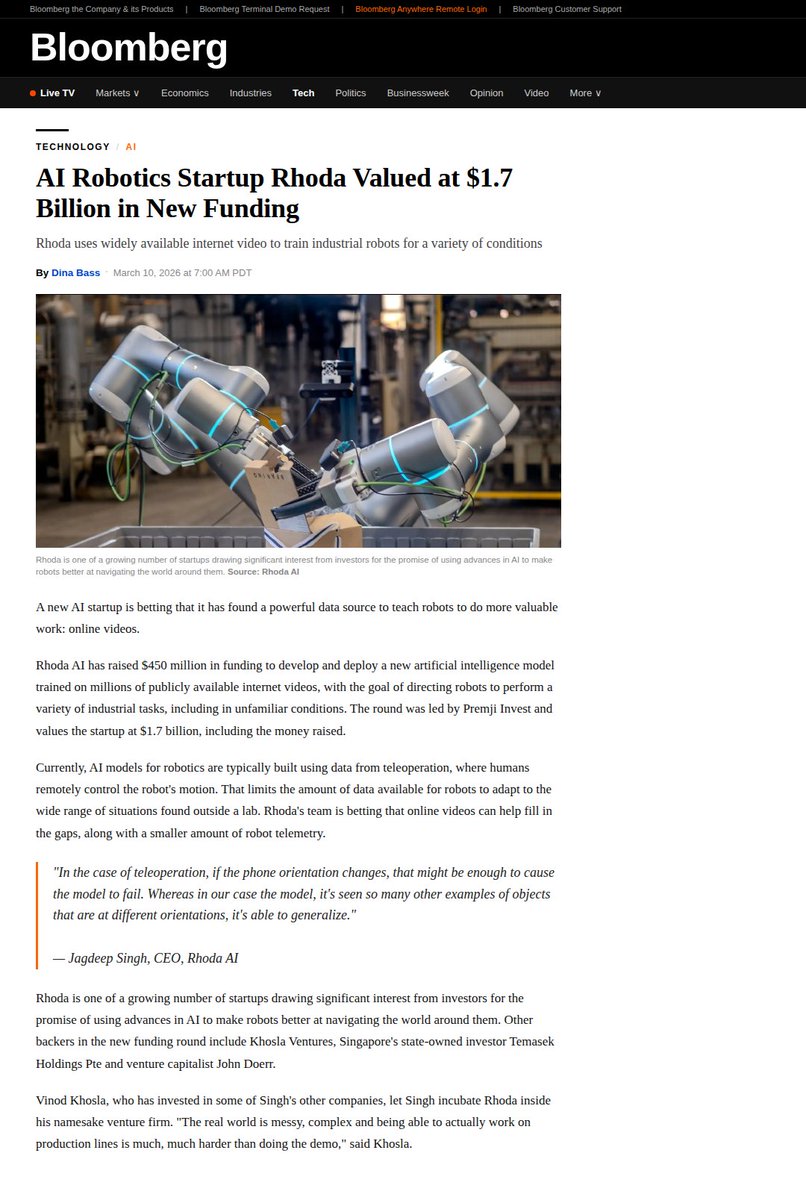
Bloomberg article in comment.
Learning motion priors from internet-scale video moves us toward generality and robustness. Generalist robot policies expand the surface area of what can be automated and will materially impact global productivity.
After operating in stealth for the last 18 months @rhodaai , we’re excited today to finally show the world what we’ve been working on. We believe we’re on a path to physical AGI with the launch of our brand new foundation model, the Direct Video Action (DVA) model.
@startupjag@rhodaai The product challenge in robotics isn’t getting the demo to work - it’s getting the system to hold up when a customer changes their line, swaps a component, or moves the fixture six inches. Rhoda's DVA model solves this.
Proud of the team for getting this out into the world. A huge amount of deep technical work went into making these systems work in real industrial environments.
The gap between robotics in the lab and robotics in the real world has been one of the hardest unsolved problems in the industry. We’re excited to come out of stealth and show the research community how we’re tackling the issue.
Bloomberg article in comment.
@rhodaai The last decade of AI progress has come from learning from internet-scale data - applying that same principle to physical intelligence opens up an entirely new frontier for robotics.