"What's moving ETH this week?"
Ask a model and you get a fluent answer from what it already knows. Useful, but you can't see where it came from, and it stops at the answer.
An agent is built around the task, not the question. It's given:
- tools it can use: price data, news, on-chain data
- knowledge to draw on
- steps to follow
- a format for the result
So it gathers the data, works through the steps and hands back a structured result you can check.
The model is still the engine. The agent decides what the engine works on, and in what order.
That's the line we draw at Origins. Models supply the reasoning. Agents and Skills turn it into finished research.
#ORIGINS
The agenda for Trading the AI Era is out.
An afternoon in Bangkok on how AI is changing crypto trading, hosted by Origins Network, the day before Binance Blockchain Week opens.
What's on:
- Keynotes from projects building across AI and crypto trading, Origins Network included
- A panel on how AI is changing crypto markets, with Q&A
- Networking to close the day
The full agenda is on the event page, and any changes will be posted there.
📍 ZillaSpace, Bangkok
27 Nov 2026 · 14:00–19:00 (UTC+7)
Register: https://t.co/P3yajLcbhE
#ORIGINS
The detail that matters here is "within defined spending limits."
Agentic commerce runs on small, frequent payments. No one will approve each one by hand, so the limit does the job the approval used to: how much, to whom, for how long.
That moves the real decision earlier. People stop approving payments and start approving the rules every payment has to follow. Those rules have to be easy to read, check and revoke.
#ORIGINS
Most AI x crypto projects deploy a few contracts on a shared chain. Origins Network is its own chain, built on the Cosmos SDK.
It's a real trade-off. A shared chain gives you users and liquidity on day one. An app-specific chain gives you control:
- Block space and fees aren't shared with every other app on the network
- Staking, validator and upgrade rules are set by the network's own stakeholders
- Core logic can live in the chain itself, not squeezed into a contract
The cost: you build the network, the validators and the tooling yourself. For Origins Network, core development is complete, and deployment and integration testing is being prepared.
EVM compatibility keeps the other side of the trade. Builders can still use the contracts and tools they already know.
#ORIGINS
Origins Network development update, November.
- Chain: core development completed, deployment and integration testing in preparation
- AI: 3 third-party models integrated, Skills Hub in development
- Wallet: OR Wallet New in development (iOS, Android) https://t.co/vtCWpo9smm
Deepfakes change what counts as proof. A familiar face or voice used to be enough. It isn't anymore.
What still holds is the check at the moment of sending: who receives the funds, on which network, and how much. A wallet should make those three things impossible to miss before anyone signs.
It's a standard we're designing OR Wallet New around.
#ORIGINS
"Non-custodial" is on almost every wallet's homepage. In practice it comes down to one question: who can move your funds?
In a custodial account, a company holds the keys. It can freeze your account, recover it, or lose it.
In a non-custodial wallet, the keys stay with you, usually backed up as a recovery phrase. Nobody can reset it for you, including the team that built the wallet.
That trade-off is the design brief: full control means backups, signing and every transfer have to be as clear as possible.
OR Wallet New is being developed as a non-custodial, multi-chain wallet.
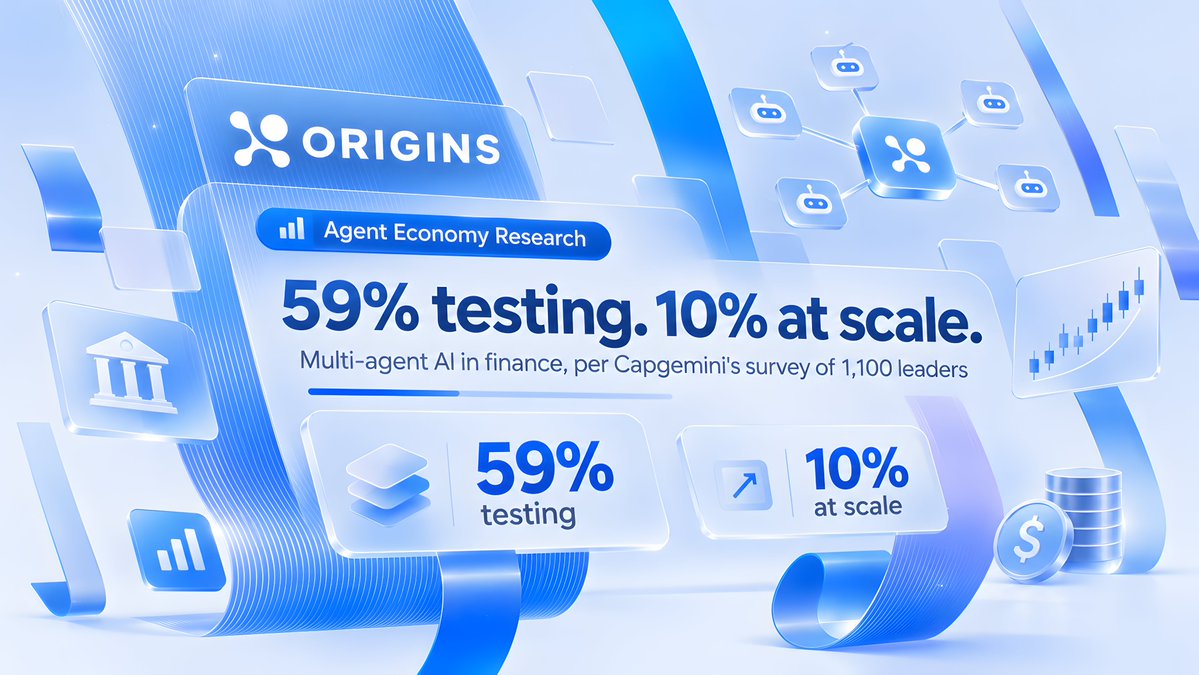
Capgemini surveyed 1,100 financial services leaders across 14 markets for its World Cloud Report, published 5 November.
59% are piloting or deploying multi-agent AI systems. Only 10% have achieved enterprise-wide orchestration.
90% are using or planning intelligent model routing, sending each task to the model that best balances performance and cost.
Read together, the bottleneck has moved. Building one capable agent is no longer the hard part. Getting several agents and models to work as one reliable process is.
That's the problem we're designing Workflow on Origins around: Skills that run as one research process, with each step able to use the model that suits it, and every step open to checking.
Source: Capgemini, World Cloud Report for Financial Services 2027, Nov 2026
OR is the native asset of the Origins Network chain. It's worth being precise about what that means today, and what it doesn't yet.
Today, OR is used for:
- interacting with the chain, such as sending transactions on the network
- network participation, such as staking with validators
What we're exploring: using OR for AI services on Origins, like running Agents and Skills.
How that would work, including billing and settlement, isn't final. We'd rather say so plainly than publish a model we'd have to change later.
#ORIGINS
AI is now the most-cited risk in the Fed's survey of market contacts. The named concerns: valuations, cyberattacks, and complex AI financing.
As agents start working inside financial workflows, another question follows: can a person check what the agent saw, what it did, and what it was allowed to do?
A prompt is a request. A Skill is a method.
Ask a model to "plan a trade" twice, and you may get two answers in different shapes, built on different assumptions. Neither can be compared with the other.
A Skill fixes three things in advance: what goes in, the steps the analysis follows, and the format of what comes out.
Trade Planner, one of the Skills in the Origins app pilot, works this way. It asks for your direction, timeframe and risk preference, and returns an entry, a stop-loss and a take profit level. It plans the trade. It doesn't place it.
That structure is what makes the work comparable, reviewable and easy to hand over. It's the principle we're building Skills Hub on.
#ORIGINS
Origins Core has a public block explorer.
Every block is listed as it's produced, with the validator that produced it, the transactions inside it and the addresses involved. Gas and network utilisation sit on the front page.
Anyone can check them without waiting for us to publish a number.
For a network that's still being built, that's the more honest kind of update. Progress you can check on-chain counts for more than progress we describe.
Explorer link in the reply below.
Origins Network is heading to Bangkok, Thailand for Binance Blockchain Week.
On 27 Nov the day before BBW opens, we're hosting "Trading the AI Era", a side event with several Web3 projects building at the meeting point of AI and blockchain.
If you're in town for BBW, come meet the team.
Hosted by Origins Network
📍 Zillaspace, Bangkok
27 Nov 2026 · 14:00–19:00 (UTC+7)
Register here : https://t.co/P3yajLcbhE
#ORIGINS
"Is this stock worth a closer look?" sounds like one question. A careful analyst answers it in six steps:
1. Collect the data
2. Read the macro backdrop
3. Identify the trend
4. Analyse the single stock
5. Check the risks
6. Write the report
A chatbot tends to blur these into one answer. A Workflow keeps them apart, so each step has its own input and output, and a weak step shows instead of hiding.
Some of these steps already exist as separate Skills in the Origins app pilot. Market Scanner, for example, screens a watchlist and shows the signals behind each result.
Workflow is how we're designing those Skills to run as one research process, where every step can still be checked.
#ORIGINS
Catching illicit flows sooner is where AI earns its place in an investigation: it can read more wallets and more hops than any team.
The harder part is the hand off. A flag that can lead to a freeze needs a trail a person can check: which data, which pattern, how confident. The faster detection gets, the more that trail matters.
You're sending USDT to a friend. The wallet asks one more question: which network?
Pick the wrong one, and the funds can end up somewhere slow, costly or impossible to recover.
It happens more than people admit. In a survey of 746 crypto investors in Japan (Clabo, April 2026), 15.8% said they had sent funds on the wrong network, and 14.6% to the wrong address.
That's usually filed as user error. We'd call it a design problem. A multi-chain wallet should check the network for the user, rather than rely on them to remember it. It's one of the problems we're working through as we develop OR Wallet New.
Source: Clabo Inc., Crypto transfer trouble survey, Aug 2026
#ORIGINS
Most smart contract developers already work in one environment: the EVM.
Origins Core is built with Cosmos SDK and stays EVM compatible, so Solidity contracts and familiar tooling carry over.
New chains rarely lose on technology. They lose when builders have to rebuild their whole stack just to try them.
#ORIGINS
Ranking #2 at 6x lower cost per task is the more useful result for anyone running agents at volume.
A research workflow is a chain: data collection, macro analysis, trend, single-stock analysis, risk check, report.
Most of those steps don't need the top model. Which step gets which model becomes a real design choice.
It's why we're building Origins' AI layer to work across more than one model.
#ORIGINS