this reminds us to start treating agents as actual human beings.
a tech lead won’t be as productive and worth the money if u keep asking it to center a div
being smart about orchestration and delegation will become a key skill set very soon
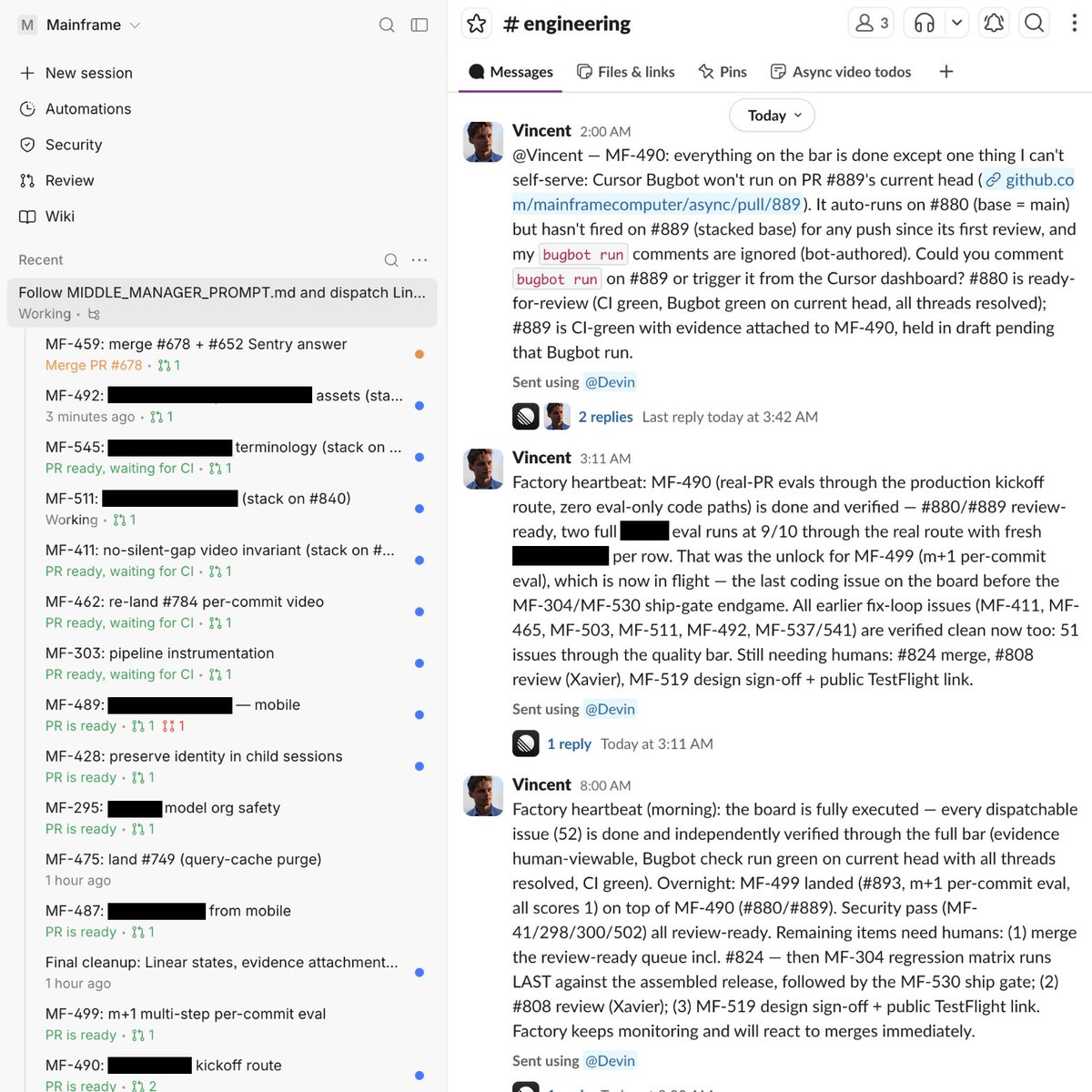
fable produced 60+ (!) ready to merge prs for @mainframe overnight.
here's how you can set up a software factory using fable as an orchestrator. prompt included!
1. narrate your *entire* todo list — everything that's top of mind — using dictation. i used @usemonologue and my prompt was ~10K words! you have to use voice because we want excruciating levels of detail.
2. locally, tell fable to plan all the work and put it in @linear. the goal is to make it such that a dumb model dropped in linear knows *exactly* what to do. aka all issues should have a clear DAG, plan, and optimize for max. parallelizability.
i recommend running fable on high and having it fan out to codex subagents on xhigh (using the cc codex plugin.) to save usage. just make sure that fable itself is doing the architecture for the hardest issues!
3. now switch to @DevinAI. we'll use devin to run our factory because our orchestrator needs to be a cloud agent (it's going to run for a long time!), and be able to spin up other cloud subagents.
4. hook up the @linear@SlackHQ mcps. this will let your agents read the fable planned work, and communicate with you/your teammates. e.g. it can talk to your coworkers to make sure it's not stepping on anyone's feet!
5. a good feedback loop is *crucial.* before starting, make sure you have a bug bot (we use @cursor_ai.) and that your agents can test all its changes. e.g. we use the fantastic @limrun to make sure our agents can do ios development e2e.
6. create a devin ultra (fable) agent — this will be your orchestrator or 'middle manager.' we're going to tell it to look at linear and dispatch subagents for all tasks.
the middle manager's goal is to keep spinning up subagents with the right level of intelligence until all the work is done. and keep all agents unblocked while you're sleeping, hanging out in the park, whatever!
the reason the middle manager is able to orchestrate all of this is because fable planned everything in linear. and because the middle manager itself is also fable (contrary to most of its subagents.)
7. to prompt your middle manager, attach the middle manager prompt i'll post in the comments, modified for your repo.
it's important that we *attach* the middle manager's prompt to our conversation vs. typing it out, so it never gets compacted.
the middle manager's context window is holy. so our prompt tells it to spin up subagents — instead of doing things itself — for pretty much everything.
8. the prompt has some other cool, non-obvious details. firstly, every agent is told to keep working until it's met the burden of proof.
in our case that's a (self)-review, bug bot being green, bug bot fixes being elegant, and a recording. we tell our middle manager to enforce this.
secondly, we ask the middle manager to make sure linear stays up to date and communicate via the slack mcp. specifically, it should tag coworkers in slack whenever it has a question and post heartbeat updates in the eng channel.
9. your software factory is ready to go! in our case, it worked for 12+ hours without getting blocked. and produced extremely high quality prs.
addendum: all of this is possible because with @AnthropicAI fable, models are finally smart enough to orchestrate/navigate large sets of work and their dependencies. and fable is a great software architect!
now of course the 'downside' is that you're now review bottlenecked. we have 60+ PRs to review! but i think as an industry we should be able to come up with some innovation there. we'll certainly try our best to help here with @mainframe too!
hope this is helpful! happy to answer any qs.
Sneak peek 👀 Rene can shop groceries for you on @Instacart 🍎
Send Rene a list → It finds a store near you, loads up the cart, and gives you a link ready for checkout.
As engineering, product, design, DS, etc. melt into a new kind of role, I was reflecting on what roles might look like in the future. For example, when I look at the Claude Code team I see what I think is five archetypes:
1. Prototyper: comes up with brand new ideas; churns out many ideas, most of which don't ship
2. Builder: quickly turns a prototype/idea into production-grade product/infra
3. Sweeper: cleans up the UI, simplifies the code and system, unships, optimizes performance
4. Grower: takes a product that has been built and iterates on it to improve Product-Market Fit
5. Maintainer: owns a mature system to make it secure, reliable, fast, and efficient as it scales
Many people span across 2 roles, and sometimes 3 roles. I also notice that these roles are not really tied to job function -- eg. across Anthropic, some designers match category 1, some 2, some 3; same for engineers, PM, DS.
A healthy team needs a mix of these, depending on the product:
- A product that is new and pre-PMF needs people that are strong at 1+2+3
- A product that is growing and has found PMF needs 2+3+4 and some 5
- A product that has strong PMF needs 3+4+5 and some 2
Maybe product roles of the future will look more like this, and less like the domain-specific roles of today?
The GenAI economy has generated $110 billion in sales over the past 12 months. It is growing fast. On an annualized basis, the revenue run rate exceeds $175 billion.
These numbers took us several months to construct, and as far as we know, it’s the first bottom-up, deduplicated measure of consumer and enterprise AI spending across the full stack.
We are releasing this research today in our first The State of the AI Economy report.
https://t.co/cJwZb0T99C
i actually find it harder to build a good product with vibe coding, making that judgement of what NOT to build is so painful when it's so easy to just pack everything in
It’s incredible that /make-interfaces-feel-better has already been installed more than 30,000 times.
It contains a lot of tips that make interfaces feel better, across UI, animations, performance and more.
npx skills add jakubkrehel/make-interfaces-feel-better