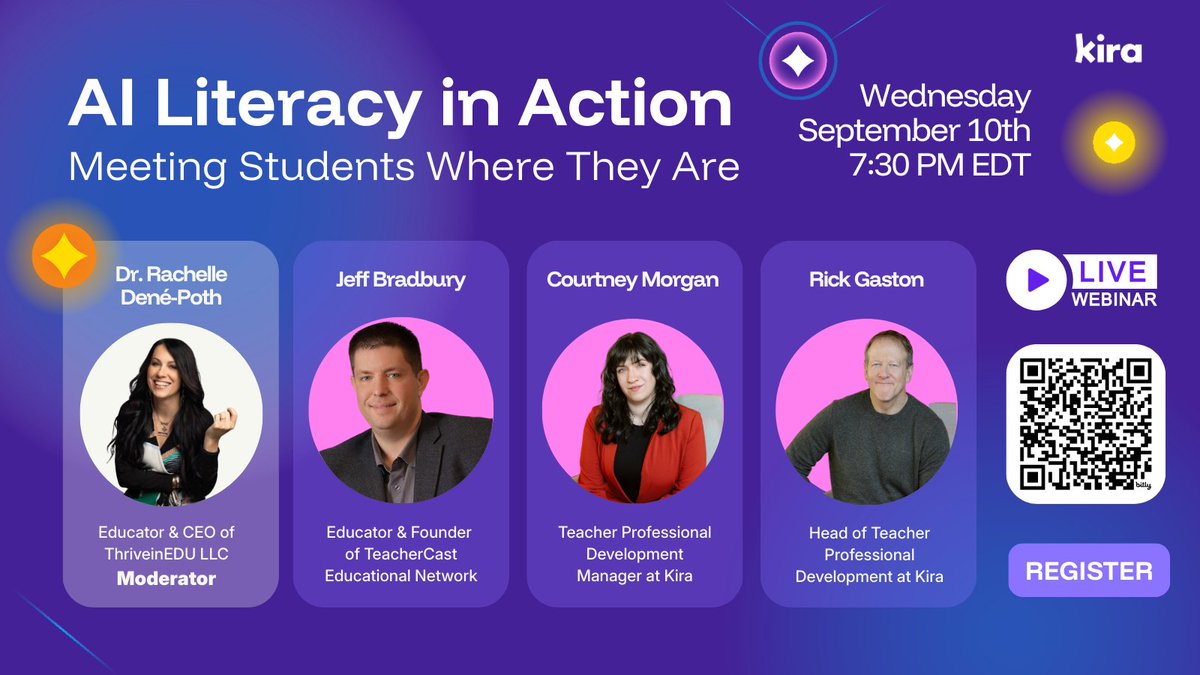
We’re excited to join this panel on AI literacy in education on Sept 10 with @Rdene915 & @AskTheTechCoach@TeacherCast!
→ Hear different perspectives on safe, impactful AI use
→ Explore Kira’s #AI resources for teachers & students
→ Share your questions and ideas about using AI to personalize learning
Register here 👉https://t.co/10fAqdjK2X
#AIinEducation #EdTech
📚Teachers, you already do the impossible.
Buying your own supplies shouldn’t be part of it.
🎉 Kira is buying 1 item off 100 teachers' wishlists.
To help us do that:
Like this post, follow @kira_learning, drop that wishlist (!! & tag a teacher!) 💜 👇
✨Bonus: In the same comment, share one way you plan to use AI in your classroom!
#ClearTheList #BacktoSchool #ClearTheLists2025
📋: https://t.co/TtLP1V5fvX
Did you know? With Essay QuickGrader you can:
- Paste any student essay
- Select a rubric you've created with Kira
- Hit Grade & voilà. You get:
✅ Scores aligned to your rubric
✅ AI + plagiarism check
✅ Feedback to share with students
Learn more:
https://t.co/T1zw5yJsUM
📋#KiraAI Rubric Generator How-To:
🔎 Filter by subject + grade
📝 Add assignment context
🎚️ Define criteria
💾 Use it, reuse it—saved to your library!
It's that easy!
Learn more here 👉 https://t.co/TpuNJd6lr1
🚀 Just launched: Essay QuickGrader + Rubric Generator
💜 Build standards-aligned rubrics
💜 Grade essays in minutes
💜 Check for AI & plagiarism
So you can spend time on what matters most—your students.
👀 and we’re just getting started!
Try Kira now: https://t.co/3HOSzCJWYa
What if grading didn’t have to be time-consuming or inconsistent? 👀
Kira's about to make grading more precise, fair, and headache-free. Instant, standards-aligned, totally customizable.
Curious? Sign up for free: https://t.co/dk6pyuxwF2
#AIinEducation#EdTech#KiraAI
Really interesting observation by @6pasinetti. The differences between DeepSeek and ChatGPT highlight fascinating contrasts in their development philosophies. DeepSeek seems to emphasize computational efficiency and precise outputs, while ChatGPT focuses on open-ended interactions and conversational adaptability. These design choices could reflect broader cultural influences, shaping not only how AI systems infer and reason but also how they prioritize tasks and problem-solving approaches. As AI continues to advance globally, these cultural imprints might become even more pronounced, influencing the evolution of AI inference, reasoning, and decision-making in ways that reflect the diverse perspectives driving innovation.
Models like DeepSeek demonstrate that the marginal cost of advanced AI reasoning is rapidly approaching zero. This opens the door for even resource-constrained institutions to deploy sophisticated AI learning tools, democratizing personalized education. As AI becomes as accessible as electricity, the potential for global educational innovation is limitless. For those of us in AI and education, the opportunity to reshape learning has never been more real.
AI Agents that can spin up infinite cloud browsers aren’t for doing things that we already do just fine with APIs. That’s not the point. They’ll be used for the long tail of tasks that we never got around to wiring up with APIs before, which will inevitably create way more use cases for software.
Because we can now bring automation to any form of work — independent of API availability — we could potentially see a significant portion of things get automated that weren’t before. This is the kind of work that is filled with pesky, long tail tasks that we do over and over but could never easily offload.
The use cases are somewhat limitless. Move data from this app to another app. Review this website for bugs. Fill out this form and then move information into this system. Watch this data or video feed and alert when something changes. Provide product or user interface feedback on an app. Find security vulnerabilities on anything. Research these customers’ online presence and put all the information into a document. And so on.
Sure, if you worked at it, you could automate many one of these things today. But the friction in doing so is so high that by the time you get around to it you probably just end up doing the task manually anyway. Now, you just spend a couple bucks to see if the workflow works and then scale it. And ironically, the more that you automate in the browser the more evidence of new use cases emerge that eventually *will* turn into APIs.
It’s akin to the early days of the cloud. Yes, you could always provision infrastructure if you wanted before, but making it on-demand and just get started with $100, means the use cases that open up are 100X greater than when you had to build buy servers, rack them, lease datacenter space, get bandwidth, and 20 other things. We got a billion new app ideas because of the cloud.
AI Agents similarly dramatically lower the cost to automating anything, and now we’ll get entirely new ideas of what we can apply intelligence to.
When our worlds collapsed, correspondents @jolingkent and @JonVigliotti at @CBSNews moved mountains to keep our family whole. The X community rallied around us in ways we never imagined possible - full story in thread below. Some debts of gratitude can never be repaid.