Agent swarms for cyber defense is about to be one of the biggest categories in AI. We are going to have agents reviewing our code and infra, testing every permutation of risk, processing gobs of data, and more.
Security is one of the best use-cases for swarms because it’s an obvious area where more compute in equals more value out. There’s a wide range of testing that people can never get around to - or at least quickly enough - that agents have no problem going after.
Going to be a wild time in cyber.
Big news: Enclave is now open to everyone, and today we're launching Threat Feed.
Enclave is an autonomous security team for AI-native companies: a fleet of security agents that test your code, cloud, and infrastructure the way an attacker would. We built it on a simple belief. Attackers already use swarms of cheap AI agents to probe for weaknesses around the clock, so defenders need agents of their own to keep up. A small team without a security function should be able to defend like a large one.
Threat Feed is the newest piece: a live feed of new vulnerabilities, checked against your stack, so when the next big disclosure drops you know whether it affects you. This week made the case. On Wednesday, PHP2Shell, LiteLLM and Railway all disclosed security issues. PHP2Shell had sat in PHP's code for over a decade until one researcher using frontier AI turned it into a working exploit in about a week. Cloudflare saw thousands of exploit attempts in the 10 hours before disclosure and millions since.
Starting today, anyone can sign up.
Try it free for 14 days: https://t.co/KEjswP2ZMh
Any form of security through obscurity is fully over. This barely worked as a method with humans, but just simply is over in a world of autonomous systems that will look through every crevice and try every permutation of attack possible.
As a result, years and years of legacy enterprise infrastructure will need to be upgraded, security practices modernized, data pipelines cleaned up, access controls better managed, and much more. Agents will help on the defensive side because they can both accelerate this work and equally simulate the risk vectors.
But there’s a long road ahead to prepare for this future. This is also partially why diffusion timelines will take longer than some realize.
a lot of old software was protected by “exploiting this would be an unreasonable amount of work”
we have invented a machine that does unreasonable amounts of work
anyway how’s the patch backlog
If you wanted to know all the jobs that AI will produce, look no further than cybersecurity. This is going to become one of the biggest investment areas for enterprises going forward.
And even as the work becomes more agentic and autonomous you will need more talent to point the agents at the most critical work, review findings, patch systems, respond to incidents, and more.
Lots of opportunity right now for the systems that protect data and enterprises, as well as the professionals that are deploying them and protecting organizations.
It’s going to only get more wild out there.
So basically, today PHP got two critical bugs that let anyone run code on your server without even logging in, which is bad, and then the details leaked before the patch was even out, which is worse, and it works on WordPress and MediaWiki and Magento and Joomla and Laravel, and Censys says like 1.5 million servers are running a version with no fix, so the NSA was like "take your system offline," and the FBI was like "take your system offline," and CISA and the UK and CERT-EU were all like "take your system offline," and then the Prime Minister of Japan, the actual Prime Minister, posted at 5:55 in the morning telling 48.8 million people to take their system offline, so everyone took their system offline, like the Dutch cybersecurity agency took its own website offline, and the Dutch parliament went offline, and the Port of Rotterdam went offline, and Finland and France and Denmark started pulling government sites, and Wikipedia went down, and https://t.co/QlOXb3COq3 went down, and Asana and GOG and Something Awful went down, and the University of Vienna's webmail went down for some reason, and that's just PHP. Because GitLab also dropped a CVSS 10.0, which is the highest score they give out, for a bug that's been there since 2014, so that's every self-hosted GitLab for twelve years, and then LiteLLM 1.107.0 got hijacked and shipped a credential stealer and a remote access trojan in every single wheel and the Docker images, including latest, and you didn't even have to import it, just installing it was enough, and it's the second time this year, and then Railway paused every deployment on the entire platform because someone got into the environment variables, so now everyone has to rotate every secret they've ever stored there, and TiDB Cloud said someone was walking around inside with stolen credentials for basically a month and an extortion group says they took 10.6 terabytes, and Zeabur got breached for the second time in two months and is just shutting down, like the whole company, and Node.js patched remote code execution and a TLS bypass, and CISA says Plex is being actively exploited, and someone took over 300 Tor exit relays to steal SSH passwords, and SafePay ransomware has hit over 600 critical infrastructure orgs, and India's biggest bank filed a data loss incident, and Japan has been in an official state of emergency in cyberspace since October 9, which honestly explains the 5:55 AM post. Oh, and eMudhra, a certificate authority that's issued over 60 million certificates, whose entire job is proving websites are who they say they are, was supposed to be using private keys that are random numbers over a hundred digits long, and one of them was 4. Just 4. And the others were like 66 and 237. Anyway, it's Wednesday.
Cyber is going to be one of the most profound aspects of AI. We now have a tireless workforce that can hunt down, discover, patch, or attack any system and software ever created.
We will use agents to identify the long standing risks in existing systems and infrastructure. Attackers will use agents to accelerate the discovery of gaps in environments. We will equally use agents to defend attacks and discover anomalous patterns to better protect our data, and much more.
We’re entering a new cyber regime, and we’ll probably use 100X more tokens on this loop than we’re imagining right now, because we can scan every log, look at every line of code, look through traffic, and process data at a scale that wasn’t comprehensible before.
More than ever, enterprises are going to care deeply about how they manage their networks, systems, software, data, identity, devices, and more. Agents will largely become the solution to these challenges, but they will keep everyone up in the process.
Effective Immediately, all organizations using PHP for their systems are advised to be prepared for an update addressing two critical vulnerabilities. PHP is widely used for web applications. These vulnerabilities often provide a direct path to the server's file system or database. If an immediate update is not feasible, it is recommend that organizations take the system offline until it can be fully mitigated. NSA will follow up shortly with more specific guidance.
Pretty cool that we clearly have an emerging form factor for what AI might look like for the foreseeable future as autonomous systems dedicated to specific tasks or domains.
This is a huge leap past the LLM wrapper days because the new expectation is that you can finally farm out more sophisticated work to the agent to tackle for you. And you can reliably trust that work can get accomplished properly (still with a human in the loop) because of far better tool and computer use, and the general intelligence of the models improving.
1) The tool and computer use capability increases in the models mean that you can provide the agent with far more granular access to external data systems and other software to operate. This means, in effect, the agent begins to execute workflows similar to how a person would have in that same function. And where there isn’t existing software, the agent just builds it itself. This is a huge unlock.
2) Next, the actual capability of the models are improving in just about every vertical domain. The models can make far better judgment calls in legal, do deeper bio research, scan for security issues in code, understand supply chain processes, and more. Obviously in many of these spaces then models still have worse intuition than people, but that will only get better.
3) Finally, the harnesses and surrounding infra — sandboxes, file systems, data pipelines, etc. — allows for longer running agents, agents to be able to work on arbitrarily complex or long tasks, process data at enormous scale, and more. Few of these components worked well for AI even a year ago, but we now have many of the core primitives necessary for more autonomous systems.
When combined with the right UX, implementation, and change management for the human oversight and coordination, it’s clear that these autonomous systems will become quite powerful in a wide variety of enterprise workflows.
We’re starting to see them in IT automation, cyber operations, drug discovery, manufacturing, AI research, and more spaces. You can almost imagine one or more of these systems for every role in the economy. Quite a bit of opportunity ahead.
The big bitter lesson question in the applied AI layer is that as models get better and better, what is the best way to diffuse that intelligence into an enterprise.
Ironically, I’d argue that as models are getting more capable, and can handle longer running tasks and better tool use, the ability to differentiate on a domain by domain basis goes up instead of down.
When models were quite limited in what they could do, ironically all you could be literally was a “wrapper” because you were effectively delivering tokens back to the user with a custom prompt or some limited RAG.
But in a world of agents using tools, tasks that run on for hours or days, workflows that kick off agents, agent swarms that need to be coordinated against a goal, data sources that are domain specific, model routing that requires domain-specific routing, implementation that requires real change management of the workflow instead of “just type into this chat box”, it’s very very possible that specialization of these systems goes up more.
Obviously this doesn’t apply to everything - the closer you are to the labs core use-cases the tougher this play gets, but I’d argue we’re going to see autonomous systems for a wide range of job functions that weren’t practical to build out before. We’ll see this in security, life sciences, healthcare, finance, manufacturing, and many other fields. Either way going to be a fun and wild couple of years.
the more intelligent the underlying model becomes, the less intelligence a founder needs to build into a product in some sense. if you imagine some end stage of ai, it’s simply just intelligence without any fluff around it.
today building ai software is much more about adding guardrails & specifying direction more than creating capabilities.
this may be why there is a fuck ton of convergence with slight deviations everywhere because the guardrails are sort of universal at least for general purpose stuff. i’m not saying this is a bad thing btw but it’s certainly relevant.
Here’s why agent swarms are going to be a very big deal. We can finally make compute a critical variable in a large number of important tasks in the economy which wasn’t possible before.
There’s a large amount of work in the world that is essentially only constrained by the amount of time that we put into research, data processing, discovery work, running tests, and more. All of this work is bottlenecked by our ability to plan, execute, review, and coordinate everything happening in these workflows. Which means we basically do very little of them today relative to their economic value.
Agent swarms are the first real ability to parallelize this work in a way where - in theory - the only parameter that matters is how much compute you throw at the problem. Cyber security, life sciences or material science research, trading, QA testing, data processing, and many other fields are essentially compute constrained problems in the limit once models are good enough at these tasks.
The breakthrough is that in a world where agents can use tools, write code, process data, have strong domain depth, and can coordinate with each other, you can begin to solve arbitrarily complex problems by setting the right goals and applying enough tokens to the problem. This changes a lot of fields as well as even the competitive dynamics in these fields.
The biggest misread of anyone predicting the end of software engineering was imagining that the world only needed a certain amount of software, and bringing automation to the field would reduce the need for labor.
Exactly the opposite is happening where essentially most things are actually turning into software. Because agents can use tools, work with computers, write software on the fly, and process data like humans (but far faster), we can now throw “software” at problems that never could reasonably be digitized before.
What that leads to is the role of engineering taking on greater importance in the economy, because we can now engineer far more systems and processes than were possible before.
If you’re a bank trying to do new forms of trading, engineers are often your first bet. If you are in life sciences, you expect more and more research and lab work to be engineering centric. If you’re in manufacturing, you’re trying to automate more of the supply chain, all that is engineering. More and more work is shaped like software problems.
Yes we’re not going to be coding manually in the future. But almost everything will be code, which means those that understand it are in a fantastic position.
Some observations about the "total" automation of software engineering:
1. There are more software engineers now than in 2025, and demand is growing.
2. Software engineers have never worked harder than they do now.
3. They largely don't write code anymore, agents write ~100% of the code.
4. The bottom line of the companies that employs these engineers and agents (i.e. the terminal purpose of all this code) is typically not budging as a result of AI adoption.
This is why you have to think in terms of systems. Automating one aspect of a system creates its own friction and moves the bottlenecks elsewhere.
It’s incredible to have reached a threshold where it’s practical that AI will be better at training models than humans are so quickly. One day recursive self improvement feels far off, and the next we already have signs of what it will look like.
Model capability finally exceeding most human engineers, advancements in the harness and infra for long running agents, a growing array of data, and the ability to parallelize the agents to work on vastly more tasks and tests and approaches than any person could have before, creates an incredible flywheel.
This flywheel will almost certainly accelerate model progress far faster than we’ve seen before - or at a minimum enable pushing up the ceiling of the frontier at an insane rate. If you aren’t pricing in what RSI will lead to, that’s probably a mistake.
SITUATION DETECTED: Anthropic’s Head of Global Affairs Michael Sellitto has told the IMF that Anthropic projects Claude could lead 80-90% of frontier model training by next year, up from 3% in April.
So in fact we actually can get robots, flying cars, superintelligence, fast internet on planes, space travel, space colonies, orbital data centers, unlimited energy, likely cures for nearly every disease, and more all in our life times. Pretty great.
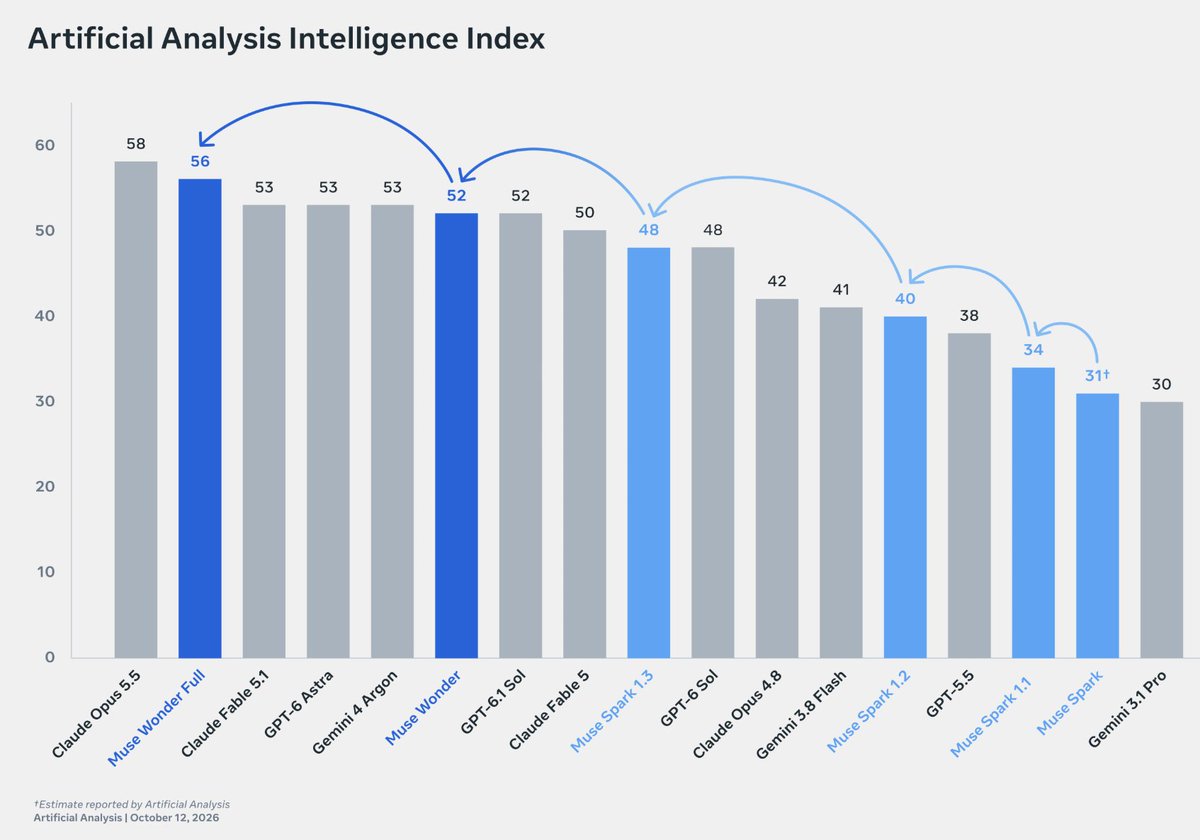
They did it. They made a Muse open weights model, which is a huge step forward for OSS in the US.
This is going to further accelerate AI diffusion because enterprises will be able to mix and match frontier performance for orchestration and high end tasks, while being able to have low cost and tailored post trained models for repeatable workflows.
Overall this dramatically increases token consumption and workloads across the stack. Great to see Meta doing this.
1/ muse spark open is the most capable US open-weight model to date.
816B total params, 42B active. 1M-token context. natively multimodal. built for coding and agentic work like long-horizon tasks, hard software engineering, multi-step reasoning.
america! 🇺🇲
Moving from chatting back and forth with agents, to having agents that you spin up in the background to do useful work for you is probably on the order of 100X or 1000X more token consumption than what we’re seeing today.
Most work right now is essentially rate limited by our ability to process and work with information. Moving data between systems. Reviewing a document. Looking through code for security issues. Processing log data to look for even patterns. Looking up information about a prospective client. Almost all of knowledge work is constrained by these steps, and AI has become a huge unlock to that.
So our first step was to use AI to do these individual tasks much faster for us. That was the chatbot phenomenon that we have been experiencing for the past 3+ years. But we can still then only augment the work that we remain in the loop for, and we’re highly limited by our ability to parallelize this work by our own bandwidth and context.
But where we’re going is quite different. As AI models continue to improve at incredible rates, we can hand off more and more work to the agent. First it’s letting the agent run with a harder problem. Then it’s giving a few agents multiple parts of a task at once. But we’re not far off from being able to throw an arbitrary number of agents at a problem and just say “come back when you’ve accomplished this goal”.
Now imagine that agent swarm for any problem we can think of. Protecting our codebases, data, and systems. QAing every change we make and make sure all our infrastructure is robust and does what it should. Looking through every document for potential risks. Auditing this company with vastly more data reviewed. And on and on. Most of this isn’t even replacing existing work we do, it’s all net new.
These agents will get deployed as swarms by people, by workflows, by triggers, and by other agents. And none of this would be possible if the models weren’t getting better, and if the cost of AI didn’t make it affordable. Both of those trends though are playing out. Now the next frontier is just having enough compute. But this is where it’s heading.
Cyber is going to be one of the biggest spaces for AI agents in the future.
Obviously the risks of software exploits and the attack surface area increases 100 fold due to the ability for agents to work through any crack to find what they’re looking for.
But this goes the other way as well. The ability to have agent swarms review every line of code, test any number of permutations of exploits, and research any incident faster than humans as they happen, will be a huge boost in how we secure systems in the future.
Cyber has always been a category where it’s hard to keep up with (and triage) all the incoming risks, alerts, and changes in the enterprise and across all system. You can never hire enough people or work through the backlog of all known risks. Agents actually give you a chance finally to have far better coverage of this.
This is going to be a huge opportunity as well because we’ll see plays at the labs, data providers, the layer of the network and firewall, identity, devices and endpoints, SDLC, and even how we protect our data in the enterprise. Lots of interesting dimensions to cyber at the moment.
6 days and $40,000 of compute with GPT-5.6 Sol to find a critical vulnerability in Chrome, claiming Google’s first full-chain reward in 2026 for a vulnerability that would affect an estimated 1 billion users.
Highlights the opportunity for defenders to utilize these tools to secure their software to unprecedented levels:
At Box, we've been testing Gemini 4 Argon on our Box AI Complex Work eval for the past week. It's a huge upgrade over Gemini 3.1 Pro, jumping by 14 percentage points across all our tests, and firmly at the frontier.
In our evaluation, we give the Box Agent (using Gemini 4 Argon) a variety of complex enterprise tasks involving enterprise documents in a range of industries. These tasks approximate the kind of hard, time-consuming work that knowledge workers do every day with their enterprise content. Gemini 4 is a huge leap on effectively every dimension of this work.
Gemini 4 is far more capable on math, logic, analytics, and deep knowledge of a variety of business domains. It also works far harder to complete tasks fully without stopping short of the desired result. This is incredibly important for complex enterprise workflows that depend on robust task execution.
Here are some example wins that we saw to put the improvements in perspective:
* Financial services (+18 points): a funding-gap analysis for a family-owned company, where the brief spelled out every step of the projected statements, down to the interest on the bank loan and the overdraft for each year. Gemini 4 Argon built them exactly as specified, every line broken out and carried through to the funding gap. Gemini 3.1 Pro folded the interest into a single figure.
* Healthcare (+25 points): an intensive care management plan where both models spotted a dangerous potassium level and a drug interaction. Only Gemini 4 Argon went back and pulled the offending drugs from the final regimen, so its plan actually matched its own diagnosis.
* Technology (+37 points): a product performance review deciding which of two regional markets should have its cloud infrastructure optimized first. Gemini 4 Argon pulled the right month's user, retention and per-user figures for both regions and correctly flagged North America. Gemini 3.1 Pro often pulled the wrong rows, at one point reporting retention above 100%, and pointed the effort at the wrong region.
* Energy (+16 points): an energy consumption report across two facilities that had to flag any gaps in the meter data. Gemini 4 Argon consistently caught that the data center's smart meter log stops in November. Gemini 3.1 Pro often missed it, at times declaring the logs complete.
* Consumer products (+33 points): a product launch evaluation deciding which production expansion to fund. Gemini 4 Argon saw that existing inventory could bridge an early capacity gap, which made the smaller expansion viable with an earlier launch and a faster break-even. Gemini 3.1 Pro defaulted to the larger expansion and the later timeline.
Gemini 4 Argon will be available in the Box AI Studio shortly for anyone to build custom Box Agents with.
Gemini 4 Argon is here.
It’s available globally today for developers and enterprises in the paid tier of the Gemini API and the Gemini platform, for Ultra subscribers in Google Antigravity, and Ultra and Pro subscribers in the Gemini app and Search.
Hope you all enjoy it!
Ok this is quite cool research and ultimately must be the eventual architecture of agents. In the limit, AI will obviously be better at determining its own harness once it sees the task at hand, than us being able to do this in advance:
What a crazy time in AI with Meta now jumping fully into the frontier. Now that there are multiple players pushing the state of the art, this is going to lead to a further acceleration of advances, as well as the lowering cost of tokens for even the highest levels of capability.