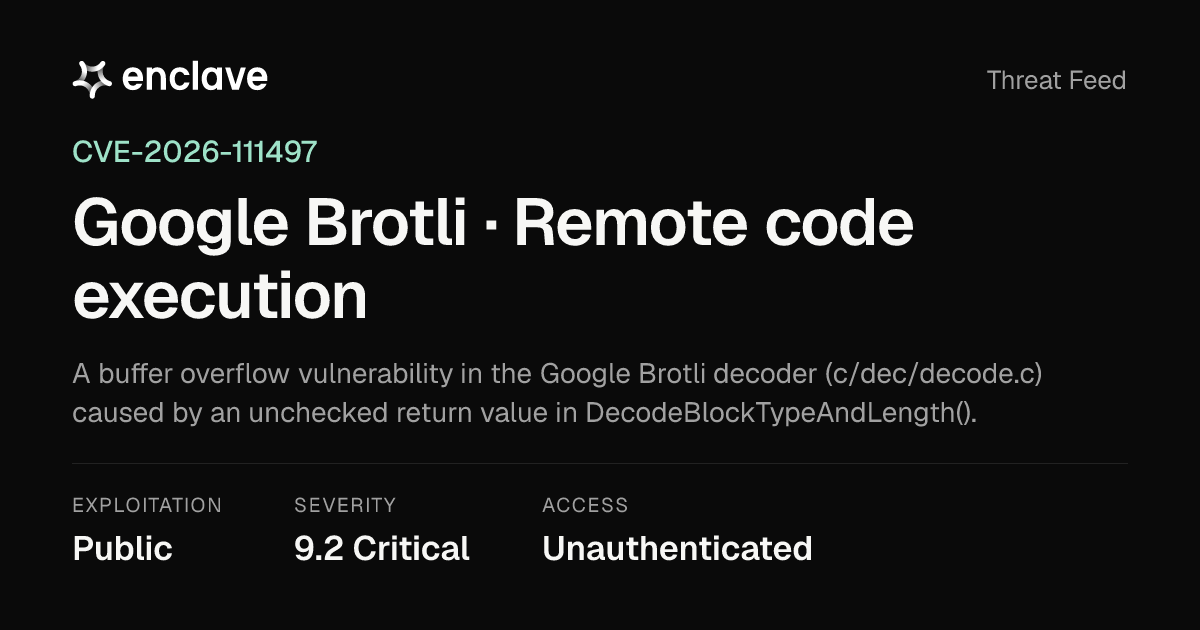
Node2Shell (CVE-2026-111497) is a memory bug in Brotli, the compression library bundled into Node.js, Python, system libs, Envoy and more.
Most teams don't know every place Brotli runs in their stack. It's usually a transitive dependency or an OS package, and pip-audit may not flag it yet.
Enclave's agents scan your code, cloud and servers and show you exactly where you're exposed.
Advisory + free check: https://t.co/n2WDOnYAj9
During this red-teaming exercise, we also found a vulnerability that allows for unauthenticated remote code execution in Brotli, a widely-deployed compression library included in many pieces of software such as Node.js, Bun, and Envoy.
The flaw could let an attacker run their own code on affected systems by sending or replying with malicious compressed data, without any need to create a user account. That is, an unpatched server that accepts compressed input could be taken over by a malicious client, and an unpatched client that accepts compressed input (such as “curl --compressed”) could be taken over by a malicious server.
This root cause issue was actually fixed in the Brotli source code in February, but it wasn’t known at the time that it gave rise to a security vulnerability and there was no more recent release of Brotli. Since Brotli is built into other software, any software which includes this library needs to take the update too, followed by the users of that software. We disclosed the vulnerability to Brotli and other downstream projects such as Node.js, which released or are currently releasing security updates, and Brotli cut new release versions and published a CVE.
More details on the patch and mitigations below:
https://t.co/Y1Y72aHxrW
We’ll likely have 1,000X more tokens flowing through cyber agents soon than we do today.
As the surface area of cyber risk increases, at some point soon it will be nearly impossible to keep up with the volume of new risks (we’re essentially already there). Large companies barely had the resources to pull this off before, but the vast majority of companies don’t.
There’s a never ending set of libraries to keep up with, tools to leverage, and sprawling infrastructure and code to secure. We’ll have agent swarms that can fan out, leverage any security tool, test various perpetuations of attacks, read through logs, process enterprise data for risk level, and more.
This capability only emerged in the past few months. Wouldn’t have been possible before long running agents and computer use were good enough, and models hadn’t been trained on cyber deeply. That’s all changing now.
This is a huge area of opportunity right now for every layer of the security stack across identity, firewall, network, code scanning, data protection, and more. And it’s at least one reason to be optimistic about the balance of offensive and defensive capability.
Big news: Enclave is now open to everyone, and today we're launching Threat Feed.
Enclave is an autonomous security team for AI-native companies: a fleet of security agents that test your code, cloud, and infrastructure the way an attacker would. We built it on a simple belief. Attackers already use swarms of cheap AI agents to probe for weaknesses around the clock, so defenders need agents of their own to keep up. A small team without a security function should be able to defend like a large one.
Threat Feed is the newest piece: a live feed of new vulnerabilities, checked against your stack, so when the next big disclosure drops you know whether it affects you. This week made the case. On Wednesday, PHP2Shell, LiteLLM and Railway all disclosed security issues. PHP2Shell had sat in PHP's code for over a decade until one researcher using frontier AI turned it into a working exploit in about a week. Cloudflare saw thousands of exploit attempts in the 10 hours before disclosure and millions since.
Starting today, anyone can sign up.
Try it free for 14 days: https://t.co/KEjswP2ZMh
This is the quickest way to check your exposure to recent zero days.
1. Connect all your integrations
2. Ask the agents to scan your entire attack surface
3. Get an answer
Node2Shell (CVE-2026-111497) is a memory bug in Brotli, the compression library bundled into Node.js, Python, system libs, Envoy and more.
Most teams don't know every place Brotli runs in their stack. It's usually a transitive dependency or an OS package, and pip-audit may not flag it yet.
Enclave's agents scan your code, cloud and servers and show you exactly where you're exposed.
Advisory + free check: https://t.co/n2WDOnYAj9
During this red-teaming exercise, we also found a vulnerability that allows for unauthenticated remote code execution in Brotli, a widely-deployed compression library included in many pieces of software such as Node.js, Bun, and Envoy.
The flaw could let an attacker run their own code on affected systems by sending or replying with malicious compressed data, without any need to create a user account. That is, an unpatched server that accepts compressed input could be taken over by a malicious client, and an unpatched client that accepts compressed input (such as “curl --compressed”) could be taken over by a malicious server.
This root cause issue was actually fixed in the Brotli source code in February, but it wasn’t known at the time that it gave rise to a security vulnerability and there was no more recent release of Brotli. Since Brotli is built into other software, any software which includes this library needs to take the update too, followed by the users of that software. We disclosed the vulnerability to Brotli and other downstream projects such as Node.js, which released or are currently releasing security updates, and Brotli cut new release versions and published a CVE.
More details on the patch and mitigations below:
https://t.co/Y1Y72aHxrW
Big news: Enclave is now open to everyone, and today we're launching Threat Feed.
Enclave is an autonomous security team for AI-native companies: a fleet of security agents that test your code, cloud, and infrastructure the way an attacker would. We built it on a simple belief. Attackers already use swarms of cheap AI agents to probe for weaknesses around the clock, so defenders need agents of their own to keep up. A small team without a security function should be able to defend like a large one.
Threat Feed is the newest piece: a live feed of new vulnerabilities, checked against your stack, so when the next big disclosure drops you know whether it affects you. This week made the case. On Wednesday, PHP2Shell, LiteLLM and Railway all disclosed security issues. PHP2Shell had sat in PHP's code for over a decade until one researcher using frontier AI turned it into a working exploit in about a week. Cloudflare saw thousands of exploit attempts in the 10 hours before disclosure and millions since.
Starting today, anyone can sign up.
Try it free for 14 days: https://t.co/KEjswP2ZMh
Agent swarms for cyber defense is about to be one of the biggest categories in AI. We are going to have agents reviewing our code and infra, testing every permutation of risk, processing gobs of data, and more.
Security is one of the best use-cases for swarms because it’s an obvious area where more compute in equals more value out. There’s a wide range of testing that people can never get around to - or at least quickly enough - that agents have no problem going after.
Going to be a wild time in cyber.
Introducing Threat Feed: a live feed of new vulnerabilities, checked against your code, cloud, and infrastructure.
Knowing whether a disclosure affects you should not require a security team.
@EnclaveAI is now open to everyone.
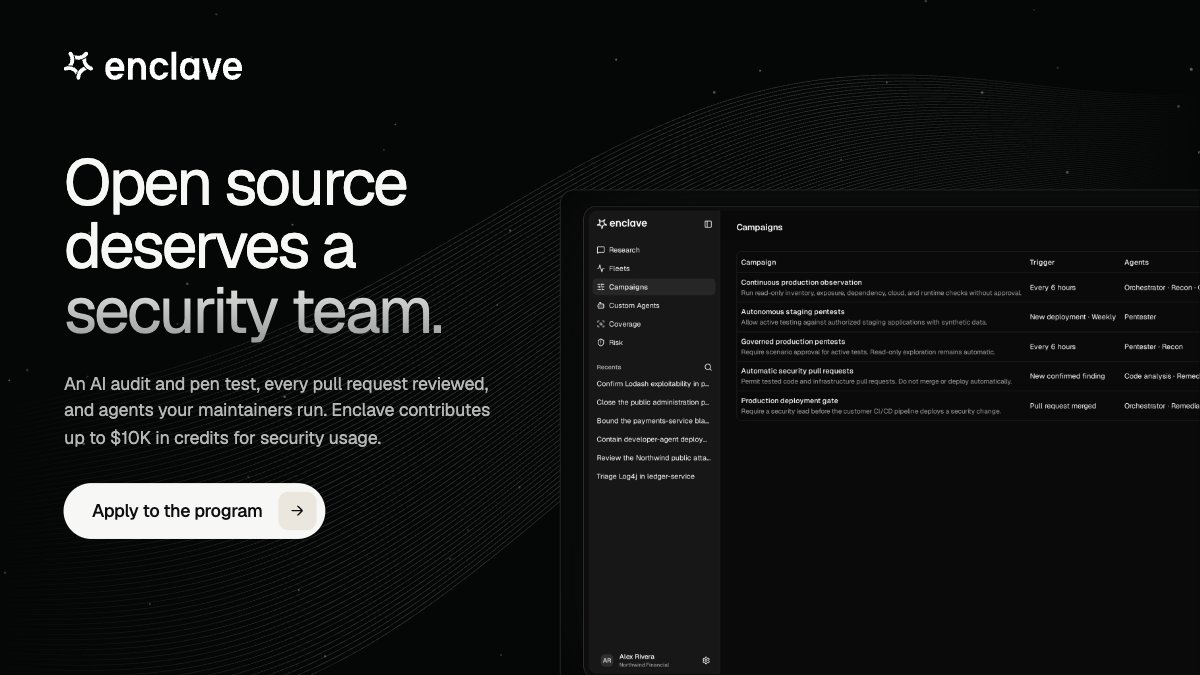
Enclave for Open Source is live!
PHP2Shell showed how fast AI-driven research moves: flaws that sat in PHP for over a decade were turned into working exploits in about a week, according to the researchers who found them.
Most open source projects don't have a team that can absorb that. We're giving them one.
Enclave contributes up to $10K in credits for security usage.
Apply: https://t.co/PgDCvm6D9t
What a day…
The future of cybersecurity is swarms. Swarms of agents attacking and swarms of agents defending.
Or rather, fleets vs. swarms: Governed agents on defense, vs cheap and relentless agents on offense.
Whoever coordinates faster wins.
Cyber is going to be one of the most profound aspects of AI. We now have a tireless workforce that can hunt down, discover, patch, or attack any system and software ever created.
We will use agents to identify the long standing risks in existing systems and infrastructure. Attackers will use agents to accelerate the discovery of gaps in environments. We will equally use agents to defend attacks and discover anomalous patterns to better protect our data, and much more.
We’re entering a new cyber regime, and we’ll probably use 100X more tokens on this loop than we’re imagining right now, because we can scan every log, look at every line of code, look through traffic, and process data at a scale that wasn’t comprehensible before.
More than ever, enterprises are going to care deeply about how they manage their networks, systems, software, data, identity, devices, and more. Agents will largely become the solution to these challenges, but they will keep everyone up in the process.