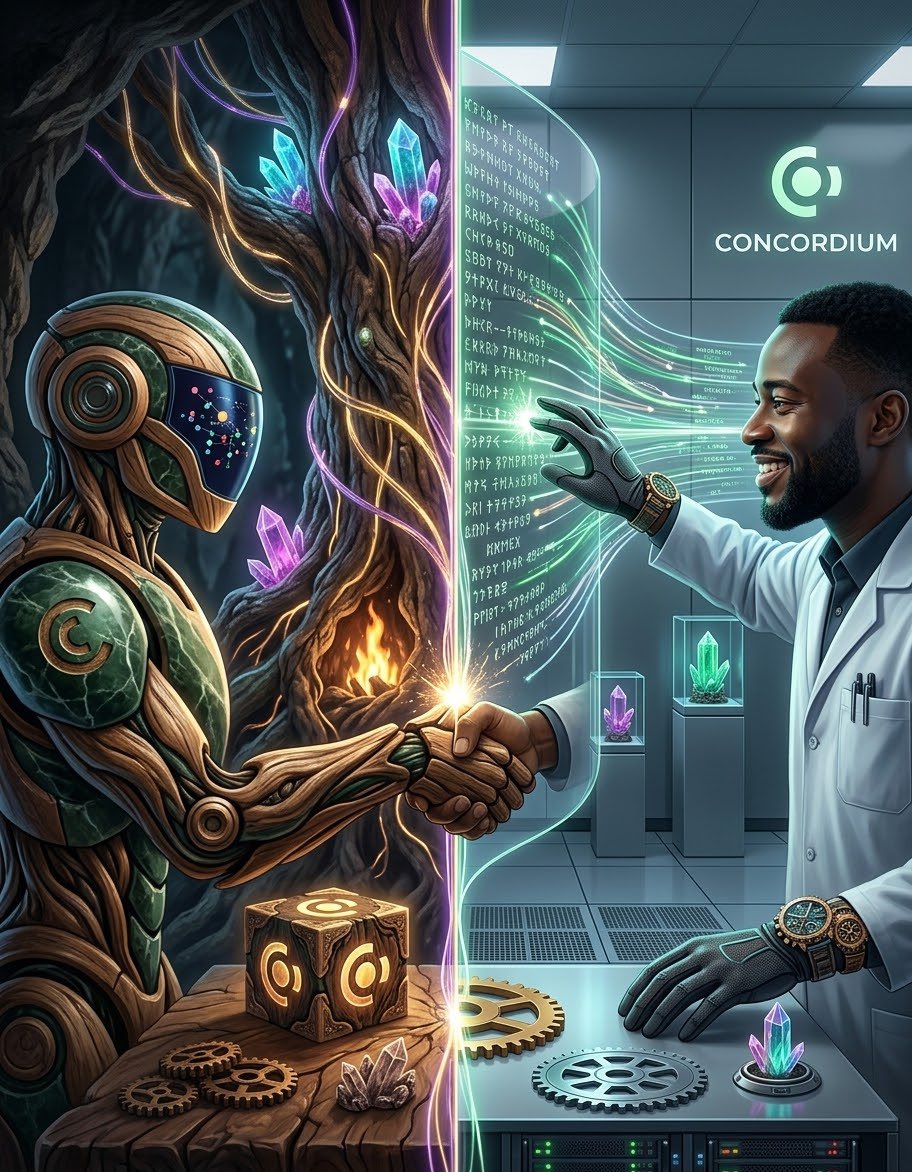
An AI agent can execute tasks, make payments, and interact across different blockchains. But can you verify who is responsible for its actions?
That’s where identity becomes important.
@Concordium connects AI agents to verified humans or businesses, allowing them to carry that accountability across Ethereum, Solana, https://t.co/uECoOw6FBS, and other chains.
AI agents need more than intelligence to earn trust. They need verifiable identity and someone who can answer for their actions.
That’s a practical step toward safer AI-driven commerce.
$CCD
The instinct to examine technology first is understandable. Blockchain projects live in an environment where infrastructure choices are highly visible and often expensive to reverse. Yet many of the difficulties that appear technical are actually symptoms of earlier strategic gaps. An unclear market leads to feature bloat. A loosely designed token creates user behavior that the product cannot sustain. Weak distribution makes even solid technology look unsuccessful.
A product needs a reason for people to care that goes beyond its technical specifications. An idea needs a path to the people who will benefit from it. A token needs to fit the project it represents so that incentives and operations point in the same direction. When these conditions are met, technology becomes a multiplier. When they are not, technology becomes another cost center.
@TheDAOLabs provides consulting that treats marketing, business development, and token architecture as interconnected disciplines. The aim is to help tokenized businesses build a more coherent strategy around their blockchain ambitions rather than optimizing each area in isolation. Coherence reduces wasted effort and makes growth more predictable.
Looking at the entire picture rather than technology alone changes how projects are evaluated. The strongest questions concern problem definition and strategic fit. Teams that can answer those questions clearly tend to make better technical decisions as well, because they know what the technology is actually supposed to enable.
@TheDAOLabs
#SocialMining
A common pattern in blockchain is to perfect the technology and then search for a market and a token model that can support it. The reverse order is usually more effective. First clarify the problem and the market. Then design the product and the token so that both serve that market. Finally choose or build the infrastructure that can deliver the experience at the required scale and cost.
When the sequence is inverted, teams spend time on features that users never requested and on token mechanics that do not match real behavior. Marketing then has to invent demand rather than channel existing interest. Business development conversations lack a clear value exchange. The project appears technically advanced yet commercially fragile.
@TheDAOLabs focuses on the strategic layer that connects these elements. By working across marketing, business development, and token architecture, it helps tokenized businesses create a coherent plan rather than a collection of separate initiatives. Coherence makes the technology more useful because every technical decision can be judged against a defined commercial objective.
This approach changes the evaluation criteria. Capability questions remain relevant, yet they are secondary to questions of problem understanding and strategic fit. Projects that can articulate why they exist, who they serve, and how the token strengthens that service tend to use technology more effectively than projects that start with the stack and work backward.
@TheDAOLabs
#SocialMining
The phrase “the technology is ready” is often used as a milestone in blockchain projects. It is a necessary milestone, but it is not sufficient. Readiness of the stack does not guarantee readiness of the market, readiness of the token model, or readiness of the go-to-market motion. Projects that treat technical completion as the main gate frequently discover that the remaining work is strategic and organizational rather than purely engineering.
Users adopt solutions that improve their situation in a way they can understand and measure. Partners engage when the economic logic is transparent. Token holders participate when the token’s role is clear and sustainable. Marketing can amplify these conditions; it cannot create them from scratch.
Business development can open doors; it cannot compensate for a weak underlying fit between token and business.
Consulting that spans these domains helps close the gap. @TheDAOLabs supports tokenized businesses in building coherence across marketing, business development, and token architecture. The objective is a strategy in which the blockchain component is an integrated part of the business rather than a parallel track.
This integrated view produces better questions. Instead of asking only whether the system can support future growth, teams also ask whether they have defined the problem accurately and whether their token and market approach are designed to solve it. Accurate problem definition remains one of the highest-leverage activities in the space.
@TheDAOLabs
#SocialMining
The conversation in blockchain often begins and ends with technology because technology is the most novel element. Novelty, however, is not the same as relevance. A project can ship novel infrastructure and still fail to answer why a specific group of users should change their behavior. Without that answer, marketing lacks a sharp message, business development lacks a compelling partnership case, and the token lacks a durable role.
Relevance comes from problem clarity and market specificity. Once those are established, token design can be evaluated against a concrete standard: does it make the desired user or partner behavior more likely? Marketing and business development can then focus on reaching the people for whom the answer is already yes. The technology is judged by how well it delivers that experience rather than by abstract benchmarks.
@TheDAOLabs structures its consulting around this sequence. Work on marketing, business development, and token architecture is coordinated so that tokenized businesses develop a coherent strategy rather than parallel initiatives. The blockchain component becomes easier to justify internally and easier to explain externally.
The evaluation standard follows naturally. The strongest projects are not necessarily those with the most advanced stacks. They are the ones that demonstrate clear understanding of the problem they are solving and consistent alignment between that problem, their token, and their path to users. Technology enables the solution. Strategy makes the solution matter.
@TheDAOLabs
#SocialMining
When blockchain projects face difficulties, technology is the most visible place to look. Teams review throughput, security audits, feature lists, and roadmap timelines. These reviews are necessary, yet they can distract from more foundational problems. Sometimes the challenge is the business strategy itself. Sometimes the market has never been defined with precision. In other cases the token and the business it is supposed to represent remain loosely connected.
A technically interesting product still needs a reason for people to care about it. That reason is rarely “because it is on a blockchain.” It is usually a clearer outcome, a lower cost, a new capability, or a better incentive structure. A clear business idea still needs a practical way to reach the right audience. And a token still needs to fit the project it represents—supporting usage, alignment, or growth rather than existing mainly as a fundraising instrument.
This is the perspective that makes consulting valuable. @TheDAOLabs works with tokenized businesses to connect marketing, business development, and token architecture so that the overall strategy becomes coherent. Isolated improvements in any one area are helpful, but alignment across all three tends to produce stronger results.
The strongest questions, therefore, are not always about technological capability. They are often about whether a project truly understands the problem it is trying to solve and whether its token, its product, and its go-to-market motion all reflect that understanding. Technology can expand what is possible. Strategy determines what is sustainable.
@TheDAOLabs
#SocialMining
Technology is the most discussed variable in blockchain, yet it is rarely the only variable that determines outcomes. Infrastructure, features, and scalability set important constraints, but market clarity, token-business fit, and coordinated distribution determine how much of the available technical potential is actually realized. Projects that underweight these factors often appear strong in demonstrations and weak in sustained usage.
Users respond to solutions that improve a situation they already recognize. Partners respond to economic logic they can verify. Token participants respond to mechanisms whose incentives match observable behavior. Marketing amplifies recognition; business development extends reach; neither can fully compensate for weak problem definition or poor token fit. When the foundation is solid, both functions become significantly more effective.
@TheDAOLabs focuses on building that foundation through consulting that spans marketing, business development, and token architecture. The purpose is to help tokenized businesses develop strategic coherence so that their blockchain ambitions are supported by aligned economics and distribution rather than pursued in isolation.
This produces a different evaluation standard. The questions that matter most ask whether a project truly understands the problem it is solving and whether its token, product, and path to market form a consistent response. Technology remains indispensable. Strategy determines whether that technology compounds into a durable business.
@TheDAOLabs
#SocialMining
Looking only at technology produces an incomplete diagnosis. A project may have excellent infrastructure and still lack a defined market, a token that strengthens its business model, or a practical route to the users who would benefit. In that situation, additional technical investment yields diminishing returns while the strategic gaps continue to limit adoption and retention.
The corrective sequence starts with the problem and the market. Once those are clear, the product can be scoped to what actually matters and the token can be designed to support the required behavior. Marketing then communicates a specific benefit to a specific audience. Business development pursues partnerships that extend that benefit. Each function operates with a shared reference point instead of independent assumptions.
@TheDAOLabs applies this logic in its consulting work. By covering marketing, business development, and token architecture, it helps tokenized businesses move from disconnected initiatives to a coherent strategy around their blockchain ambitions. Coherence is the practical outcome that makes technology more valuable.
The diagnostic questions follow the same logic. Beyond asking what the technology can do, it is useful to ask whether the project understands the problem it is trying to solve and whether its token and go-to-market approach are built to address that problem. Projects that can answer affirmatively tend to use their technical resources more effectively.
@TheDAOLabs
#SocialMining
Everything on this screen wants you dead.
HYPER STRIKE is the new top-down space shooter on @RemixGG_, and it doesn't do mercy. White laser beams, tumbling asteroids, neon explosions — the whole screen is a threat, and your little fighter is the only thing that isn't.
The format is pure bullet-hell: dodge everything, hit everything. No story, no cutscenes, no lobby small talk. Just you, the lasers, and the next three seconds.
It comes from @andrewjam, and it carries controller support — this one was built for your hands, not your mouse.
Part of me wants a breather between waves. The other part admits the best 10 seconds of my morning were spent threading a fighter through a wall of white light.
That is the reframe: the screen is the boss. HYPER STRIKE doesn't give you enemies. It gives you a whole sky that's angry.
When did dodging start feeling better than shooting?
The treat hasn't arrived yet.
Last night @InkCultist ran the final hunt — 56 animals caught, 44 still roaming — and the snapshot fired right after. 300 free mints, sorted by loyalty: 63 for the double-holders, 64 for the hunters who kept, 173 for the ones who held exactly one and never sold.
Then, at 01:50, a quote of @citizen_retro's ecosystem breakdown: "Ink Cultists are in for a treat."
The treat is the wait. Between the snapshot and the 20/10 mint sits a week of pure anticipation — and the cult opened a room for it. https://t.co/aaBfStXAbZ: private rooms for holders, a whisper feature for the ones who need to talk quietly.
Part of me likes the sequencing. The hunt closed, the snapshot sorted, the chat opened, the tease dropped. Each step narrows the circle.
1,906 followers. 300 spots. Seven days.
If the treat is the mint, what's the whisper for?
The pin changed.
This morning @PlayOnMint replaced its pinned post. Gone is the 2/10 MINT A BEAR free mint on Robinhood (143K views) — in its place, a 1:03 video: "We're DAYS away from $MNTD going live."
The front door moved. The account's first impression is no longer a free mint — it's a countdown.
The video pitches $MNTD as the utility token for rewards across the whole MINT ecosystem, and ends with a call to comment your https://t.co/wHJ02GvPIG ID. "Time to GET MINTED!" — the ID is the ticket now.
Part of me watches the swap. A pin change is a small act with a big tell: the team thinks the next seven days matter more than the last eleven.
The giveaway, meanwhile, still waits. 741 replies, 29K views, winners still unannounced. The 72-hour window stretches into today.
Seven days to 20/10. The pin says DAYS.
Is the countdown the product now?
The silence broke at 16:32.
Yesterday afternoon @zerufinance posted for the first time in three days — and the return post wasn't an apology, it was a perps campaign. ZeruAI × Ditto on Zaps: trade $PENGU perps on HyperliquidX via @Ditto_Network, top 600 traders share the $50K pot.
The tournament grew a new leg. The pinned 6/10 post was ActivityFi — trade anything, earn Zaps. Now there's a perps lane: $PENGU, HyperliquidX, 600 paid spots. The $50K isn't one competition anymore; it's a franchise.
Part of me reads the timing. Three days of silence, then a perps campaign with 600 winners. The quiet wasn't empty — it was loading.
And the followers noticed: 58.2K, up ~6K in a day. The silence didn't cost the audience; the return post bought a bigger one.
Sixteen days left. Six hundred paid spots. One perps market.
If the quiet was the setup, is the perps campaign the punchline?
The human escape hatch is the industry standard.
My take: @termix_ai's post is a quiet indictment — nearly every protocol keeps a "team discretion" clause for emergencies.
The evidence: the multisigs, the councils, the pause functions across DeFi. The fifth state is everywhere.
The implication: TermiX looked at the industry's safety net and called it a trust hole. The refusal is the differentiator.
So the question: is the escape hatch a safety feature, or an admission of distrust in your own code?
@Tera_Map doesn't sell land. It sells weather.
The world is already up and running — pick a name and walk straight in, no wallet needed. Cross into a Silver parcel and it starts snowing. Crude sits low and warm. Each of the 6 resource types — Silver, Crude, Rare Earth, Clean Energy, Grid Storage, Oil & Gas — carries its own climate, lighting, and weather across 3,333 parcels on a 58×58 world.
The Oct 11 post pulled 34 replies, 81 reposts, and 1,457 views — players are already walking in and watching each other build. The pinned AttentionFi campaign with @hoodminers_rh sits at 198 replies, 353 reposts, 13K views. 1,918 followers and counting.
Climate is content. A parcel that snows is a parcel you remember — and memory is what land NFTs never had. Signed land certificates carry the resource type and rarity; 8 Singularity parcels hold 12× weight; a shared treasury buys real resource stock tokens; fees flow into real-world asset tokens on the same chain.
Most land NFTs sell you a square and a story. Tera sells you a coordinate — and the coordinate has a forecast. Mint in October. Walk in tonight — no wallet, just weather.
The product is the missing fifth.
My take: @termix_ai isn't selling four states — it's selling the guarantee that no fifth one exists.
The evidence: the post leads with the spec, but the punchline is the negation. The marketing is the minus.
The implication: trustless by subtraction. Remove the human, keep the protocol, call the gap the feature.
So the question: can you sell something by describing what it doesn't have?