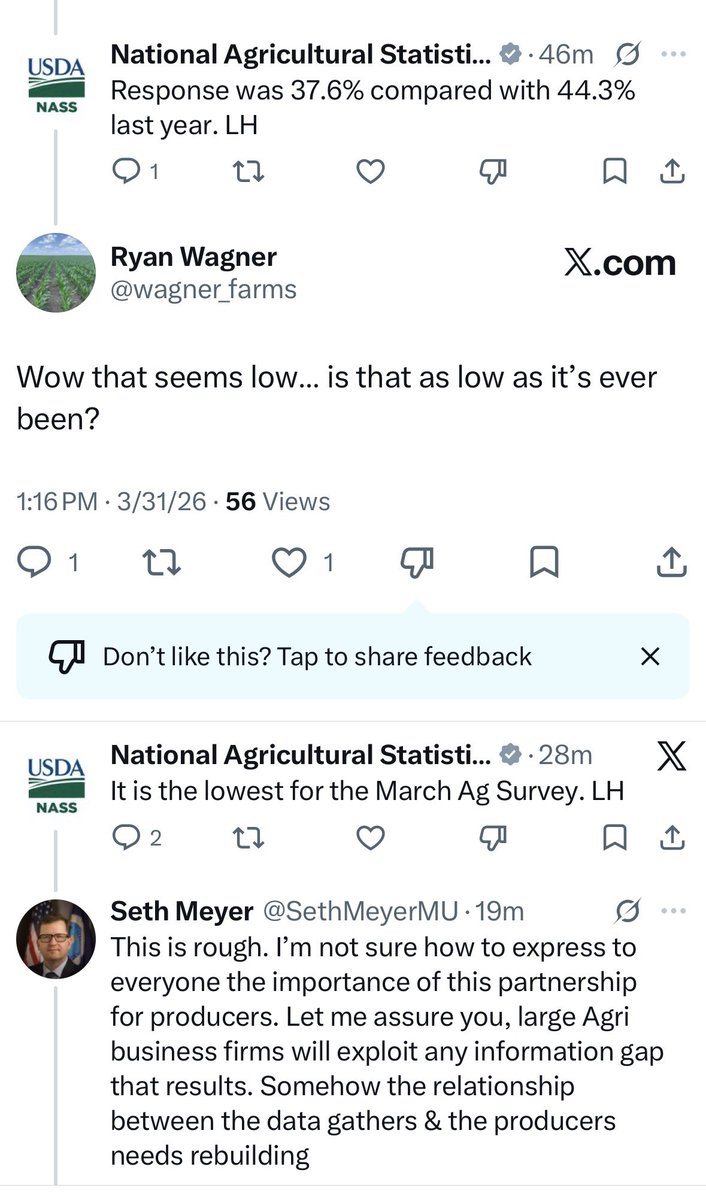
@profarmer …and of course we’re at the end of the pendulum’s swing in which people distrust institutions generally. The attacks on public education, against the University system, dismantling large swaths of federal agencies ostensibly in the name of deficit reduction (lol). It all fits.
The responses to this thread illustrate the problem of systematically destroying credibility in public institutions. It’s not healthy for a functioning society, but here we are.
(There’s also a problem in focusing solely on one’s self interest, i.e. USDA should pay respondents.)
Sadly, this has been decades in the making. In my farm radio days I always joined the @profarmer Crop Tour, and always marveled at things farmers would say about USDA data. Some guys desperately *wanted* to believe that USDA was playing silly buggers with the data for #reasons.
@AgFreeAgent It concerns me greatly that we’re losing generations of readers generally. I’m in my mid-40s and read at least an hour every day for pleasure… but I don’t see people younger than me doing that so much.
Unfortunately, this has roots down in the high school and middle school levels. I was pleasantly surprised that our seventh grader was assigned Fahrenheit 451 this year, but that feels like an anomaly from what I hear from parents in other districts.
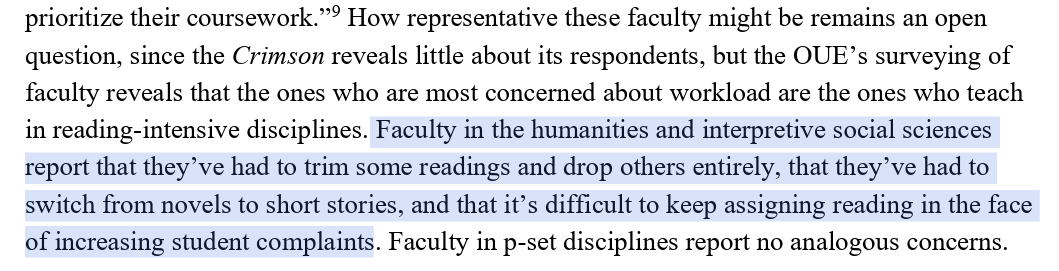
Harvard faculty report that they've had to "trim some readings and drop others entirely, switch from novels to short stories, and that it’s difficult to keep assigning reading in the face of increasing student complaints."
I’d love to see schools rely less on Chromebooks & Canva in class (our daughter is building slide decks in nearly every class on a weekly basis), and more on books and hand-written assignments.
Note I said “schools” and not “teachers.” Teachers didn’t create the problem.
@juhasz_joh61433 @marciac95_ Any time someone splutters “indoctrination” in a discussion of university education, I know the rest of the argument is specious, because it isn’t going to be rooted in facts or anything remotely close to objectivity. Sad.
@juhasz_joh61433@marciac95_ You’re blaming universities for failed public policy. When we as a society decided to slash public funding of education, tuition necessarily started climbing, aided by access to limitless debt. It’s a clear failure of basic economic policy, not the schools you hate.
@juhasz_joh61433 @marciac95_ It’s a shame we no longer value learning, intelligence, reason, logic, new experiences, research, scientific progress, or basic civic literacy as a society today.
I no longer wonder how mighty Rome collapsed - we’re living it now.
@marciac95_ The older I get, the more I think the European gap year concept has merit. We push kids to figure out what they want to do with their life way too young.
I’m still reinventing myself 25 years later! Life is a journey :)
@marciac95_@h_bandere This is important - there are several reasons my parents’ generation wanted their kids to go to college, and money was only part of the story. Health, longevity, and physical wellbeing was also part of the equation.
@marciac95_ YES! I called my Masters degree “future-proofing” my career, and I was right. I would never have gotten into association leadership without a graduate degree, even if that degree was in ag economics and not something specific to nonprofit leadership.
Pat Riley says he wishes NBA coaches still wore suits and ties:
“I think when fans look over at the sidelines they want to see someone that looks like a leader.” (via @ramonashelburne)
@jbollenbacher Absolutely! Same here - I love to cook. And it makes for a great family activity, too; we all pitch in, and enjoy a meal around the table (without screens!).
Cheaper, healthier, more enjoyable.
There is an interesting bit of research to be done here on the effect of removing home economics and shop class from the school curriculum.
Sure, we as parents need to bear some responsibility for teaching life skills like cooking, but when dual-income houses are the default…