Forthcoming in the AER: "Difference-in-Differences with a Continuous Treatment" by Brantly Callaway, Andrew Goodman-Bacon, and Pedro H. C. Sant'Anna. https://t.co/DK3l1laHyQ
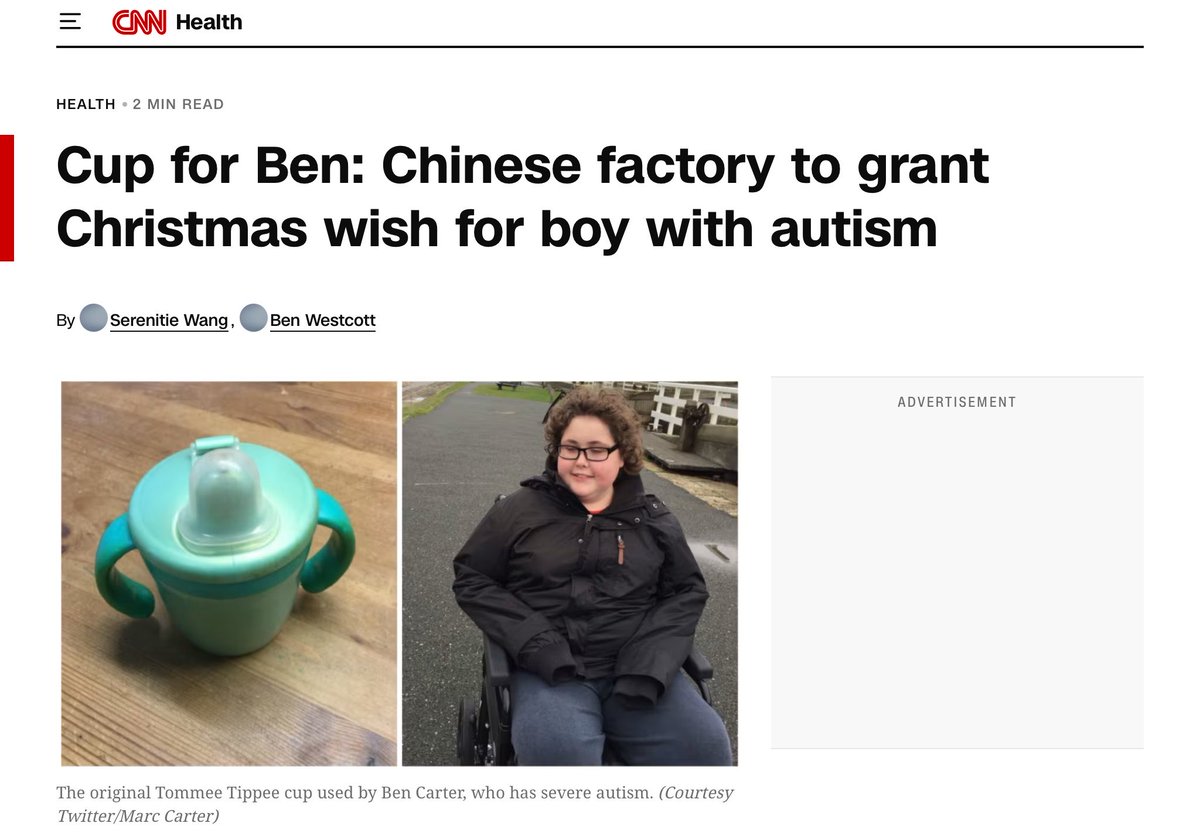
This is a story of how a Chinese factory in Dongguan showed what real kindness looks like.
British boy Ben Carter has severe autism and would only drink from one specific blue Tommee Tippee cup he’d used since he was two. The cup was falling apart and the model had been discontinued for years — without it he risked dehydration.
Chinese workers hunted down the old moulds unused since 2003, carefully made 8 slightly different coloured versions so Ben could test which one he’d accept, then produced 1,000 more as a lifetime supply.
This is how we should help each other.
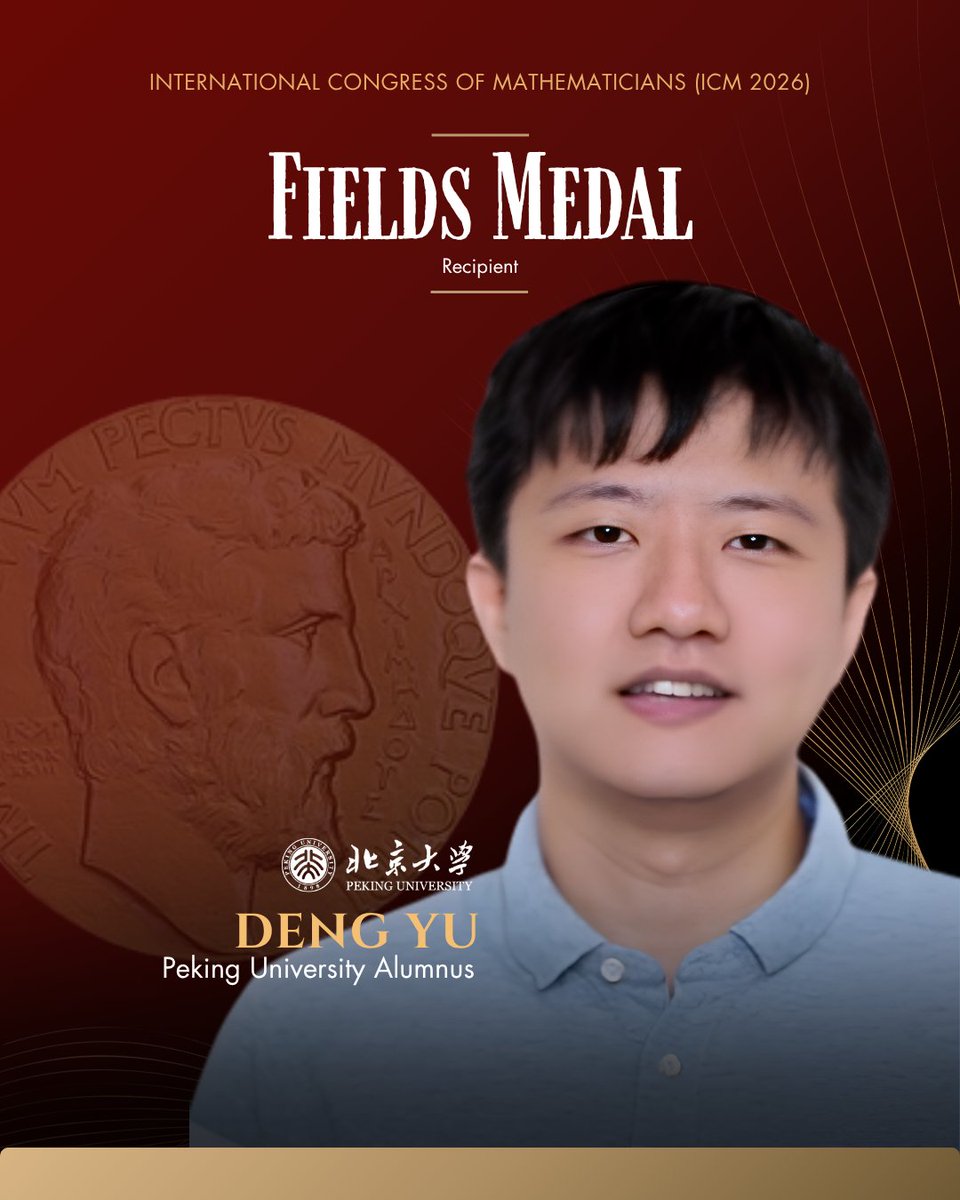
Huge congratulations to PKU alumni Wang Hong and Deng Yu, recipients of the 2026 Fields Medal — mathematics’ highest honor! 🧮
Announced at the 2026 International Congress of Mathematicians (ICM) in Philadelphia, the pair are among four mathematicians worldwide to claim this prestigious prize, awarded every four years to outstanding scholars under 40.
The awards are historic on several levels.
—First time two mathematicians who completed undergraduate studies in mainland China win the Fields Medal in the same year.
—Both joined Peking University as undergraduates in 2007.
—Wang Hong becomes only the third female Fields Medalist ever, the first Chinese woman, and the first recipient with a bachelor’s degree from a mainland Chinese university.
We are immensely proud of their extraordinary breakthroughs and lasting contributions to global mathematics.
Zhilin is an outstanding alumnus of Swatow Gimsuan High School (汕頭金山中學)
The first time I learned about NLP and machine learning was when people at Gimsuan were talking about Zhilin's achievements at CMU
He is truly a role model for people like me
Congratulations to Zhilin Yang, founder and CEO of @Kimi_Moonshot, on the latest Kimi release. What a huge win for the open-source community!
It feels like just yesterday Zhilin was graduating from my lab at CMU, jointly co-advised with William Cohen. Not only did he complete his Ph.D. in just four years, but he also made truly fundamental contributions to ML during his time at CMU.
What a spectacular career! Congrats again Zhilin, and thank you and the entire Kimi team for everything you're doing for the open-source community.
A post about Pope Leo XIV's encyclical on AI. Why the Pope is right, but perhaps not right enough.
Artificial intelligence is reshaping the world in front of our eyes: how we communicate, how we access information, how we work, how income and status are distributed among us, and soon how we fight and kill each other. Yet the public conversation about AI remains stuck on the minutiae of competition between labs, or on a false dichotomy between AI as a “stochastic parrot” with no real capabilities and AI as an alien superintelligence poised to take command of humanity.
The more important questions are about what we want from AI, and whether our current mindset, institutions, and control mechanisms are equal to the task of steering it toward our welfare.
It is refreshing, then, that a bold and powerful voice has weighed into this debate: Pope Leo XIV. As an economist who has long argued that technology is a matter of choice rather than fate, I find Leo’s intervention welcome and, on most points, on target. But on the most consequential question of what AI should actually be designed to do, Leo stops short.
Secular readers may bristle at the encyclical’s opening invocation of the Tower of Babel. They would be mistaken to stop reading there. Leo goes much further than most pundits, journalists and policymakers in the United States by recognizing that what happens to AI, and hence to humanity, is a under our control. There are multiple possible paths for AI, and which one we take will have sweeping consequences. He is also ahead of many commentators when he writes forcefully and unequivocally that “technology is never neutral, because it takes on the characteristics of those who devise, finance, regulate, and use it.”
These were the central themes of the book I wrote with Simon Johnson, Power and Progress: Our Thousand-Year Struggle over Technology and Prosperity. It is heartening to hear them taken up by a voice with Leo's reach.
The Pope is also right to question the current trajectory of AI in warfare and law enforcement. What was taboo only a few years ago – AI-driven mass surveillance, algorithms selecting targets for killing – has become routine. Many in Silicon Valley are now calling openly for a new military-algorithmic complex centered on AI as an instrument of American hard power. Leo captures something deep and too often ignored: “Any technology that facilitates attacks without seeing the face of human beings lowers the moral threshold of conflict.”
His call for the “disarmament of AI” follows directly from these observations. As he explains, disarming AI means “freeing it from the mentality of ‘armed’ competition, which today is not limited simply to the military context, but is also an economic and cognitive phenomenon.” His moral clarity in stating that “there is no algorithm that can make war morally acceptable” should be a warning to technologists rushing to design new weapons of mass destruction.
Underneath these specific concerns lies a more fundamental claim: that what is technically feasible is not the same as what is good for humanity, and that the difference depends on who controls the technology and what ideology and interests guide them.
Leo edges toward what I take to be the most important point about AI's future when he observes that “while AI promises to boost productivity by taking over mundane tasks, it frequently forces workers to adapt to the speed and demands of machines, rather than designing machines to work with those who work.”
But here he does not go far enough. He stops short of questioning the prevailing design philosophy of AI itself: a philosophy centered on mimicking human capabilities and automating human tasks, with the ultimate goal of artificial general intelligence (AGI) that can do everything a person can.
This philosophy rests on a mistake. It assumes that artificial intelligence and humanintelligence are fundamentally similar, and therefore machines should naturally take over whatever humans currently do. Yet these intelligences are fundamentally different.
Humans are “one-shot” learners. We form hypotheses from a few examples, mentally simulate possibilities, and refine our understanding through a social process of trial and error. This is how children learn language - imitating a few words, generalizing, and adjusting based on how others respond. We are not, however, very good at absorbing massive volumes of information or sifting through unstructured data for relevant patterns.
AI models are almost the opposite. They thrive on enormous training sets and excel at pattern recognition at scale. But they have, as yet, no genuine creativity, no real-world embodiment, and no capacity for trial-and-error learning grounded in interaction with the physical and social world.
When two things are different – you shouldn’t, and typically you couldn’t – use one to mimic the other. If you did, you would end up with suboptimal, disappointing results. It would have been a colossal mistake, and the Chicago Bulls’s legendary coach Phil Jackson would have gone down in the annals of basketball as one of the worst coaches in history, if he decided in the 1990s that because Michael Jordan was the better player, Jordan should mimic everything that Scottie Pippen and Dennis Rodman were doing in the team. The team went from championship to championship because these players worked together and complemented each other.
The same applies to AI and human skills.
The more productive path is complementarity – using AI to do what humans cannot, so that humans can do what they do best. An electrician aided by AI diagnostics, a nurse supported by AI in interpreting symptoms, a teacher using AI to personalize instruction for each student; these are the contours of a different AI future, one that raises rather than displaces human capability.
Optimists and industry insiders will respond that automation-first AI can still benefit everyone, provided redistributive policy keeps pace. But this argument has a poor track record. Forty years of digital automation have already concentrated gains at the top, hollowed out middle-skill work, and produced disappointing aggregate productivity growth. There is little reason to expect that an even more powerful round of automation, deployed by even more concentrated firms, will end differently. We can and must demand a different design.
The global stakes from the future of AI are even larger than those we can see around us in the United States. For the developing world, where billions still depend on the prospect of decent jobs as a path out of poverty, an automation-centric AI agenda is not merely suboptimal. It is simply transferring to foreclose the most important route to broad-based prosperity.
The biggest failing of today's AI industry is its refusal to recognize any of this. It is guided instead by an ideology of control (the industry’s own over humanity) and by a conviction that machines are uniformly better than humans.
As Leo rightly notes, this failure is enabled by the fact that a handful of companies now command the future of AI.
What we need is a combination of moral clarity and a serious, society-wide debate about what AI can do and what we want it to do. That debate must move beyond exhortation toward concrete choices: antitrust action against the dominant platforms, public investment in human-complementary AI, regulation of surveillance and autonomous weapons, and meaningful rights for workers and citizens over the data on which these systems are built.
The Pope's intervention makes such a debate a little more likely today than it was before.
It is now up to the rest of us to carry it further than he was willing to go.
Today, we share a breakthrough on the planar unit distance problem, a famous open question first posed by Paul Erdős in 1946.
For nearly 80 years, mathematicians believed the best possible solutions looked roughly like square grids.
An OpenAI model has now disproved that belief, discovering an entirely new family of constructions that performs better.
This marks the first time AI has autonomously solved a prominent open problem central to a field of mathematics.
Having spent the past few weeks in Beijing giving talks and attending meetings, here are some quick observations as I wait for my flight to NYC to board:
1. The talk of the town has, of course, been the Xi-Trump meeting, but no one (not even usually well informed elite circle insiders) seems to know what it actually accomplished, other than a continuation of the detente that’s been in place for the past several months. That’s about as good an outcome as one could realistically expect, I suppose, but clearly a real “grand bargain” is not in the cards anytime soon.
2. The Chinese economy seems to be in a steady state, neither improving much nor visibly deteriorating like it was in 24-25. In that sense the government’s stimulus policies have had a positive effect, but the vast majority of industry people I talked to remain very pessimistic about domestic profits and consumption. The dominant sentiment is that the only way for major firms to generate profit growth is through direct overseas expansion.
3. That said, technological advancement is of course very real and quite impressive (although it’s not quite as visible in Beijing as it is in, say, Shenzhen). One interesting and very pleasant side effect of the EV revolution (paired with infrastructure investment) has been that Beijing is now a bike-able city again, given the sharp reduction in exhaust fumes on city streets and the expansion of bike lanes. Armed with a new bike, I could almost explore the city like I used to back in 2000. Hugely nostalgic feeling.
4. Academia is, in general, in a pretty dour mood. STEM subjects and the social sciences/humanities alike have seen very significant funding reductions over the past 2 years, but the latter have of course gotten the worst end of the deal. Political censorship also seems to be visibly ramping up again, with the sheer scale of perceived “red lines” snowballing to levels unprecedented since the early 1990s. As the recent Yang Nianqun incident suggests, administrative regulation of faculty members’ personal affairs has also expanded (i.e., consensual extramarital relationships between adults who were not in a direct teacher-student relationship would almost certainly have gone unpunished as recently as 5 years ago).
5. In general, it’s hard not to notice the steady increase in government presence in everyday life—in both positive and negative ways. The city feels safer and cleaner than it ever has been, and yet the layers of administrative review needed for just about any kind of professional activity have clearly proliferated on a vast scale (made less painful by the digitization of most government services and more uniform law abidance, but still more onerous than it used to be despite all that).
6. The most alarming thing, I suppose, is that general optimism (personal or socioeconomic) seems to be in particularly short supply among the younger generations. This is obvious even among the most intellectually gifted kids at Tsinghua and PKU, where the level of career anxiety seems to be at a level that I have never encountered before. Unsurprisingly, willingness to form families or plan ahead in general at the personal level is very low.
All in all, it was, as always, a very informative couple of weeks. The stay was also made much more pleasant by the fact that I managed to do it before Beijing becomes brutally hot. I look forward to being back more often in the near future.
In her final semester at Harvard, Amanda Nguyen was raped. She did everything survivors are told to do. Then she discovered that the physical evidence collected from her own body would be destroyed in 6 months — unless she filed paperwork to stop it. And then filed it again. Every 6 months. Forever. She was 22 years old. She decided to change federal law instead. 🌟
Amanda had interned at NASA. She had big plans. The kind of future that takes years of hard work to build was finally within reach.
Then everything shattered.
She went to the hospital. She reported the assault to police. She endured the forensic exam. She made the careful decision to file her rape kit anonymously — worried that an open case could affect security clearance applications for her dream careers.
That's when the system revealed how broken it truly was.
Because she was anonymous, Massachusetts law gave her only 6 months before her rape kit — physical evidence collected from her own body — would be permanently destroyed.
Not the 15 years the state allowed for pressing charges.
Six months.
No official process to extend it. No clear instructions. No one to guide her. She had to figure it out herself, every 6 months, forcing herself to relive the worst experience of her life just to preserve her right to eventually seek justice.
She started researching rape kit laws in all 50 states.
What she found was staggering.
Some states kept kits for years. Others destroyed them in as little as 30 days. Some states charged survivors for the cost of their own kit collection. Others never notified survivors what happened to their evidence. No consistency. No standard.
*"Justice should not depend on geography,"* she said.
But it did.
In November 2014, Amanda founded Rise — a nonprofit dedicated to changing that reality. Everyone who worked with Rise was a volunteer. They fundraised through crowdfunding.
Their goal was rewriting federal law.
She met with lawmakers across Washington. Staffers told her it wasn't a priority. Some questioned her story. She kept going. She learned that the most powerful thing she could do was stop being abstract — to walk into a room, look a senator in the eyes, and say: *this happened to me. I am sitting in front of you.*
Together with Senator Jeanne Shaheen, she drafted the Sexual Assault Survivors' Rights Act — proposing that survivors should never be charged for their rape kit collection, should receive testing results, and must be notified at least 60 days before their evidence was scheduled for destruction.
In February 2016, the bill was introduced.
It passed the Senate unanimously.
It passed the House unanimously.
Not a single vote against.
On October 7, 2016, President Obama signed the Sexual Assault Survivors' Rights Act into federal law.
Amanda Nguyen was 24 years old.
Rise continued working state by state. To date, Rise has helped pass 33 laws across the United States, covering protections for over 84 million rape survivors.
A movement started in spare time, with no budget and only volunteers, became one of the most effective civil rights campaigns of its generation.
And Amanda never stopped reaching for the stars — literally.
In 2024, Blue Origin announced she would be the first Vietnamese woman to fly to space. The young woman who had once feared that fighting for justice would cost her a future in space proved the two didn't have to be a choice.
She was nominated for the Nobel Peace Prize. Named a Time Woman of the Year. She wrote a memoir called *Saving Five.*
But perhaps the most remarkable thing about Amanda Nguyen's story is not any single achievement.
It is the fact that she turned the most painful moment of her life into something that made the world more just for millions of people who will never know her name.
She was a college student who needed the system to work.
When it didn't, she rebuilt it herself.
**At 24 years old.
📖 Out Oct 2026 via @UofMPress — a posthumous work by Xiaohong Xu @UMSociology
The Great Separation upends scholarship on China's neoliberalism, tracing ordoeconomism to before the Reform era.
📖 Book: https://t.co/kTBy4jMtVA
🔗 About Xu: https://t.co/FPJN0KzamR