10 Must Read Diverse Books on India:
1. From Plassey to Partition: A History of Modern India - by Sekhar Bandyopadhyay
1. India's Struggle for Independence - by Bipan Chandra
1. Social Background of Indian Nationalism - by A.R. Desai
1. India: Development and Participation - by Jean Drèze and Amartya Sen
1. Mohandas: A True Story of a Man, His People, and an Empire - by Rajmohan Gandhi
1. India: From Midnight to the Millennium and Beyond - by Shashi Tharoor
1. Society in India - by Ram Ahuja
1. Modernization of Indian Tradition - by Yogendra Singh
2. India After Gandhi: The History of the World's Largest Democracy - by Ramachandra Guha
3. A Brief History of Modern India by Rajiv Ahir (Spectrum's)
Which one is your favourite
🌟 Scholarly Commendation:
Profound appreciation to journalist Nistula Hebbar for a Chronological Political Analysis, Institutional Accountability, Governance Diagnostics, and Political Risk Assessment of the Education Ministry. The article presents a multi-layered governance narrative linking leadership accountability, public trust, education governance, and youth political mobilisation.
@nistula
🔑 Very Important Facts, Arguments & Insights (UPSC | Concise)
🔹 Core Thesis: Dharmendra Pradhan's resignation represents not merely an individual political setback but an Institutional Accountability Event triggered by a Crisis of Examination Credibility and growing Youth Mobilisation.
🔹 The article traces Mr. Pradhan's journey from ABVP Activist, BJYM Leader, Petroleum Minister, and Education Minister, highlighting his steady political ascent before the present crisis.
🔹 The NEET Paper Leak is portrayed as the Immediate Trigger, but the article argues that the crisis accumulated through Successive Governance Deficits rather than one isolated event.
🔹 It identifies a series of institutional controversies:
NCERT curriculum debates
UGC equity regulations
Repeated examination irregularities
CBSE evaluation concerns
Question-paper leaks & answer-sheet mix-ups
🔹 These controversies collectively contributed to an Erosion of Institutional Legitimacy and declining Public Trust in India's examination ecosystem.
🔹 The article argues that the Middle-Class Social Mobility Contract—where competitive examinations serve as pathways to opportunity—was weakened by repeated credibility failures.
🔹 It highlights the emergence of Gen-Z Political Agency, suggesting digitally networked youth transformed examination grievances into broader demands for Administrative Accountability.
🔹 Political insight: Leadership Accountability increasingly depends not only on electoral performance but also on maintaining Institutional Credibility and Governance Responsiveness.
🎯 Exactly What the Author Wants to Say
> The resignation of Dharmendra Pradhan symbolises the political consequences of sustained institutional failures in India's education governance. The deeper crisis is not merely exam leaks but the erosion of trust in public institutions, where youth mobilisation transformed administrative lapses into a nationwide accountability movement.
⚖️ Constructive Criticism (Balanced Perspective)
🔹 The article attributes significant weight to the Education Minister's political responsibility but gives comparatively less attention to the Systemic Complexity of examination management involving multiple agencies such as NTA, State Authorities, Testing Infrastructure, and Law Enforcement.
🔹 Greater discussion of Corrective Institutional Reforms—including Digital Examination Security, AI-enabled Monitoring, Cyber Forensics, and Governance Modernisation—would have strengthened the policy dimension.
🔹 The analysis primarily examines the political trajectory rather than quantitatively evaluating improvements or shortcomings in broader education-sector outcomes during the minister's tenure.
🧠 UPSC Enrichment Keywords
Institutional Accountability • Governance Deficit • Public Trust • Administrative Responsiveness • Examination Integrity • Policy Credibility • Youth Political Mobilisation • Institutional Legitimacy • Regulatory Governance • Human Capital Development • Education Governance • Political Accountability • Social Mobility • State Capacity
#EducationGovernance #NEET #InstitutionalAccountability #PublicPolicy #Governance #Youth #EducationReforms #NTA #PublicTrust #UPSC #IndianPolity #PolicyAnalysis
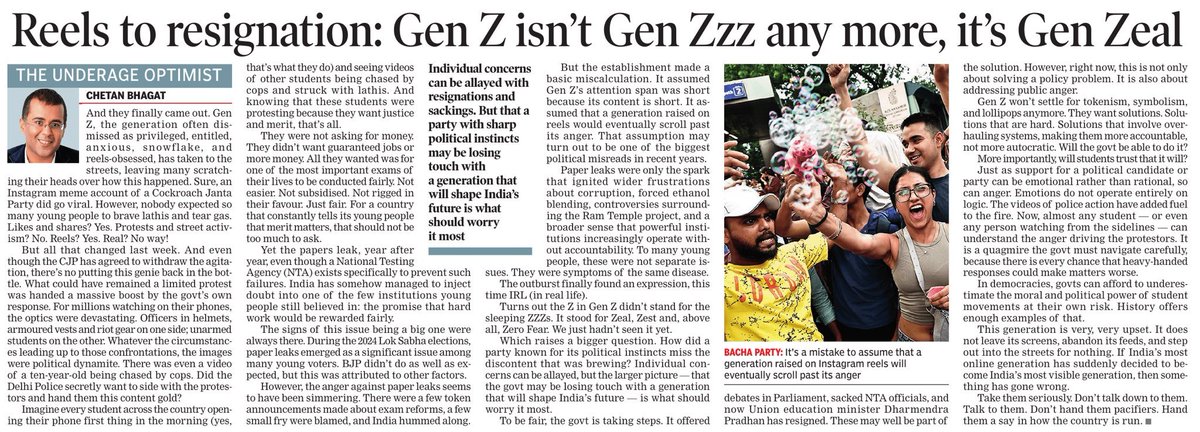
Kudos to Chetan Bhagat for a behavioural-political, generational sociology, and democratic mobilisation analysis. The article insightfully explains how Digital Native Behaviour, Collective Action, and Institutional Trust intersect to transform online discontent into real-world political participation.
@chetan_bhagat
🔑 Very Important Facts, Arguments & Insights (UPSC | Concise):
🔹 Core Thesis: Gen Z has transitioned from passive digital engagement to active democratic participation. Social media is no longer merely an entertainment platform—it has become an Engine of Civic Mobilisation.
🔹 The article argues that the NEET/Paper Leak Crisis became the Catalytic Trigger, but the underlying drivers were:
Institutional Distrust
Youth Anxiety
Perceived Governance Failure
Demand for Accountability
🔹 The Cockroach Jantar Party (CJP) is presented as a Symbolic Digital Movement, demonstrating how Memes, Reels, and Viral Content can evolve into Mass Political Mobilisation.
🔹 The article challenges the stereotype of Gen Z as Attention-Deficit, arguing instead that they possess High Political Consciousness when issues directly affect their future.
���� A key insight is that governments often Misread Digital Behaviour, assuming online outrage is temporary, whereas Digital Networks can rapidly convert into sustained public action.
🔹 The article argues that Institutional Accountability cannot be restored merely through symbolic measures such as resignations or suspensions; Structural Reforms are essential.
🔹 The movement represents a shift from Identity Politics towards Issue-Based Mobilisation, centred on fairness, transparency, and equal opportunity.
🔹 Strategic Insight: Digital Public Sphere is becoming a major arena where democratic legitimacy is negotiated, especially among younger citizens.
🎯 Exactly What the Author Wants to Say
> Gen Z is no longer politically indifferent. It expects transparent governance, institutional integrity, and merit-based opportunity. Governments that dismiss digitally organised youth movements as temporary social-media trends risk underestimating a generation capable of converting online networks into sustained democratic pressure.
⚖️ Constructive Criticism (Balanced Perspective)
🔹 The article effectively captures the energy of youth mobilisation but relies largely on observation rather than Empirical Data measuring long-term political behaviour.
🔹 It could have discussed the risks of Misinformation, Echo Chambers, and Algorithmic Amplification, which also influence digital mobilisation.
🔹 While emphasising public accountability, the article gives comparatively less attention to the practical challenges of implementing systemic examination and administrative reforms.
🧠 UPSC Enrichment Keywords
Digital Democracy • Youth Political Mobilisation • Collective Action • Digital Public Sphere • Networked Citizenship • Institutional Trust • Governance Legitimacy • Behavioural Politics • Issue-Based Politics • Political Socialisation • Participatory Democracy • Social Capital • Civic Engagement • Public Accountability • Democratic Responsiveness
📌 UPSC Value Addition
GS-2: Democracy, citizen participation, governance, public accountability, role of technology in politics.
Essay: Youth in democracy, digital citizenship, institutional trust, governance reforms, social media and political participation.
#GenZ #YouthPower #DigitalDemocracy #Governance #Accountability #PublicPolicy #Democracy #InstitutionalTrust #SocialMedia #CivicEngagement #EducationReforms #UPSC #IndianPolity
🏛️ Commendation to the editorial board for an exceptionally Macroeconomic, Institutional Reform, and Policy Continuity-oriented analysis that eloquently reaffirms the enduring relevance of the 1991 Liberalisation Reforms as the intellectual foundation of India's long-term Economic Transformation, Competitiveness, and Structural Modernisation.
@IndianExpress
Very Important Facts, Arguments & Insights (UPSC | Concise)
🔹 Core Thesis: India should Revive the Reformist Spirit of 1991 through Second-Generation Structural Reforms, rather than waiting for another economic crisis.
**🔹 In 1991, India faced a severe Balance of Payments (BoP) Crisis, Fiscal Indiscipline, and critically low Foreign Exchange Reserves, forcing Gold Pledging and IMF Assistance.
**🔹 The 1991 Union Budget under Dr. Manmohan Singh initiated Macroeconomic Stabilisation, Fiscal Consolidation, Trade Liberalisation, and Financial Sector Reforms.
**🔹 Landmark reforms included Industrial Delicensing, Reduction in Import Tariffs, Liberalised FDI Regime, Exchange Rate Reforms, and Disinvestment, dismantling the Licence-Permit Raj.
**🔹 The article argues that these reforms significantly improved GDP Growth, Productivity, Investment, and Global Economic Integration over the subsequent decades.
**🔹 The author cautions that the resurgence of Protectionism, Higher Tariffs, and excessive Industrial Policy Intervention may weaken long-term competitiveness.
**🔹 Future reforms should strengthen Independent Regulatory Institutions, Evidence-Based Policymaking, and Expert-Led Governance.
**🔹 Reform priorities should expand beyond markets to include Education, Skilling, Healthcare, Justice Delivery, and State-Level Reform Partnerships.
**🔹 Sustainable growth requires Cooperative Federalism, Participatory Reform Processes, and Institutional Credibility.
🔹 Core Strategic Insight: Continuous Structural Reform, not crisis-driven policymaking, is the key to achieving Viksit Bharat and sustained high-growth development.
🔍 Constructive Criticism (Balanced Perspective)
🔹 The article strongly celebrates the 1991 Reforms, but gives relatively limited attention to their Distributional Costs, including rising Income Inequality, regional disparities, and adjustment challenges for vulnerable sectors.
**🔹 It underplays the rationale behind selective Industrial Policy and Strategic Protectionism, which several successful economies have used alongside market reforms.
**🔹 A more balanced analysis could evaluate how Market Reforms, Industrial Policy, and Social Protection can complement one another in the current geopolitical environment.
🎯 Core Lesson (Author's Message)
> India's next development leap requires a revival of the 1991 Reform Ethos—anchored in Macroeconomic Prudence, Competitive Markets, Institutional Independence, and Continuous Structural Reforms that strengthen both economic efficiency and human capital.
🎯 UPSC Keywords
1991 Economic Reforms • Liberalisation • Privatisation • Globalisation (LPG) • Balance of Payments Crisis • Fiscal Consolidation • Structural Reforms • Regulatory Independence • Ease of Doing Business • Second-Generation Reforms
#EconomicReforms #Liberalisation #1991Reforms #IndianEconomy #StructuralReforms #FiscalPolicy #Governance #ViksitBharat #UPSC #India
🚨🚨 VERY IMPORTANT
Summary of AI Impact Summit | Don’t Miss This 🚨🚨
This can directly shape Prelims + GS-II (Global Governance) + GS-III (Science & Tech) + Essay. AI governance is now a permanent UPSC theme.
In the age of reels, something quietly different is happening at the World Book Fair. Beyond the glitter and gimmicks, the glossy imported stuff, the same old Panchatantra and Amar Chitra Katha, are books that help develop a taste for reading, writing and learning for Indian children and connect them to their context — the history, myths, stories and real life of this vast subcontinent.
Do visit the modest stalls of Parag, Ektara and Eklavya. Do look up the Parag Honour List — a curated collection of outstanding books in English and in Hindi for children and young adults. Ektara Trust (Jugnoo) brings together a series by Gulzar, books by Vinod Kumar Shukla and a recent novella by Krishna Kumar, from poetry and picture books to novels for young readers. Pratham Books, Tulika, Pitara and Karadi Tales add to this many-voiced world of Indian children’s literature.
You would discover much more than I could, especially if you take children along with you to the exhibition.
As they say, children’s books are where imagination learns to walk.
Read: https://t.co/TiZToCdmyg