Also, an interesting survey. Does anyone know the state of funding for scaling the various proposals and if any of them are being pursued in industry?
https://t.co/h6m9WaE820
@dylan522p It is also probably tied to the Margiela craze, which started because of a record breaking auction in 2025 of a collection from his early years.
@dylan522p Hahahaha maybe tech CEOs showing up at fashion shows made SF change its attitude towards fashion. Although I still wouldn't call the city fashionable.
...may be one of the hardest to replace, because human desire is deeply related to psychological projections. Aw, this motived me to read up on price theory, and I eventually found @alexolegimas work. This is a really great article.
During a discussion with my brother once, I was critiquing how AI doomers' opinions on labour completely disregard the notion of scarcity and how humans attach value (price) to objects. With some half baked thoughts, we talked about how advertisement and the arts...
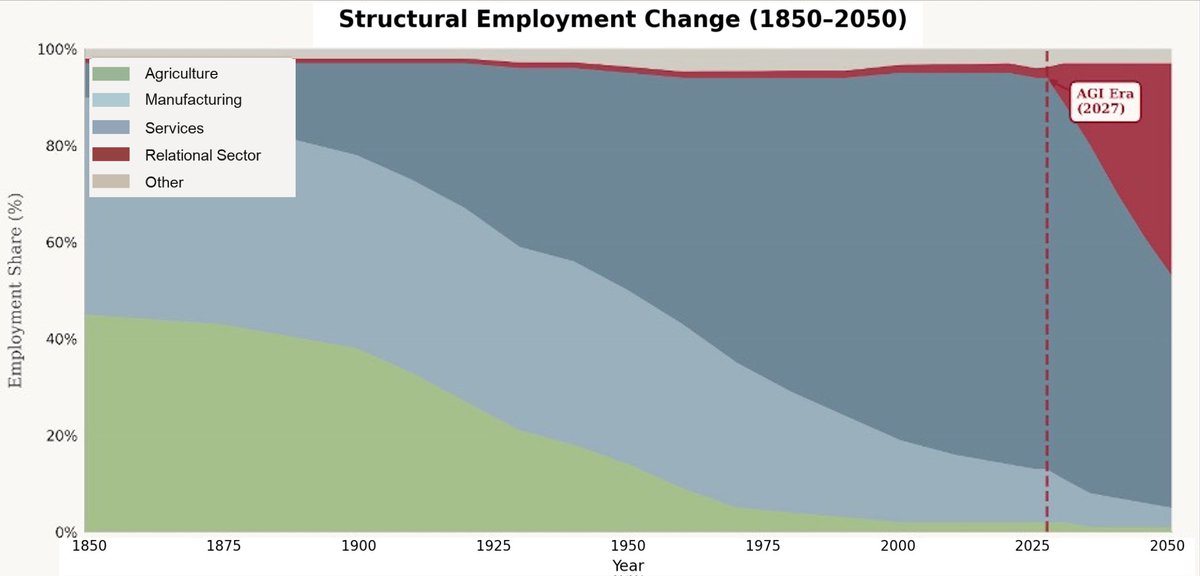
New essay on the economics of structural change and the post-commodity future of work.
1. Almost any question about the impact of advanced AI on the economy needs to start at the same place: what is still scarce? Answer that, and the analysis becomes pretty straightforward. This essay explores what becomes scarce if AI really can replicate most of what humans do in production, and what this mean for the future of jobs.
2. My conjecture, working through the economics: labor reallocates across sectors, and the sector it reallocates to has properties that keep labor a meaningful share of the economy. Ultimately this is about the structure of demand itself. For this, we have to go back to Girard, Augustine and Rousseau: once people's base needs are met, their preferences shift to comparative motives (e.g., status, exclusivity, social desirability). This motive is inherently non-satiated.
4. The key paper is Comin, Lashkari, and Mestieri (Econometrica 2021). As people get richer, they don't buy proportionally more of everything. They shift spending toward sectors with higher income elasticity. They estimate income effects account for 75%+ of observed structural change.
5. The ironic consequence: the sector that gets automated becomes a smaller share of the economy, not a larger one. Agriculture got massively more productive and its share of employment collapsed. Manufacturing too. The "stagnant" sectors absorb the spending and the jobs.
6. So the question is: which sectors have high income elasticity in a post-AGI world? I argue it's what I call the relational sector. Categories where the human isn't just an input into production, it is part of the value.
7. Why does the relational sector have high income elasticity? Because human desire has a mimetic, relational dimension. We don't just want things for their intrinsic properties. We want what others want, and we want it more when others can't have it. Girard, Rousseau, Augustine, and Hobbes all saw this.
8. In work with Kristóf Madarász, we showed this experimentally: WTP roughly doubles when a random subset of others is excluded from the good. And in new work with Graelin Mandel, AI involvement kills the premium. Human-made art gains 44% from exclusivity; AI-made art only 21%.
9. This all comes together for the core argument. The sector that absorbs spending as AI makes commodity production cheap is one where human provenance is part of the value, and demand for it grows faster than income. Exactly the profile that keeps labor meaningful.
10. To be clear about the claim: I'm NOT saying aggregate labor share must rise. It may fall. The claim is about sectoral composition, i.e., where expenditure and employment go once commodities get cheap, and the fact that the sector that will absorb reallocated labor maps to a substantial component of human preferences and desire.
11. If you're interested in the formal model, a linked companion technical note works out all the economics.
Read the essay here: https://t.co/NcjVgn2o8g
In many natural systems, there is structural prevention from mishaps but also defense mechanisms when adversities inevitably occur (externally or internally) in the system. AI safety would have to do the same, IMO, without any one organization having control over that safety.
Someone said to me today, "We need responsible AI because LLMs will be able to generate new knowledge that could be catastrophic for mankind."
Controlling the generation of knowledge is almost always a bad idea, and ...
First, regulate how that knowledge is used, which already exists in various scientific fields like gain-of-function. Second, if LLMs can generate new knowledge with lethal effects, then use them for antidotes and defenses against that lethality.
A lot of interest in modeling causality recently, but at present most approaches with LLMs still seem like a way to mimic it rather than actually approximate it.
"...taking us outside the IID setting. We no longer work with the observational distribution, but a distribution where certain variables or mechanisms have changed. This is the realm of causality."
A great article on the topic by Bernhard Schölkopf.
https://t.co/OD6A21BT8t
@anshulkundaje articulates something the AI-for-biology practitioners (or AI-for-science for that matter) need to hear more: we are far from a stage that scale alone solves biology. Deep domain expertise and principled interpretation (as opposed to cherry-picking of results) is how we actually make progress. There's too much hubris right now in assuming one can brute-force their way through biological complexity without understanding it.
It is something so small and I was just 6 years old but still remember the images of Neptune in an envelope and the values he installed in me without intention. Those basic principles of integrity are still values through which I navigate life.
This made me think about how core values are often transmitted from parent to children through quite observations rather than explicit conversations. When I was little and we didn't have a printer at home in the early 2000s, I would ask my dad to print for my projects from work.
When Charles de Gaulle led France, he treated public money as something untouchable.
At the Élysée Palace, there was a strict rule for him: no personal expense could ever be paid for by the state.
His wife, Yvonne, kept a small notebook in which she meticulously recorded all family expenses — from food and electricity to clothing and even soap.
At the end of each month, she would send a check to the state treasury, reimbursing every last cent.
Once, an accountant remarked that this was not really necessary.
She calmly replied:
“Everything that is not public is personal.
And for personal matters, we pay ourselves.”
This principle applied without exception.
Their children and grandchildren were not allowed to use official cars for private matters.
De Gaulle himself refused any privileges of office: he paid his own bills at the palace — even for the smallest things, such as soap or family meals.
Moreover, he did not use his presidential salary, living only on his military pension.
After his death, there was no wealth or luxury left behind — only a modest house in Colombey-les-Deux-Églises, purchased before the war.
It is said that he would sometimes personally send money to the treasury if he suspected that any personal expense might have accidentally been covered by the state budget.
This was not a formality.
It was a principle.
✨ An example of true integrity, honor, and responsibility in public service.
Every time I would ask, he would instead print it from the local print shop. So, I once asked him, "Why aren't you printing for free from work?" He said, "Office amenities are for employees and it would be wrong to print for you, even if no one would care."
They cloned a mouse and kept cloning. It went 58 generations before it just couldn't
"This model predicts that in asexual lineages, deleterious mutations inevitably accumulate, ultimately producing mutational meltdown and extinction."
I don't think English is spiritually bankrupt but given that longing is the most enduring theme in Urdu literature tracing its roots to the longing of the military camps where it was invented - that word is Hijr.
urdu has a word for the pain of separation that contains, within it, the assumption that reunion is cosmically possible. while english is so spiritually bankrupt it can name the ache but not imagine its end.