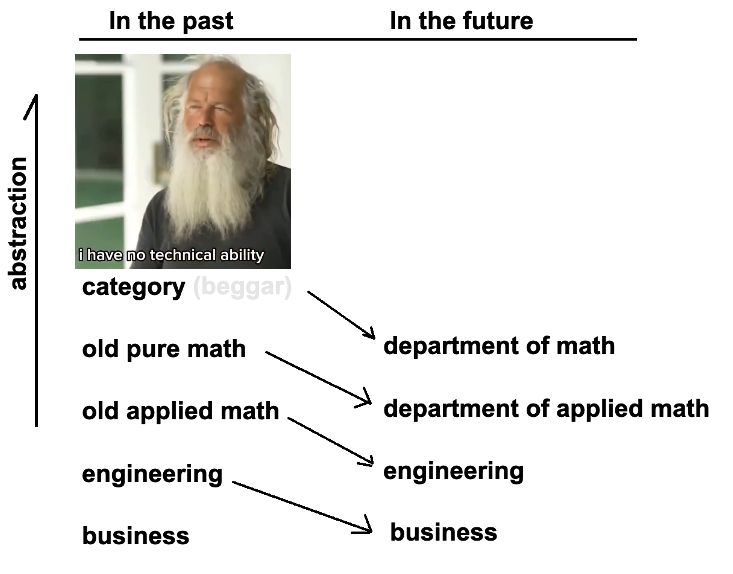
so AI is not convex hull of human knowledge but conic semigroup
That means the idea of "reachability" in control theory can "describe" what AI can do, if we can upgrade/well-define a topology of "knowledge" or "model theory"
seems fun, too bad i don't have time to dive in
The project in my eyes is "small", but this is exceptional for undergraduate level with no prior experience in optimization
I propose this project to force myself to learn Lean
I just wanted to learn/have fun
Xinyuan is a very hard working student, my pleasure to work with him
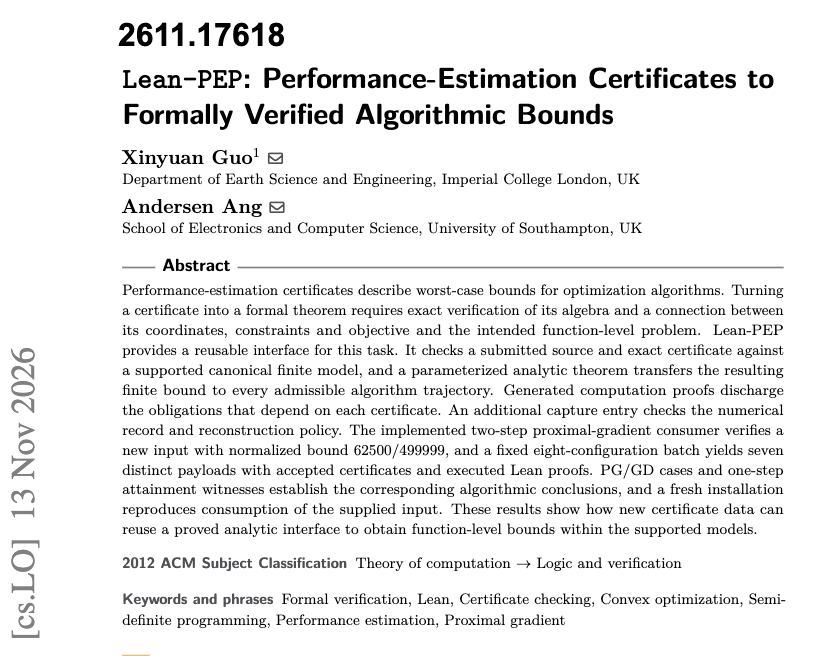
I supervised my undergrad CS year3 student (now Imperial) project to turn
PEP worst-case numerical bound for optimization algo
to Lean-verified auto-gen proof
e.g. 2-step proximal gradient
F(x)−F*≤LR² 62500/499999 Lean-verified
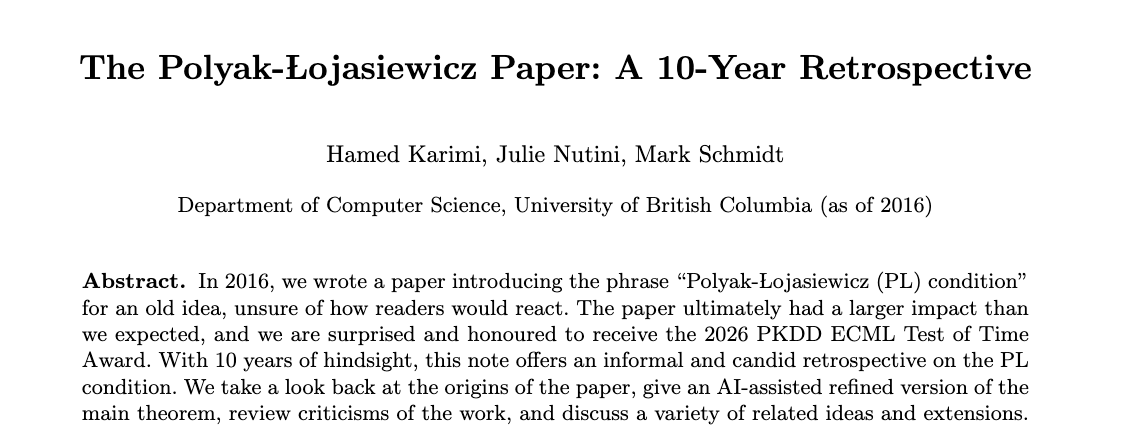
a nice and honest paper
https://t.co/9bb2DrkNYz
I am also among those who don't see why Polyak-Lojasiewicz's 'impact' and think highly-cited as "just deep learning people not knowing optimization and cite PL as monkey-see-monkey-do"
(but I did use ProxPL in my work though)
I found that Italy has "Centre for Grothendieckian Studies"
then I discovered L’inégalité de Grothendieck en bref by Hiriart-Urruty and Lassère
and later "the Grothendieck Résumé"
and then I start speaking random German ... das ungeheuerlich ist !!!!!
https://t.co/LZGmqk60S3
When x and y are independent random variables, their joint cumulative dist function (CDF) is the product of the individual CDFs:
F(x, y) - F(x)*F(y) = 0
Can uncorrelatedness (Cov(x,y) =0) also be expressed in terms of the CDFs? Yes.
This is due to the beautiful and little-known identity by Hoeffding (1940):
Cov(x,y) = ∫∫[F(x, y) - F(x)*F(y)] dxdy
It says that the difference between independence and uncorrelated-ness comes down to point-wise equality vs. a (weaker) integral equality between the CDFs.
@docmilanfar Oh my gosh this is absolutely Wonderful
Going to add this to teaching!!!
I always feel that motivating Cov(x,y) as replacing one X in E[XX] to Y is “not so natural” in teaching !
@peter_richtarik A Random spark from me:
Have you considered ellipsoid version? Very natural “next step” after ball (if the norm is Identity-weighted)
My gut feeling is there’ll be something to juice more from ellipsoidal stuff
(Didn’t read paper so my Q may hv been answered)
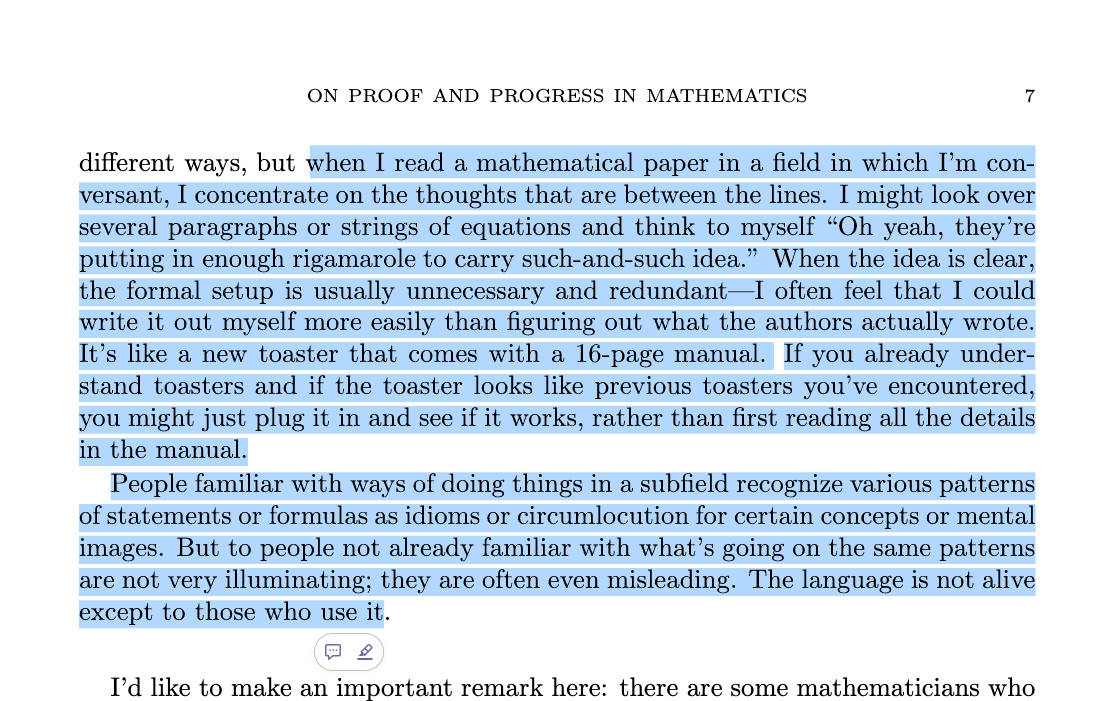
Reading Thurston.
I have the same feeling when I read a shit-ton of whatever-prefix-gradient descent-whatever-suffix in 2017-2021
good to see AI killing those trashy works ha!
@NoahChrein I don't get the hype/vibe at all
replacing the terms from algebraic geometry to vegetable biology Latin names you get the same vibe
so what's hype/vibe here I am curious
As a Belgium/Canada-trained factoriZation, tensoriZation, optimiZation researcher in UK, everyone always wanting me to spell factoriSation, tensoriSation, optimSation
How to feel the pain: Dragon Ball Z → Dragon Ball S
Finished torturing year-1 AI and Computer Engineering students on epsilon-delta and calculus. Now switched to torture year-2 students with this holy book until brain explosion.
Exciting.
so until someone can prove Faithful(T), then none shall be too comfortable about math's correctness
Well how to fix this
just do
LEAN-Verify( LEAN-Verify( LEAN-Verify( ... )))
until brain explosion in higher-order category vacuum
n/n
I don't see LEAN-verifying math too seriously now
Treating "my math is LEAN-verified" as "math is done"
cannot be more wrong
A human has an idea in natural language (NL)
Human is fuzzy, full of vagueness, so NL not fully mathematicalizable
1/n
And now important part:
"LEAN verified T(s)"
does NOT, by itself, tell you that T was faithful.
LEAN may prove the translated theorem correctly
but the translation itself can be wrong ( actually this is what people found in OpenAI's NS eqn proof )
6/n