I'm tired of armchair experts crying about "locked stablecoins" on Kaspa when they don't even know how the chains they use every day work. So here are the real numbers. $KAS
BNB has been running for over 6 years with $9.18B locked and there's still no native Tether USDT. Tether never issued it there. Binance owns the contract, holds the reserves and mints its own pegged token on a 21 validator PoS chain.
Arbitrum has been running for over 5 years and peaked at $3.46B in bridged USDT, with $1.31B in bridged USDC.e for 2 years. There's still no native USDT, it's all locked on ETH and it runs on a centralised sequencer.
Polygon has been running for over 6 years and peaked at $1.48B in bridged USDT, with $2.31B in bridged USDC.e for more than 3 years. There's still no native USDT there either and it's all locked on ETH.
Avalanche peaked at $1.98B in bridged USDC.e and $940M in bridged USDT.e, and native USDT only came after more than a year.
Every big chain ran billions on the exact same lock and mint model. Now look at Trestly on Kaspa L1.
It's the first pure PoW L1 with a native covenant stablecoin and a built in L1 DEX. It settles at 10 blocks per second and there's no centralised sequencer.
It's not controlled by one company like Binance's pegged USDT. 5 independent, known Kaspa signers secure it, so 3 of them have to sign every transfer and 4 have to agree to change the rules.
It's open source so everyone can audit its code, and you can check the 1 to 1 reserves on chain any time.
The critics can keep waiting for Tether to save them. We actually shipped it on Kaspa L1.
Do what you want with this information.
Good night, Kaspa family 🌙
One last look at what I built before bed… what a week.
The kind words from Michael Sutton and all of you mean more than I can say. I’m still taking it all in.
Thank you, from the bottom of my heart.
Good night. 🩵
#KAS#Kaspa
$10 Billion stolen from Crypt.
Not anymore.
On #Kaspa your money has rules that YOU decide. Enforced by the entire Network.
FAST. SECURE. DECENTRALIZED.
Stolen keys? No problem.
https://
https://t.co/Coi1x73WsU
aspa-vault/releases/tag/v1.0
…
I put 500 $KAS in a Kaspa account and I'm posting the key. All 24 words.
Take it if you can. You have 7 days. Share
The coin carries its own rules, and the network enforces them no matter who holds the key.
The key, the rules and every attempt, live:
https://t.co/DZJXYjSMZv
KaspaDollar whitepaper is now live! Please find it under the /whitepaper page on our website. Do note, that this is a working document that is subject to both internal and external review!
As part of this release we also want to talk about why KaspaDollar is not just a stablecoin and why $KAS is the only collateral possible. That is, in this post we want to go through some of the decisions that have been taken so far and the thinking behind them, because a few of them look strange from the outside until you see what they protect.
KaspaDollar is not a business. There is no planned revenue that will be extracted from the community and there is neither any developer fee. The deployed contracts will not have an admin key and no central form of control at all. Our goal is to design it into a self-sustaining system that inherits the properties of the base layer itself. Therefore, it should be considered a product designed for the people of $KAS, owned by $KAS miners, if anything.
Let’s backtrack a little bit to understand the motivations behind this.
Why do we want decentralization and why do we resist censorship? Because there are countless examples of centralized entities abusing their power in their own favor. When it comes to stablecoins we can see this concretely with freezes. A concrete example is when Circle blacklisted the Tornado Cash contracts in 2022, every depositor in those pools had their USDC frozen with them. In addition, Tether blacklisted more than a billion dollars of USDT in 2025 alone. One can argue that most of the cases are in line with a criminal investigation but what prevents a centralized issuer from freezing without proper cause? What is the point of a decentralized PoW if a centralized stablecoin captures the majority of the TVL. Some might argue that this is why we should just stick to $KAS. But $KAS comes with a volatility not every holder can accept. Many people want to offload profits or losses into a stable asset knowing that the value of $KSD will with near certainty equal the same value tomorrow.
Everyone in the Kaspa movement has their own reasons for being here, but we believe and hope that all of them are rooted in the core crypto ethos.
Kaspa is a PoW-backed L1 with capabilities that exceed any other PoW network, and it is PoW for a reason, because this is the consensus mechanism that has proven to be the most decentralized way of agreeing on chain.
Some people point out that mining hashrate on Kaspa, and on Bitcoin, is too concentrated in a handful of pools or miners. That is true, but the same is true of staking on PoS networks like Ethereum with one major difference. The difference is that PoW is actual hardware, an ASIC machine that took years and a tremendous amount of capital to develop that can do exactly one thing, mine $KAS.
Attacking a PoW network with hardware you bought means attacking the only income your hardware will ever have. A PoS attacker’s stake can be slashed only for misbehavior the protocol can prove, and voting a false price or censoring a transaction is not one of them. Therefore in a PoS system, the stake could simply be retargeted.
Now the reason why $KSD only uses $KAS for its collateral is to bind it to the success and health of the network. The price that $KSD runs on is voted by the miners themselves. So the only party that can attack $KSD is a large miner, and that miner would be doing it in public, against the asset that pays for its hardware. Therefore, the more of Kaspa’s economy settles in $KSD, the more an attack on $KSD is an attack on $KAS itself, and the reward would be in the very asset the attack is destroying.
Some have suggested that we should use gold or $ETH as collateral. If we did this, $KSD would actually become more likely to be attacked and exploited. With $ETH or gold the reward would be paid in an asset the attack does not impact. It would also mean that the collateral is no longer on Kaspa at all. Gold on Kaspa is only a claim on gold that is held by a custodian, and $ETH on Kaspa is a claim on $ETH secured by PoS.
$KAS is the only asset that exists natively on the base layer, with no issuer and no bridge in front of it. So ironically, through less diversification we get a stronger system, one that is closer to the security properties of $KAS itself.
However, we can also not ignore the fact that centralized issuance is needed for adoption. That is why KaspaDollar also creates the infrastructure that any future issuer on Kaspa will need, including centralized ones like @circle or @tether if they ever come. The biggest piece is the oracle itself, a price feed voted by the miners that any Kaspa protocol can read, whether it is a lending market or a DEX. Simply put, providing technical rails that are built and verified by the core team can have a very beneficial stamp of approval, which could make issuance and building on Kaspa less daunting.
Consider what Kaspa DeFi would look like if it were built on bridged stablecoins or on stablecoins that originate on an L2. A covenant on the base layer can have flawless security and still hold nothing more than a claim on money that lives somewhere else, with completely different security properties.
If the dollar inside it is bridged, its value depends on the bridge’s multisig. If the dollar comes from an L2, its value depends on that L2’s sequencer and the L2’s security. If the L2 has any form of centralized control, then the security of Kaspa’s DeFi inherits the security of an external system, that can be completely disjoint from the original sought properties.
Therefore, an important statement is that: the base layer implementation is only as secure as the weakest asset within the protocol. $KSD is the only dollar on Kaspa where both the collateral and the price are secured by the same miners that secure $KAS, and that is what makes it the foundation for Kaspa DeFi.
Happy 5th birthday Kaspa!
so young, and carrying so many hopes,
already rusty, yet smooth on your feet.
you’ve danced through crescendos, quickening (y)our beat,
then a toccata, a covenant bond --
our trust in your hands, your future in our care.
a knight drawing near, swift and hard to sway,
keeping time with the world, come what may.
whole worlds to build, and silver ink to dream them in --
im(.ag)ine all the songs still waiting to begin
NEW ✨
This setup can push $KAS upward to $0.70–$1.00, making it the best opportunity since my previous entries in 2023.
Here's why I just added more #Kaspa 👇
We're giving away a Hogwarts Legacy custom wrapped NVIDIA GeForce RTX 5090 to celebrate its official release with DLSS 5 🪄
To enter:
🟢 Share this post
🟢 Comment #RTXON
Terms and Conditions: https://t.co/45T3R732hf
🚨Crypto Review - $KAS 🚨
$KAS - Rating 94/100
2027 Price Potential - $0.089 - $0.35
Review any Altcoin 👉 https://t.co/G2iDiOdLqJ
A full overview of $KAS 🧵👇
1️⃣ Project
Rating - 10/10
@kaspaunchained is a proof-of-work blockDAG L1; no premine, no ICO.
2️⃣ Utility
Rating - 9/10
Pays network fees, mining rewards, and L2 via iKAS.
3️⃣ Team
Rating - 9/10
Co-founders Sompolinsky & Zohar co-authored the GHOST protocol.
4️⃣ Social
Rating - 10/10
$KAS is on X, Telegram, Discord and Reddit.
180,000+ watchlists on CoinGecko.
5️⃣ Tokenomics
Rating - 10/10
28.7B max supply, 96.8% circulating; no pre-mine.
6️⃣ Partnerships
Rating - 7/10
Igra Labs building EVM-compatible ZK-rollup on Kaspa.
7️⃣ Exchanges
Listed on 34 exchanges (47 markets), incl. Bybit, Kraken, KuCoin, Gate.
8️⃣ Summary
Overall Rating - 94/100
Kaspa is a fair-launched PoW blockDAG L1 with a very strong team and community.
Mid cap Layer 1 with huge upside potential if adoption and partnerships pick up. A $10B market cap would be 11x from here.
Comparison:
If $KAS reaches $SOL's market cap ($53.4B) that would be 63x from here.
$0.03 -> $1.9
9️⃣ That's it!
Reminder: you can review any coin like this at https://t.co/G2iDiOdLqJ.
What #Altcoins should I review next? 👇
@binance,
Thanks for including me in the top 100 blockchain people list, appreciate the signal!
I must decline the Dubai invite though. I do not wish to disrespect, but many of the award voters are avid kaspians who rooted for my kaspa status at least as much as for my research. Let them win or count me out.
Crypto has turned from a euphoric cypherpunk project to a house-friendly casino. You may not be the culprit, but as a top player you hold the lion’s share of the responsibility to correct this, and the October crash your USDe oracle glitch helped trigger adds to what needs to be addressed.
There are three classes of crypto, as @mert put it recently: commercial crypto, casino crypto, cypherpunk crypto. <<Binance should hold a privilege policy for the latter.>> A TBTF CEX should know better and play a different game with hardcore crypto projects.
When binance lists a green frog three weeks post its “launch” but skips a fair-launched-Nakamoto-Consensus-100ms-upgrade-ATH-top-20-the-only-nonbitcoin-marathon-mined project, this is not merely binance rationally calculating; it is also binance molding the market in a way that is alas misaligned with the roots of the movement.
You may feel that kaspa’s sovereign money thesis is boring – that bitcoin is already money and that implementing an internet-speed bitcoin is useless - fine. Wrong but fine. But what’s the thesis for the green frog?
Money is a classic chicken-and-egg product. It is a scam up until one moment before tipping point, “most of the value comes from the value that others place in it.” Considering your resources and influence, I think it's safe to say you can serve as both the egg and the chicken and make it worth your while to push sound attempts towards tipping point.
@cz_binance tweeted recently that “strong projects will be listed.” But binance is part of what defines "strong", it bears responsibility for the market’s compass and impulse and definition of strong. It is not a read-only entity.
Binance listing fees are legit, they are just unfit for category cypherpunk. Kaspa devs and early supporters fairly mined less than half what satoshi and hals mined. We don’t have a 20% ZEC-style founders’ reward or protocol-enforced dev fund; this is not a jab at ZEC and the wonderful @Zooko, who was crashing in my car on a late Thursday back in the low ZEC MC days – if somebody deserves to win it is zooko – but assuming binance is not taking a maxi bet, it should revisit its relationship with hardcore crypto.
We are here through bull and bear, ICOs NFTs XYZs; and we are the source of confidence that restores faith and capital inflow post meme-induced or CEX-induced crashes.
Please fix this.
Thanks again,
hashdag
cc @michaelsuttonil
Exhibit A: Binance Innovation Zone
Exhibit B: 10 bps Nakamoto Consensus
Kaspa community is no joke!
I officially told my team to work on a $KAS risk model.
Also wondering if I should buy some $KAS before the bull market gets out of hand.
P.S. I apologize for calling you bots in previous polls.
Bitpanda, the European crypto broker with 7.4 million registered users and an EU-wide MiCA license, offers Kaspa's KAS to its customers.
Bitvavo and Kraken also trade KAS directly against the euro.
@kaspaunchained
$KAS could be positioning itself for one of crypto’s biggest growth opportunities.
Stablecoins and tokenised money are increasingly attracting banks, institutions and billions in capital.
But here’s what caught my attention…
Kaspa is exploring its own decentralised dollar, an overcollateralised stablecoin backed by KAS.
Why is this important?
A native stablecoin could provide the missing liquidity needed to unlock lending, borrowing and DeFi across the Kaspa ecosystem.
Imagine combining Kaspa’s high-speed Proof-of-Work network with a growing stablecoin and DeFi ecosystem.
If the team can deliver, this could be a significant catalyst for $KAS.
Could Kaspa be preparing for a much bigger role in the next phase of crypto adoption?
$KASPA is building the network.
The market is still watching the price⚡️
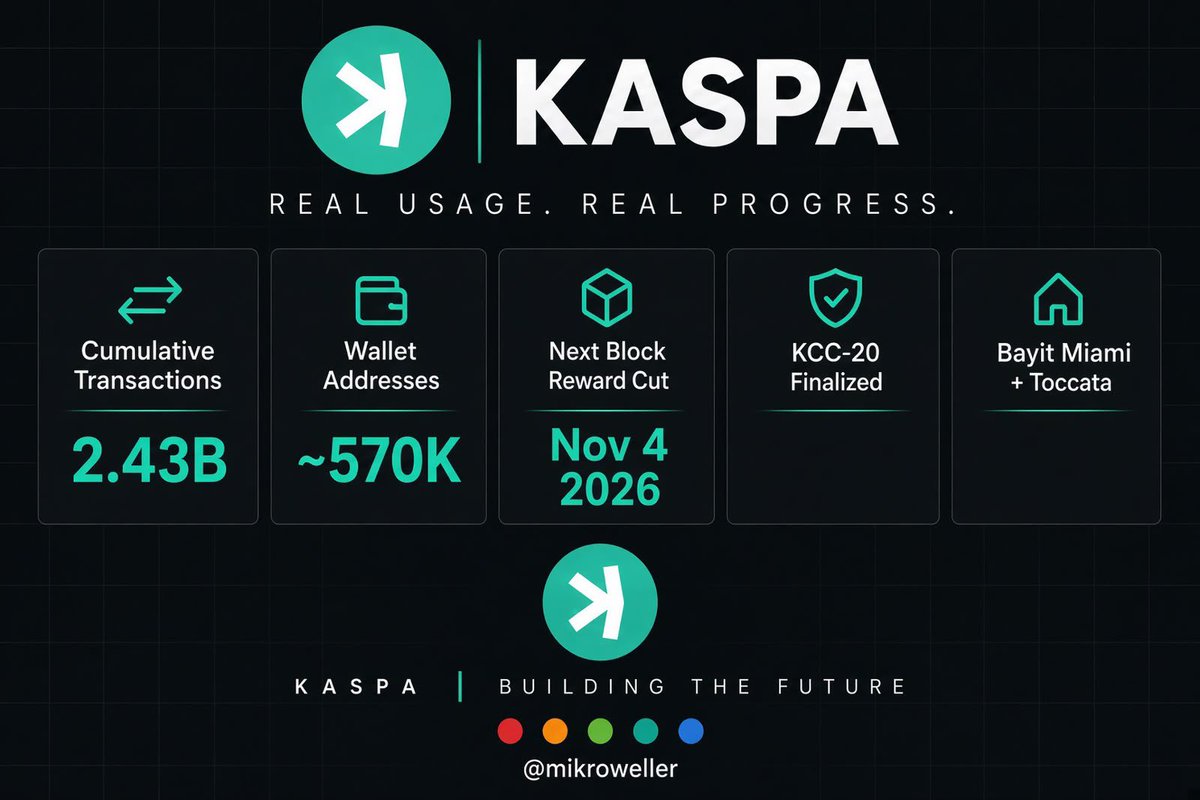
2.43 billion cumulative transactions.
570K wallets closing in, and the network keeps moving while price action stays relatively quiet.
But look beyond the chart, there’s a lot happening.
November 4: another emission cut.
The block reward drops from 2.060 to 1.945 KAS, roughly 5.6% less new supply. With around 96.8% of the maximum supply already emitted, Kaspa is getting closer to its final supply.
KCC-20 has gone final.
Covenant standards are locked in, giving builders a common format instead of leaving everyone to figure it out independently.
Covenant development is advancing.
Kaspero Labs has released a red team tool that lets developers test hostile transactions against covenant rules before deployment.
That’s the kind of infrastructure work that matters.
Real world utility is moving forward.
Bayit Development remains on track to accept KAS for two Miami townhomes, with completion targeted for 2027.
Toccata is live.
Covenants and ZK verification are moving beyond presentations and into implementation, while DAGKnight development continues in parallel.
Step back and look at the bigger picture:
Network activity. Supply mechanics. Developer infrastructure.
Real world payment experiments.
Protocol development.
All moving at the same time.
The market can stay obsessed with short term price action. I’m watching what is actually being built.
Price can go quiet.
Development doesn’t have to.
Kaspa's New Security Tool Simulates Real Attacks on Contracts
Kaspa (@kaspaunchained) $KAS ecosystem's Kaspero Labs (@KasperoLabs) has released kaspa-redteam to help developers identify weaknesses in SilverScript contracts.
Unlike basic code checks, the tool signs hostile transactions and evaluates them against rusty-kaspa consensus rules.
It reports cases where consensus accepts a transaction that an attack expected to fail.
Developers can then replay the exact transaction and investigate the vulnerability.
JUST IN: KASPA DEVELOPERS GET A TOOL THAT TESTS CONTRACTS WITH SIMULATED ATTACKS
Kaspero Labs released kaspa-redteam. It signs hostile transactions and tests them against Kaspa's network rules, flagging cases where the network accepts one an attack expected to fail. Developers can then replay the exact transaction.
$KAS