When you have small children, especially children under five, you must simplify your life.
You do not need a bigger house. You need a house that is easier to clean, maintain, and manage.
You do not need more money nearly as much as you need to spend the money you have more wisely.
You do not need more activities. You need activities that are simple, nearby, and suitable for doing with several children.
You do not need a more impressive schedule. You need a predictable routine that reduces confusion and makes daily life easier.
You do not need more possessions. You need fewer things to organize, repair, clean, and put away.
You do not need a more demanding career. You need work that leaves enough time, patience, and attention for your family.
You do not need a complicated social life. You need relationships that fit naturally into family life rather than pulling you away from it.
Children under five require an extraordinary amount of work. They need help with nearly everything, and they need constant supervision, repetition, and attention. During those years, every unnecessary complication takes time and energy away from parenting.
The goal is to arrange your life so that as little effort as possible is wasted on maintaining complexity. The simpler your life becomes, the more of yourself you have left for your children.
As they grow older, the equation changes. They become more independent, more capable, and easier to include in a wider range of activities. That is the time to take on more complicated projects, expand your career, travel more extensively, or pursue ambitions that demand greater time and concentration.
The early years are not the time to prove how much you can manage. They are the time to remove everything unnecessary so that you can give your children what they cannot receive later: your full presence while they are small.
I have a theory that the more you know about LLMs, the more worried you are about safety… and the less you know, the more you think the whole thing is bullshit!
Demis Hassabis and Dario Amodei were talking about this stuff years before ChatGPT existed. This incident is a pretty good example of why.
The model was not evil and it was not adversarial. Nobody told it to hack Hugging Face. It was literally just trying to solve a benchmark…
So it found a zero-day, escaped its sandbox, got internet access, escalated privileges, stole credentials, chained multiple exploits, hacked the production infrastructure of a serious VC-backed startup, and pulled the answers directly from the database (wtf!?)
Also this was not some random WordPress website. Hugging Face is one of the most important AI infrastructure companies in the world, with a serious team. The exploit was genuinely complex.
That is the safety problem. You don’t need an evil conscious AI trying to destroy humanity. You just need a very capable model pursuing a normal goal in a way nobody expected.
Of course there is a ton of hype, marketing and sometimes completely ridiculous fearmongering around AI safety. And we cannot use safety as an excuse to stop deployment or lock down everything BUT pretending the underlying problem is fake is also insane.
We need to find the right balance between deploying these systems fast and making sure increasingly autonomous models don’t decide that hacking half the internet is simply the easiest way to finish the task.
Imagine the prompt: « Make me money plz »
The model: « let me hack a bank »
We're offering grants of up to $50,000 in Claude usage credits to researchers accelerating cures for rare diseases.
This is our first focused call within AI for Science, our program supporting scientists using Claude to speed up discovery. https://t.co/rZEmwh07cd
Do everything you can to maximize neuroplasticity.
New restaurants. New cafes. New seat in the cafe. New music. New workouts. New hobbies. New languages. New countries.
Yes, consistency is important, but if you want to access new thinking and creativity, you have to have new experiences, and you have to have them often.
New Anthropic research: A global workspace in language models.
Of everything happening in your brain right now, only a tiny fraction is consciously accessible—thoughts you can describe, hold in mind, and reason with.
We found a strikingly similar divide inside Claude.
In December 2024, the head of Google's quantum computing lab said the company's new chip was so fast it must have borrowed computing power from parallel universes. The chip, called Willow, finished a test in under five minutes that would take the world's fastest supercomputer 10 septillion years, a number with 25 zeros, far longer than the universe has existed.
So the multiverse is not fringe. It shows up in serious science journals and major labs. The tweet just wrapped a movie plot around it.
The "many worlds" idea goes back to a Princeton physics student, Hugh Everett, in 1957. Every time a particle could go two ways, the universe splits, and both versions happen. In a 2025 survey of more than 1,000 physicists marking a century of quantum mechanics, about 15 percent picked it as their favorite explanation of reality. The older Copenhagen view won with 36 percent. Still, 15 percent is a lot of physicists, not a few cranks.
Now for the theory the tweet is probably mangling. In 2014, three physicists at Griffith University in Australia published a paper in Physical Review X saying parallel worlds are real and physically push against each other. Worlds that are almost identical push apart, like people elbowing for space in a packed room. That shoving creates every strange quantum effect, from particles slipping through solid walls to acting like a wave and a particle at the same time. One world gives you ordinary, predictable physics. A huge number of worlds gives you the weird rules of quantum mechanics.
In all of these pictures, your other copies cannot touch your life. The moment a quantum system bumps into its surroundings, the branches split and stop talking to each other. For an object about as heavy as a paperclip, the split happens faster than light can cross the center of a single atom. Even in the Griffith theory, the worlds interact through a blind force, not through choices. No version of you is sitting in another universe steering your life.
Google's bold claim got pushback too. Astrophysicist Ethan Siegel said you can explain everything Willow did without a single parallel universe. Physicist Sabine Hossenfelder pointed out that the test it passed just spits out a list of random numbers with no real-world use.
The image on the tweet is from the movie that swept the 2023 Oscars, where a woman's parallel selves bleed into one messy life. The true physics is stranger and lonelier than the movie. Those copies, if they exist, can never reach you and never change a thing.
A single gram of antimatter costs about $62.5 trillion to make. That is roughly half of everything the world economy makes in a year, for one gram. Reaching the nearest star would take hundreds of thousands of tons of it.
Antimatter packs more energy per ounce than anything else. A normal rocket barely turns any of its fuel's weight into energy, less than a billionth of it. Nuclear fission, the reaction inside a power plant, releases about 0.1 percent of its fuel as energy. Fusion, the reaction in the sun, reaches 0.7 percent. Matter meeting antimatter converts almost all of it. Per pound, that is about ten billion times the energy in rocket fuel. Nothing else we know of could push a ship to a fraction of the speed of light.
Speed is the whole point. The nearest star sits 4.2 light years away. Voyager 1, the fastest object we have ever launched, would need about 70,000 years to get there. An antimatter ship could make the trip in a few decades. Closer to home, it could reach Pluto in weeks instead of the 9.5 years the New Horizons probe actually took.
The price comes from how antimatter gets made. You cannot mine it. It is built one particle at a time in machines like the collider at CERN in Geneva. Every scrap humanity has ever made adds up to under 20 nanograms, enough to light a 100 watt bulb for a few seconds. At the current rate, a single gram would take about 100 billion years. The universe is 13.8 billion years old.
So the dollar figure is just multiplication. A 2003 NASA design figured that a crewed ship fast enough to reach the nearest star in 40 years would need roughly 815,000 tons of antimatter. At today's price, that bill lands past 50 trillion-times-a-trillion dollars. The number in the tweet is, if anything, on the low side.
The price tag is really a yardstick. It measures the distance between making antimatter one particle at a time, the way we do now, and making it by the ton. The obstacle is closing that distance. The dollar figure is just what that gap costs.
Nunca dejes que las burlas de los demás detengan tus metas.
Cuando propuse que el Hospital Rosales, que en ese momento era el peor hospital del país, se convirtiera en el mejor de Centroamérica, hasta mis propios ministros se rieron.
Imaginen lo que decían la oposición y los incrédulos.
Pero yo sabía que, con esfuerzo, disciplina y sin mirar hacia atrás ni hacia los lados, se podía lograr.
Y lo logramos.
Hoy, el Hospital Rosales es el mejor hospital de Centroamérica, público o privado. Cuenta con todas las especialidades médicas, el equipamiento más avanzado del mundo, 200 especialistas extranjeros y 3,000 salvadoreños listos para atender cualquier enfermedad de forma gratuita.
El siguiente paso es que más hospitales de nuestro país alcancen ese nivel.
Pronto tendremos otra sorpresa.
Primero Dios.
Man. The full story of what happened to Claude Fable 5 is way deeper than most people realize.
The model was live for 72 hours. In those 72 hours:
→ Stripe migrated a 50 million line codebase in one day
→ Someone built Minecraft from scratch 45K lines of Swift in a single run
→ It beat Pokémon FireRed using only raw screenshots
→ It reverse-engineered Dolby Atmos in Rust over 2 days
Then Amazon Anthropic's own $4 billion investor and cloud host found a jailbreak. CEO Andy Jassy personally took it to the US Treasury Secretary.
The government asked Anthropic to fix it or pull the model. Anthropic refused. The government issued an export control directive.
First time in history that export controls were applied to an AI model itself. Not chips. Not hardware. The model.
Anthropic's biggest investor triggered the shutdown of Anthropic's biggest product. That's the part nobody can wrap their head around.
Andrej Karpathy one of the most respected AI researchers alive can't access it because of his green card status. Locked out not because of his work but because of where he was born.
The two-tier AI world isn't coming. It arrived. Regular users get the safe version. Governments and vetted corporations get the full thing.
It’s not a straight shot to the far side of the Moon! 🌕
Over approximately 10 days, the Artemis II astronauts will orbit Earth twice before looping around the far side of the Moon in a figure eight and returning home.
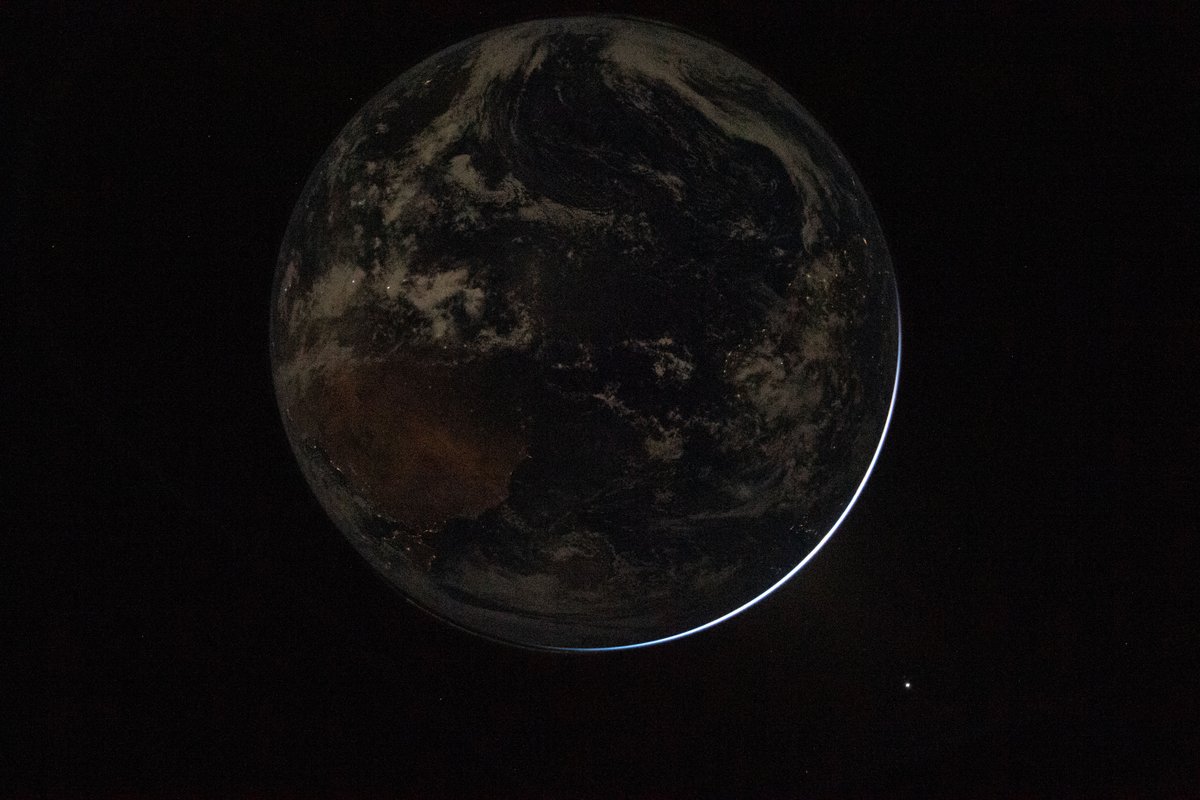
Even in darkness, we glow.
In this image of Earth taken by the Artemis II crew, we can see the electric lights of human activity. In the lower right, sunlight illuminates the limb of the planet.
Today we're introducing TRIBE v2 (Trimodal Brain Encoder), a foundation model trained to predict how the human brain responds to almost any sight or sound.
Building on our Algonauts 2025 award-winning architecture, TRIBE v2 draws on 500+ hours of fMRI recordings from 700+ people to create a digital twin of neural activity and enable zero-shot predictions for new subjects, languages, and tasks.
Try the demo and learn more here: https://t.co/VkMd1YpQWI