En el 2007 pedía prestada una PC estudiar a un familiar, en el 2010 mi madre hizo el esfuerzo de comprarme una PC que me duró muchos años, ahora tengo la oportunidad de gozar de un hermoso equipo y TODAS estas etapas tiene un factor en común. El apoyo incondicional de mi madre
basal-omni 🇵🇱 - TOP1 🤩🤩🤩 🌍 na świecie w modelach otwartych oraz TOP2 wśród zamkniętych i otwartych
Wg niezależnego benchmarku modeli system-one gdzie testowane są wszystkjie modele na świecie - JevBench (link do bencha w pierwszym wpisie). Czyli można? Można! Polskie AI 🇵🇱
basal wyprzedził model OpenAI, Microsoft oraz pierwowzór z TypeSafe (jev).
Thank you, @airesearch12 , for the independent evaluation on JevBench.
Vega Universal decision model. Now you don't need to train a separate model for each decision; you can use one engine and multiple LLMs as needed. This solves an important problem current decision models face: accuracy and calibration error. The idea is simple: you train a small projection layer and use that to attach any llm, vegaml package automatically ports that to a common dimension. That's it: joint training with invariance loss
https://t.co/HsjVaoTqTe
https://t.co/ai8SnOElQ8
https://t.co/UEdZMCbyuz
LLMs vs. Jev, clearly explained!
TL;DR
The key difference is not that Jev generates faster.
Jev does not generate text at all.
A traditional LLM receives context and produces an answer one token at a time. Even when the output is a small JSON object, every token depends on those generated before it.
Jev receives the same context but evaluates predefined decisions directly. When those decisions are independent, it can evaluate all of them in parallel.
Consider an agent handling a failed deployment. It may need to determine:
→ Whether the incident is urgent
→ Which team should handle it
→ Whether the proposed command is risky
→ Whether the task is complete
An LLM generates a response containing these answers sequentially. The application then parses and validates it.
With Jev, you define the questions and expected answer types upfront. It evaluates them together and returns typed answers with probabilities.
Jev supports three decision primitives:
1. **Choice** selects from known options, such as engineering, billing, or sales.
2. **Score** places the input on an ordered scale, such as low, medium, or high risk.
3. **Noul** evaluates a yes-or-no condition and returns the probability that it is true.
The probabilities matter as much as the selected answers.
If engineering receives 91% probability and billing receives 9%, automatic routing may be reasonable. If the probabilities are 52% and 48%, the system can escalate, gather more context, or call a stronger model.
This keeps control inside ordinary software.
Code owns the thresholds and consequences. Jev supplies the semantic judgment that a normal `if` statement cannot derive from unstructured text.
It works best when the possible answers are known, the decision depends on meaning, and a careful person could judge the input quickly.
It is not designed for writing, summarization, code generation, arithmetic, or decisions requiring several dependent reasoning steps. Independent questions can run in parallel, but decisions that depend on earlier results must remain sequential.
Jev also cannot return an option outside the declared schema, but it can still select the wrong valid option. Type safety prevents malformed outputs, not incorrect judgments.
The clean mental model is this:
LLMs generate new language when the answer space is open.
Jev evaluates known paths when the answer space is bounded.
I wrote the full breakdown explaining Jev and where it fits.
The article is quoted below.
Give Opus 5.5 𝗮 𝗰𝗹𝗶𝗰𝗸𝗮𝗯𝗹𝗲 𝗺𝗼𝘁𝗶𝗼𝗻 𝗱𝗶𝗰𝘁𝗶𝗼𝗻𝗮𝗿𝘆: 𝟭𝟮𝟬 𝗺𝗼𝘃𝗶𝗻𝗴 𝘀𝗮𝗺𝗽𝗹𝗲𝘀, each labelled with its name and a ready-made prompt. Click the ones you like, and Claude Code builds them into your video or site.
Five packs: motion graphics, camera moves and transitions, UI components, landing page and web effects, and photo looks and lighting.
Four steps:
1. Paste the line at the end into Claude Code to install the skill
2. Tell it "Open the motion-prompt library"
3. Tick the samples you like in the gallery and press "Send to AI"
4. Back in Claude Code, say "Edit the opening of this video like this"
It gets each sample's motion spec and reference code, and it works with Remotion, CSS or Canvas. Without the skill, press "Copy picks" and paste them in.
Paste this into Claude Code and it installs itself 👇
"Read https://t.co/QLB00Jm3Uf and install the motion-prompt skill in this environment. When it is installed, tell me how to use it in three lines."
👋🏼 ADIÓS A CAPCUT.
Ahora puedes convertir un vídeo largo en varios Shorts listos para publicar.
Y sí, lo hace automáticamente.
Se llama OpenShorts y es open source.
¿Lo mejor?
→ Encuentra los mejores momentos del vídeo
→ Genera clips en formato vertical
→ Añade subtítulos automáticamente
→ Prepara contenido para Shorts, TikTok y Reels
Todo dentro de una misma herramienta.
Ideal para reutilizar podcasts, entrevistas o vídeos largos sin tener que revisar y editar cada fragmento desde cero.
Repo en comentarios 👇
Ahenk'i yayınladık: açık ağırlıklı, Türkçe metinden sese (TTS) modeli.
Sayıyı, tarihi, fiyatı ve telefon numarasını doğru okuyor. "mı" ile biten sorularda sesi yükseliyor. Talimatla kızgın, neşeli ya da şaşkın konuşuyor, gülebiliyor.
Videodaki bütün sesler Ahenk'in. Sesi açın.
Left: YOLO26n fine-tuned 50 epochs on PPE data
Right: stock YOLO26n finds people, a local 27B vision model (Jev) judges each crop. Zero-shot, no training.
This is probably the future of computer vision.
built an arcade to play with the different system one providers out there
attention is all you need? here's how clef, jev and luna decide what they should pay attention too
clef find me boring... luna not
try it out at https://t.co/HSlCxjvTTg more in 🧵
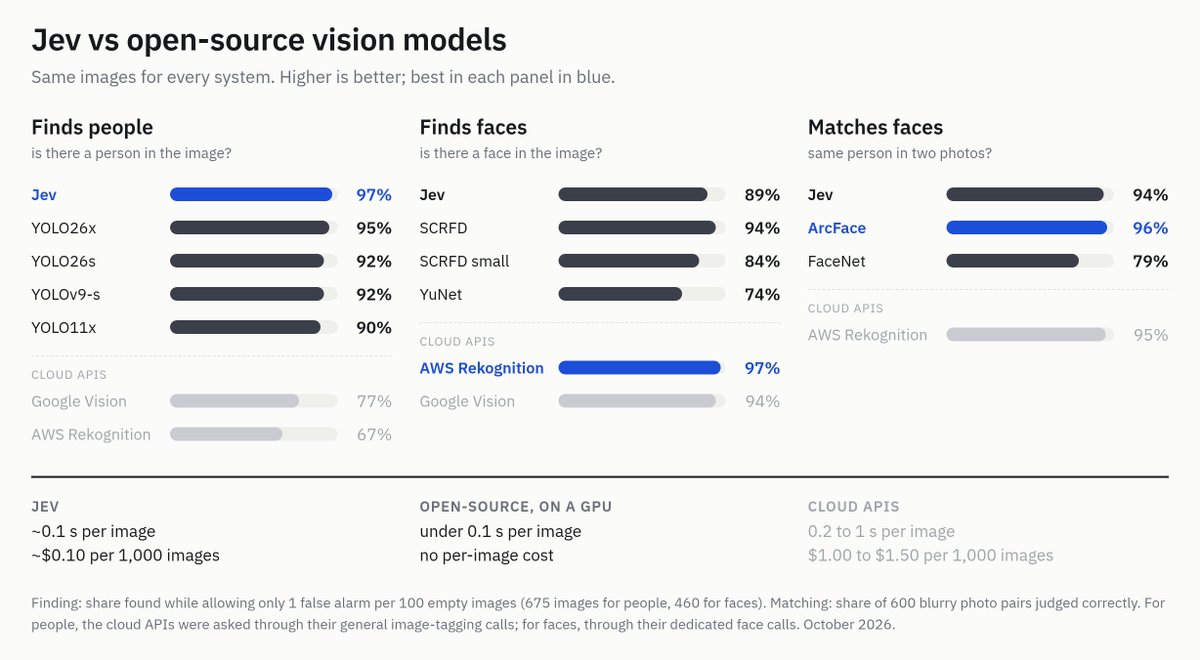
so yes, it stand very well against different vision models for people detection.
it's a bit of imperfect science, some of the tools for people detection are meant to be done on video stream, not on video frames, but the fact jev can do it on a single video frame, and with that level of accuracy for both finding people, matching their faces and recognizing known folks (i.e family members) is quite impressive.
Turn any camera into a stream of decisions.
Every second, d3-edge (0.6B) watched this rescue and answered 8 plain-English questions in ~0.1 s.
New questions, new scene: pet cam, bird feeder, doorstep. What would you ask?
https://t.co/GBVE6aUdz8
#Jev#Decision
Small decision models can be insanely good when fine-tuned.
We played with d1-omni-600M and it can destroy any model on the games + format (state, input) you train it on.
Jev’in yeni güncellemesiyle birlikte artık realtime görüntü işlemek mümkün olabiliyor.
Önceden sadece bu videoda birisi var mı yok mu diye sorabiliyorduk.