Co-founder #3: 5 Common Reasons Found in Tense Relationships Among Co-founders at Startups
Amidst the whirlwind of working under intense time pressure, resource constraints, and a multitude of daily debates that seem never-ending in the startup world, the relationships between co-founders are being challenged like never before. We comprehend that selecting a co-founder is merely the first step; the subsequent journey involves nurturing this relationship to make it enduring. Throughout this process, the dynamic between co-founders will inevitably encounter friction leading to tension. To promptly address escalating tensions, it's crucial to approach the situation with openness, accept it, and sit down to analyze the underlying causes. In today's article, I'd like to share the five primary reasons commonly found in strained co-founder relationships.
1. Power Distribution
The first reason stems from the issue of power distribution among co-founders in a startup. This is often regarded as one of the major contributors to tension between co-founders—where questions like "Who is more important? Who needs whom more?" are consistently raised. Specifically, who holds the final decision-making authority within the company? This, in turn, determines their positions as well as the level of salary, incentives, and equity they receive. If this is not established fairly and convincingly, it becomes a significant factor causing resentment, leading to a confrontational mindset. There is a tendency to undermine each other to elevate oneself, aiming to sustain and solidify their power and control within the company.
2. Lack of Care and Communication
Next, there is the issue of lacking care and communication among co-founders in a startup. The essence of this problem lies in the co-founders' desire to feel important and valued. Signs of this issue might include one co-founder feeling "excluded" in a company with multiple co-founders, and their opinions not being heard by others. Over time, as the company faces growth pressures, expands its workforce, and scales its operations, co-founders can get swept up in the overwhelming workload and the busy pace of work. This often leads them to neglect each other, forgetting to allocate time for genuine care, patient sharing, and active listening. Consequently, over time, this creates a sense of distance and growing separation among them.
3. Lack of Respect and Recognition
Furthermore, it's the issue of co-founders feeling disrespected and unrecognized within the startup. Questions revolving around this matter often linger in the midst of tensions between co-founders, such as: "Am I valued in this company? I've been working diligently since the early days, but are my contributions acknowledged and appreciated? Are you reaping all the rewards?" Personally, I've also been curious about the sentiments of the remaining co-founders when media coverage intensifies about our startup. During such times, one of the co-founders might receive much, if not all, of the media attention, while others appear less frequently or not at all. On the other hand, at the core of the startup and among its co-founders, without genuine acknowledgment of each other's contributions, conflicts and dissatisfaction are likely to emerge sooner or later.
4. Unclear Co-founder Roles
Another reason lies in the unclear distribution of roles among co-founders in the startup. One of the fundamental signs often observed is that among co-founders, there's a constant struggle over various aspects of the startup, indicating a lack of clarity in their individual roles. This can lead to all the aforementioned causes – with some doing too little or nothing, others shouldering an overwhelming load of work, some being excessively occupied, some "free-riding," some discontented, some feeling undervalued, and some no longer sensing their significance within the company.
5. Skill Disparities
Lastly, after working together for a while, co-founders might come to realize that their counterpart's skills are insufficient, leading to disappointment and a breakdown in trust. In the initial days of embarking on the startup journey, co-founders may have chosen each other due to shared vision, ideals, and startup founding goals, but over time, these attributes alone might not suffice. What they need in their co-founders is a complementary set of skills, quick problem-solving abilities, and a rapid learning mindset to acquire the necessary skills for propelling the startup forward. Especially as the startup grows a bit and the team expands, new employees also notice if the co-founders lack the expertise and persuasion required to garner their attention and collaboration. This scenario can trigger heightened sensitivity and escalate tensions.
Above are the 5 crucial reasons often found in the tense relationships among co-founders at startups. Reading up to this point, do fellow founders recognize themselves in these reasons? If so, hopefully everyone can take timely actions to preserve the initial trust-based relationships among their co-founders !
Co-founder #2: Nurturing Sustainable Co-founder Relationships
In the introductory article of the Co-founder Dilemma series, I shared about the approach to selecting a suitable co-founder for a startup. Continuing in this series, I would like to discuss nurturing a trusting and enduring co-founder relationship that drives the company's growth. This ensures that the initial right choice remains consistently right in the long run.
In most relationships, it's a common understanding that care, maintenance, and nurturing are essential for growth. I'd like to ask startup co-founders, those who are reading my article, a question: Has it been a while since you had a one-on-one conversation with your co-founder? If you just left the office and encountered your co-founder, did you approach them or alter your direction to avoid them? Are you limiting interaction and communication to the bare minimum required for your co-founder? If your answers are Yes, you might be in an unhealthy relationship, one that's highly sensitive to any conflicts or disagreements between co-founders.
Hence, co-founders should prioritize spending additional time with other co-founders, regularly going out to eat or drink, engaging in direct interactions to maintain a strong bond. Always remain open, attentive, and respectful to each other's opinions, while striving for transparent, timely information-sharing through effective communication. If any co-founder disagrees on something, don't leave the meeting until everything becomes clear, offering convincing solutions and specific follow-up actions. If the week's schedule is too hectic for meaningful interaction and effective dialogue, co-founders can plan weekend activities together, such as swimming, jogging, or hiking, fostering shared sports experiences.
In the remarkable sharing by Brian Chesky, Co-founder and CEO of Airbnb, at Stanford University recently (https://t.co/cEIGNPCveQ), I was truly impressed, especially when he discussed how he and his two co-founders nurtured a sustainable relationship over a decade while building Airbnb. Starting back in 2009, the co-founders made a pact that every Sunday, no matter how busy they were, they would meet each other. Their belief was that a co-founder relationship could only endure if based on continuous connection and communication. Among them, there was a principle that even when they argued about significant company decisions, "Winning in an argument is never more important than preserving the relationship." They believed that winning an argument alone could never lead them far, and that the true victory was in upholding their relationship.
Moreover, in reality, co-founders also need to invest time beforehand in establishing effective decision-making frameworks for important discussions between them as early as possible. Co-founders should clearly outline these frameworks and ensure that when issues arise, they can swiftly and efficiently refer to "that guidebook" to resolve problems based on their previous respect and consensus.
Above are some of my insights into the highly important challenge of nurturing a sustainable relationship built on trust and respect among co-founders in any startup. "Each tree, each flower, each startup, each scene," as each startup faces different challenges named co-founders. There won't be a one-size-fits-all solution for every startup, but there are common principles to cultivate this relationship. It's based on continuous communication, nurturing trust, transparency, and mutual respect.
@LeninUGReal Sau cú xả mạnh vừa rồi thì dự phát biểu của FED tối nay không làm ảnh hưởng đến đường giá của BTC, và BTC sẽ đi ngang để setup cho cấu trúc giá tiếp theo.
Co-founder #1: How to Choose the Right Co-founder for Your Startup
Certainly, any founder searching for a co-founder will have some basic criteria in mind: the person's skills should complement their own, they should be trustworthy and responsible, and there should be a suitable "chemistry" in terms of personality and work ethic. These are extremely important standards when selecting a co-founder. To ensure that you truly understand if the other person is the right fit, perhaps asking them the following questions could help founders to reference and apply them to some extent:
- What are the values you want to pursue in life? (For example, reputation, success, wealth, happiness, fame, creating value, social recognition?)
- In your work, what kind of person will you be? What compromises will you never make?
- How do you handle stress in both work and life?
- If you are a co-founder, what vision do you want to build for the company to aim for, as well as what kind of company culture do you want to establish?
- How much time can you dedicate to this company? (Ideally, founders should prioritize finding co-founders in the true sense, not individuals who are "hired" to receive a salary, those with a mindset of "doing extra work" or participating in "side projects" outside of their main job.)
In cases where you cannot empathize or find a shared persuasive voice from the answers of the other person to the above questions, then that individual may not be suitable for you to become a co-founder. If you haven't found a suitable person yet, you also don't need to rush to find someone just to fill the team. Being a Solo-Founder will certainly be better than making a wrong choice.
However, a Solo-founder will not succeed on their own; they need "Co-Creators" - the remarkable individuals who build the startup together with them. They might be the early employees, investors, or supportive business partners. They may not be officially recognized as "co-founders" on paper, but they can indeed provide essential resources, networks, and ideas just as crucial as the co-founders in the early stages of the startup. For instance, while we might know Jeff Bezos as the sole founder of Amazon, Shel Kaphan - Amazon's first employee who joined the company in 1994 shortly after its founding - played a critical technology role for Amazon. He's often referred to as a "forgotten founder" because he's not mentioned in the media much and didn't receive Founder's Stock, yet he's always acknowledged by Jeff Bezos as a co-creator - in fact, Bezos has shared that "he's the most important person in the history of Amazon."
Above are some of my thoughts on one of the most crucial and timeless issues in any startup: choosing co-founders. The right choice will propel the company's growth, while a wrong choice can be very costly. I will share about the next important steps to always keep the right choice RIGHT. However, as the saying goes, "rivers have bends, and people have moments," not everyone can remain a good fit forever. There will be times when someone might have to step off the startup ship earlier. In those moments, how should founders face this situation?
Check out my latest article: Build Product #3: 40 Classic Ways That Cause Market Failures for Launched Products, as Discussed by HBR
https://t.co/ZnNLOFX0i3
In today's article, as part of the Build Product series, I would like to share insights on building a Killer Feature for startups.
https://t.co/i6vGX4WZXs
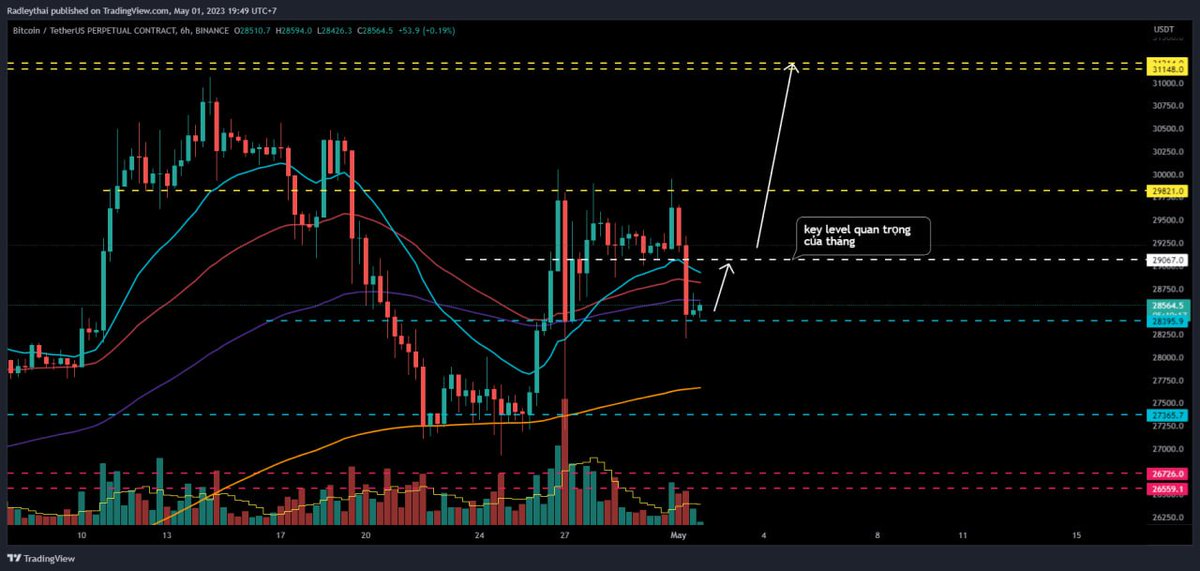
Market analysis summary for week #18:
Current support for $BTC is at 28,395. Short-term, expect a test of the key level at 29,067. If broken, the $BTC bull run may continue. Target range: 31,148 - 31,214. Plan fails if $BTC can't hold 28,395. Will update long-term analysis soon.
@miss_maria012 @prolatbuild @WhaleEverything @Pepito_Legacy What do you think about the following news this week?
1️⃣ May 2: JOLTs job opportunities
2️⃣ May 3: US ADP employment change & ISM non-manufacturing PMI
3️⃣ May 4: FED's interest rate decision, FOMC press conference - watch for #BTC impact
@Eljaboom What do you think about the following news this week?
1️⃣ May 2: JOLTs job opportunities
2️⃣ May 3: US ADP employment change & ISM non-manufacturing PMI
3️⃣ May 4: FED's interest rate decision, FOMC press conference - watch for #BTC impact
📆 Macro news this week:
1️⃣ May 1: ISM manufacturing PMI
2️⃣ May 2: JOLTs job opportunities
3️⃣ May 3: US ADP employment change & ISM non-manufacturing PMI
4️⃣ May 4: FED's interest rate decision, FOMC press conference - watch for #BTC impact. #cryptocurrency#economicnews
Digital wallets in #Web3: Secure and user-friendly tools for managing cryptocurrencies, tokens, and digital assets. Take control of your digital wealth! 💼