A commendable effort on part of both. Managing the same LAC we cannot have different concept of operations, pattern of war fighting, weapons and equipment and road maps for capability development. A positive initiative by concerned commanders to build on convergences than to continue lamenting differences. Well done Fire and Fury Corps and ITBP.
Advancing Joint Frontier Management.
The Indian Army and ITBP held a Synergy Conference at Fire & Fury Corps on 17 Nov 2026. Lt Gen Madanraj Pande, AVSM, SM, VSM and Shri Rajesh Kumar, IPS, ADG Western Command, ITBP held discussions on reinforcing border security protocols, inter-agency cohesion and unified resolve to safeguard the Nation's frontiers.
#FireAndFuryCorps
#IndianArmy
#ITBP
#Ladakh
#Jointness
#BorderSecurity
#NationFirst
@adgpi@prodefleh@NorthernComd_IA@ITBP_official@ANI@lg_ladakh
FROM THE DESK OF INDIA’S FIRST THEATRE COMMANDER
Congratulations- India has finally raised its first Integrated Theatre Command (ITC) for the Northern Borders
(This is the ASSUMPTION that I make to share my perspective on making Theatre Commands a reality).
My perspective on raising Theatre Commands (here and now) has been published in the JOURNAL OF DEFENCE STUDIES, July-September 2026 Edition, Volume:20, Issue: 3, published by Manohar Parrikar Institute of Defence Studies and Analysis.
I present a communique from the Desk of the first theatre commander of the Indian Armed Forces. It is addressed to his command and to defence and security watchers.
Through this, the Theatre Commander updates his command on the long and arduous journey to this most significant reform of the Indian Armed Forces; traces the background and the rationale for creating the ITC (structural problems sought to be addressed through creating theatre command), the raising options considered (taking Cognisance of objections related to inadequacy of resources), and why this particular raising option has been chosen. The communique gives the Interim organisational construct, Phase wise actions to be taken, to complete Phase 1 during the period 2026-2028. Salient aspects to be addressed in Phase 2 have also been identified.
To my mind, this is a 'doable option’ TODAY.
We have procrastinated for far too long. I strongly believe that the `Road to Theaterisation runs through the integration of the armed forces.’ This is inordinately delayed. Theaterisation, which I cover in this analysis, is but only `Geographic delineation of the area of operational responsibility of an Integrated formation,’ can wait – at least till Phase 2.
PLEASE READ MY PERSPECTIVE AT
https://t.co/eE3NkZQwTW
@DefenceMinIndia@HQ_IDS_India
The US midterm election results are here. There is a clear verdict against the policies and the actions of Trump led Republican administration and Congress.
Some things will change - but some will still remain the same. In this article on India - US relations I call for “Pragmatism over Sentimentalism”. It is in mutual interest.
https://t.co/jv4Nubkq4E
Recent clashes between Indian and Chinese soldiers on the LAC in Arunachal Pradesh put the spotlight back on India’s border defences and China’s continuing grey-zone tactics @adgpi@DefenceMinIndia
https://t.co/bkixuUB29r
I am afraid we are back to the same numbers debate - 29 Sqns Vs 42 Sqns. In fact,the logic of less than “authorised” 42 Sqns and reducing 17 Single service disparate commands to a fewer number ( 3/4/?) has become too repetitive.
We seem unable to think of any other rationale for theatre commands or to suggest a road map ( howsoever imperfect) to set the ball rolling.
At the macro level there are three approaches to moving towards theatre commands
a. Wait to create adequate building blocks, makeup deficiencies of major aircraft, weapons and equipment before venturing into integrated commands. ( obviously, too time consuming and would perpetuate status quo - as is happening)
b. Create theatre commands immediately and evolve/ build resources progressively (too disruptive for India’s security environment)
c. Phased and incremental reorganisation from current structures. Focus on integration and progress towards creating ITC incrementally. This approach as would be appreciated, is adequately balanced in diligence and speed.
Let us also accept that the “ Road to the Theaterisation runs through integration”. As a first step let us start “ genuinely integrating” (not the cosmetics).
What operational benefits would
accrue from Integration ( other than 17 to 3/4) ?
: Better integrated planning, having someone with institutional authority to integrate single service operational plans, to carry out cross domain ops planning visualising escalation ladders, integration of intelligence, services shaking off a sense of ownership to allow the use of scarce resources by/for other services, integration of communications and networks, integrated acquisitions and capability development, integrated development of Defence AI and critical technologies... etc
Make certain organisational changes today ( AAD, heptrs, logistics etc). The geographic delineation ( into theatres) can follow.
Let us make an implementable road map - even if spread over a decade to commence this long delayed process.
Also, while the deficiencies in squadrons need to be made up, in the interim, let us think how we can use missiles for counter air ops and advanced AD systems ( S400/500/others) for better Air defence and to take on tasks done hitherto by manned aircraft. Also augment force structure with unmanned systems.
Let all three services, MOD and others concerned realise that we are here to work together to enhance operational efficiency. Inter service acrimony is detrimental to military/national interests.
@Ptr6Vb@rwac48@IDSAIndia@HQ_IDS_India@rakesharma15@akbardalai
Lalit you left too soon. You were an inspiration and role model for many. Even in your departure you left fulfilling your passion. We pray for you to rest in peace. I am sure you will convince God to create a squash court even in heaven. Will miss you friend !!! God bless the family with fortitude and strength.
I am a member of the Norwegian Nobel Committee.
There are five of us. Five people, appointed by a parliament most of the planet could not find on a map, who decide, once a year, which human being the world has agreed to call good.
I know. I know. I think about it on the tram.
We meet in a building on Henrik Ibsens gate, a street named after a man who wrote almost exclusively about people discovering they are frauds, which nobody on the committee finds funny except me. There is a room with a long table and the portraits of the dead laureates looking down, Mandela, the Dalai Lama, a great many earnest men in spectacles, and one portrait we do not discuss, which is Kissinger, 1973, awarded while the bombs were still falling, after which two of our predecessors resigned and the satirist Tom Lehrer said political satire was now obsolete. We keep him on the wall. A reminder. Every family has the uncle.
It is October in Oslo, which means the sun gives up around four in the afternoon like a civil servant, and it rains the particular Norwegian rain that isn’t quite falling, just hanging there, judging you. I arrive with wet shoes. I always arrive with wet shoes. There is coffee, because this is Norway and there is always coffee, we drink more of it per person than almost anyone alive, and someone’s wife has sent kanelboller, the cinnamon buns, and we sit, five Norwegians, damp, caffeinated, sugared, and we decide the moral standing of the entire species.
Let me tell you how it actually works, because the world imagines a cathedral and it is, I promise you, a book club with a mandate.
287 nominations this year. 208 people, 79 organizations. Anyone can nominate, that’s the secret nobody understands: a professor, a parliamentarian, a former laureate, so the “nominee” list is meaningless, it’s a suggestion box, and every autumn some congressman nominates his own golden retriever and the press writes “SHORTLISTED.” Nobody is shortlisted. There is no short list the public ever sees. There is us, and the coffee, and the rain, and the portraits, and a Norwegian stubbornness that is older than the prize itself.
We read reports. The institute’s advisers write them, thick dull documents, and we argue. Our chairman told the BBC once that in the final meeting “there is a high temperature.” High temperature, for a Norwegian, means someone slightly raised an eyebrow and then apologized for it. We don’t do high temperature. We do a long silence, and then Kristin says “well,” and everyone knows exactly what “well” meant, and it’s settled. That’s our shouting. “Well.” You’d have to be raised here to hear the violence in it.
Now. This year. I will not say the name, because we never say the name, but you know the name.
A certain head of state wanted this prize the way a child wants a thing in a shop window, which is to say loudly, and in public, and with the full belief that wanting it was itself the argument. He said he deserved it. He said he’d ended eight wars, a number that grew most times he said it, like a fish. He had other heads of state phone us. Israel’s prime minister posted it on the internet, “Give him the Nobel.” The leaders of Cambodia and Pakistan announced they’d nominated him, as though announcing it were part of it, as though we tally mentions. A man flew around the globe collecting endorsements for a Norwegian committee the way you’d collect signatures for a petition to the council about a noisy dog.
And here, uff da, is the detail I treasure, the one that makes me smile into my coffee. The nomination deadline is the 31st of January. He took office on the 20th. So for all the phone calls, all the posts, all the gilded lobbying, the only nominations that could possibly count for this year’s prize were filed in the first eleven days of his term, before he had, by his own arithmetic, ended a single one of the eight wars. He campaigned all year for a prize whose window had shut while he was still hanging up his coat. We didn’t have to reject him. The calendar did. We just watched. Norwegians are very good at watching. We have long winters.
People think we sit there weighing his deeds. We don’t. That’s the thing I can’t make the world understand. We’re not grading his homework. We don’t owe anyone the prize for a ceasefire, however real, however loud the announcement. “He made peace” is not a sentence that ends in a medal, the way he believes it does, the way he believes every good thing ends in his name on it. The will of a dead Swede says the prize goes to whoever did the most for fraternity between nations. A dead Swede, I should add, who made his entire fortune inventing dynamite and selling arms, and spent his last years horrified at his own obituary, which called him a merchant of death, and so bought his way to immortality as a man of peace. The whole prize is one guilty arms dealer’s attempt to launder his name. We are, all of us, administering a dead man’s public relations. I find this clarifying. It keeps me humble. It should keep everyone humble, and it keeps, by my count, no one humble at all.
So who did we give it to?
An eighty-five-year-old woman. A judge. Born in Durban, under apartheid, granddaughter of a Tamil man who came to South Africa as indentured labor, a bus driver’s daughter from the poor Indian quarter, who became the first non-white woman to run a law practice in her province, who defended Mandela’s people when defending them was dangerous, who sat on the Rwanda tribunal and the court at the Hague, and who, at eighty-five, is right now a judge weighing whether a genocide is a genocide. When we told the world, our chairman said the rule of law “underpins the system we have set up to ensure peace,” and that “peace requires justice.” She wasn’t even in Oslo. She was in Nuremberg. In courtroom 600. The actual room where they tried the Nazis. You cannot stage that. God staged that, and God, it turns out, is a better satirist than any of us.
She did not phone us. She did not post. No prime minister demanded it for her on the internet. She had, as far as our deliberations are concerned, the one qualification the loud man could never manufacture, which is that she wanted the work and not the medal. The medal finds those people. It flees the ones who chase it. This is not a rule we wrote. It’s just the only pattern the hundred-odd years of our mistakes has ever shown.
The reaction from across the ocean was immediate. His spokesman posted that we “place politics over peace.” Ja. Perhaps. We’re five damp pensioners in a rainy city; of course it’s political, it was always political, it was political when we gave it to a sitting American president nine months into his first term for the promise of things he had not yet done, and we have been quietly embarrassed about that one for fifteen years, so believe me, we had a particular reason this year to prefer a woman with fifty years of verdicts behind her over a man with eight wars in front of him and a deadline already behind him.
Here is what he will never understand, the thing I’d tell him on the tram if he ever took one. We are the one prize he cannot buy, cannot post his way to, cannot have a friendly dictator phone in for him. Not because we’re incorruptible, nei, we’re as vain and wrong and human as the portraits on our wall. But because the entire point of the thing, the only power a small cold country’s book club has ever held, is that it goes to the person not performing the wanting. The moment you demand it, you’ve proven you don’t understand what it’s for, and proving that is itself the disqualification. He ran the most expensive campaign in the history of the prize and the campaign was the reason. He was never losing to Navi Pillay. He was losing to the concept.
It’s dark now. Four o’clock dark. The buns are gone. Kristin said “well” an hour ago and we all went home. I’m on the tram with my wet shoes, and somewhere across the water a very powerful man is explaining to a camera that the prize is rigged, that we’re corrupt, that he’ll win it next year, and he genuinely might, we’re only five idiots and we’ve been wrong before, Kissinger is still on the wall.
But not this year. This year an old woman in Nuremberg, in the room where the law once stared down the exact kind of man who thinks wanting a thing loudly enough should make it his, got a phone call she didn’t ask for.
That’s the job. We don’t reward the man who ends the war and announces it.
We reward the woman who spent fifty years deciding what a war was.
He’ll never see the difference. That’s rather the whole point of him.
Takk for i dag. I have to change trams.
Some great writing from @samirsaran. The argument was lucid, logical and Indian. And don’t miss the concluding lines “Some nations are still sovereign. The sky above India may be open, but the rules beneath it are written in New Delhi.”
Read More:
https://t.co/s2nCW8JczI https://t.co/s2nCW8JczI
🇮🇳 “Will connect its last village on its own terms, with partners who accept that a republic’s rules are its foundation.”
A clear-sighted & powerful essay by @samirsaran ⬇️.
Further, beyond security reviews, critical technologies require critical levels of trust. Today it’s API cut-offs, tomorrow it will be the internet. Trust has to be earned before it’s effect’s are beamed from the sky.
https://t.co/3VLCDIvBGQ
"Jakość pocisków kalibru 155 mm produkowanych przez niektóre kraje azjatyckie jest fatalna". Najciekawsze fragmenty wywiadu z dowódca 7 Brygady Artylerii „Hrehit”.
Niedawno na łamach portalu Oboronka Ukraińskiej Prawdy ukazał się wywiad z Witalijem Kornijenko, dowódcą 7 Brygady Artylerii „Hrehit” 2 Korpusu GN "Chartia". Poniżej najciekawsze fragmenty:
O zmianach w taktyce użycia artylerii w wojnie rus-ukr.
"Na początku zarówno my, jak i Rosjanie mogliśmy trzymać na pozycjach po dwie, trzy armaty. Po stronie wroga trwało to jeszcze w 2023 roku. Potem zaczęło się to zmieniać, bo wystawiasz sześć armat – a godzinę później zostaje z nich wspomnienie. Nikt już nie wychodzi na szczere pole. Dziś sprzęt po prostu nie dojechałby nawet na pozycję.
Wyjazd załogi artyleryjskiej jest przygotowywany z wyprzedzeniem. Najpierw załogi dronów przeciwlotniczych „czyszczą” niebo z wrogiego rozpoznania na miejscu. Sama pozycja to kaponiera całkowicie wkopana w ziemię, z dobrze zamaskowanymi wejściami.
(...)
Jeśli wystrzelimy z armaty sto pocisków dziennie, jest mało prawdopodobne, że przetrwa ona do wieczora. Ponieważ niebo jest pełne dronów, każdy strzał zdradza pozycję – zostanie wykryta i zaczną ją rozbijać wszelkimi możliwymi środkami.
Teraz typowe zadanie to seria do 10 strzałów. Najpierw 3–5 pocisków na wstrzelanie się, a potem ogień w cel. Co najmniej pięć pocisków, z których każdy kosztuje minimum 2000 dolarów. To daje pojęcie o kosztach."
O sposobie wykorzystywania dział samobieżnych i holowanych.
"Działa samobieżne są używane „na wezwanie” i nie zawsze będą stosowane przeciwko piechocie czy jakiemuś budynkowi. Działa holowane są już wkopane i czekają na rozkaz, mogą działać szybko.
Działa samobieżne również pracują teraz z kaponier, ale holowane nadają się do tego lepiej – są po prostu mniejsze. Do tego działa holowane są znacznie wytrzymalsze. Mogą zostać uszkodzone, ale trudno je zniszczyć – to ich zaleta."
O rodzajach amunicji 155 mm.
"Amunicja 155 mm M107 nazywana jest „krótką”. Jest masowa i tania, produkują ją wszyscy nasi sojusznicy, a nawet nasz kraj. Mamy ich wystarczająco dużo, by prowadzić wojnę. Jest celna, ale jej zasięg wynosi 14–18 km w zależności od prochu.
Jeśli chodzi o te dalekiego zasięgu, to M795 i jego zagraniczne odpowiedniki. Jest dłuższy, waży więcej i jest znacznie droższy. Przy dobrym prochu poleci na 30 km, a z gazogeneratorem dennym jeszcze dalej. Taka amunicja i prochy są dość deficytowe.
Uważam, że rezygnacja z M107 nie jest do końca dobrym pomysłem. Pociski dalekiego zasięgu szybciej zużywają lufę, dekonspirują pozycję - przy ładunku dalekiego zasięgu z lufy wylatuje taki słup ognia… Wieczorem lub wczesnym rankiem błysk widać z odległości kilometrów."
O problemach z pociskami 155 mm produkcji azjatyckiej.
"Mamy szeroki wachlarz pocisków z różnych krajów i te z państw zachodnich są w normie. Jednak ich odpowiedniki produkowane przez niektóre kraje azjatyckie [chodzi zapewne o amunicję artyleryjską z Pakistanu produkowaną przez Pakistan Ordnance Factories oraz Indii wyprodukowaną przez nieistniejące już Ordnance Factory Board - dopisek mój]... ich jakość jest szczerze mówiąc fatalna.
"Na papierze masa pocisku jest określona jako 46 kilogramów, a my ważymy go na miejscu i ma 46,9 albo 45.4 kg. A te umowne pół kilograma ma ogromny wpływ na to, dokąd on poleci.
Nie wierzymy już w standardowe tabele dla pocisków i tworzymy własne dla każdego producenta, ważymy każdą partię, sortujemy je według masy, aby różnica między „skupieniami” była mała i leciało to mniej więcej w jedno miejsce. Nie mogę pozwolić sobie na błędy, żeby pocisk poleciał 2 km w bok, gdzie siedzą nasi chłopcy z piechoty.
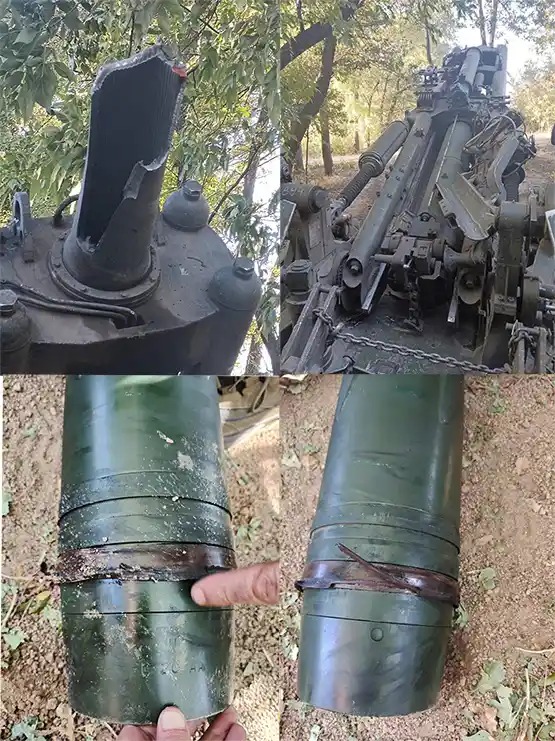
Dodam, że nasi artylerzyści na ogół boją się pocisków z jednego kraju [Chodzi o Indie albo Pakistan - dopisek mój] . Bywały przypadki, że urywały hamulec wylotowy, a nawet rozrywały lufę. A kiedy rozrywa lufę, jest bardzo źle."
Źródło: https://t.co/UiIBC1vxGp
Poniżej: Skutki użycia w haubicy holowanej M777 należącej do ZSU, wadliwych pocisków kalibru 155 mm z niewłaściwie wykonanymi pierścieniami wiodącymi. Amunicja pochodzi prawdopodobnie z Indii (produkcja Ordinance Factory Board).
What a farce! This is called total hypocrisy and a self inflicted injury.
Countries like India are faced with energy security challenge. There is a problem both with the availability of energy and its price. And these problems have been created by America only; courtesy its wars and sanctions.
Does any one in the American system realize that no one is going to be bothered about this bullying. Governments have to take care of the needs of their people and not the whims of some arrogant self appointed caretakers of the world.
If a legislation passed by a parliament cannot be implemented, it becomes a charade. So is this legislation. Americans are well within their right to harm their prestige, their image, their influence and their goodwill. Other countries are not obliged to humour them or accommodate them.
GEOPOLITICALLY FRAGILE – MILITARILY REINFORCING
During the last few days since the Mecca Accord was signed (07 Aug 2026), lot of commentary has appeared in the media, putting across various perspectives and briefly touching on implications for India.
I write a piece titled, " Makkah (Mecca) Joint Agreement: Geopolitically Fragile - Militarily Reinforcing"
The thrust is on analysing the Geopolitical aims - which so far seem ambiguous; and to focus on the real defence and security implications for India.
I hypothesise that while the Mecca Agreement may be less significant as a new `military alliance' (as some may like to project), it does provide an institutional framework for accelerating the military, defence industrial and technological capabilities of its partners.
The benefits accruing to the western neighbour should be of particular concern to us.
YOU MAY FIND SOME ASPECTS OF INTEREST WHICH HAVE PERHAPS NOT YET BEEN DISCUSSED
https://t.co/f99REqYMve