A mother dolphin in Western Australia has been carrying the body of her 2-week-old calf through an estuary.
Researchers say the behavior is believed to reflect a period of mourning that has been documented in dolphins before the mother eventually lets go to feed and survive.
$MSFT and $META will likely reaffirm or raise capex today, but it’s a Goldilocks situation. Market hates the investments right now, but they are existential to these companies long term.
@GegadyneEnergy has started commercial production for KION India Private Limited.
Multi-Ion™ packs. Built in India.
5000+ cycles. 7 year warranty. Made in India BMS and telematics.
Buying your next traction battery? Ask for Multi-Ion™
https://t.co/ConCbUnLKn
🚨23rd July 2026 - Morning
Narendra Modi announces Fast-Track courts to deal with paper leak cases & to ensure swift justice.
🚨23rd July 2026 - Afternoon
Sanjeev Mukhiya, main accused in the 2024 NEET-UG leak case gets clean chit from CBI.
#Masterstroke 😵💫
Human retinas responding to light even 10 hours after death is a remarkable scientific milestone. Beyond challenging what we know about retinal viability, it could open new possibilities for vision research, drug testing and eventually whole-eye transplantation.
https://t.co/ScsPXrPo1W
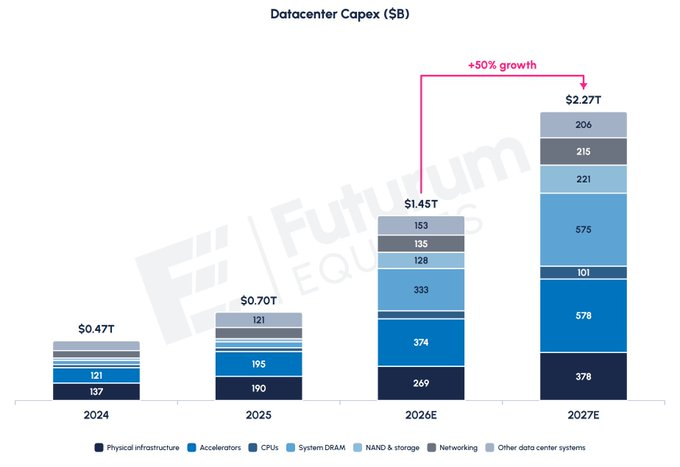
Futurum Equities expects to see 50% growth in datacenter capex in 2027 to $2.3T:
• Accelerators | 25%
• System DRAM | 25%
• Physical Infrastructure | 17%
• NAND & Storage | 10%
• Networking | 9%
• Other Data Center Systems | 9%
• CPUs | 4%
The discussion sparked by a recent statement on Passport Seva Divas has generated more heat than light.
The Ministry of External Affairs stated that a passport is a travel document, not a document of citizenship. Legally, that is correct. A passport is issued under the Passports Act, while citizenship is governed by the Citizenship Act, 1955. One law regulates the document; the other regulates the legal status.
But law and public understanding are not always the same.
For most Indians, the passport is the most authoritative document the Republic issues. It bears the name of the Republic of India, carries the holder’s identity, and is accepted around the world because foreign governments trust that India has verified the bearer’s nationality before issuing it. It is therefore entirely understandable that many people asked: if a passport is not proof of citizenship, then what is?
The answer requires some nuance.
A passport does not create citizenship. Nor is it the legal instrument that finally determines citizenship if that status is challenged before a court. Like many democracies, India distinguishes between citizenship law and passport law. In rare cases involving fraud, disputed parentage or illegal acquisition, citizenship may have to be established through the provisions of the Citizenship Act and supporting evidence. That is why a passport is not regarded in law as conclusive proof in every conceivable circumstance.
But that should not be confused with its practical significance.
A passport is issued only after the Government has satisfied itself that the applicant is entitled to one. In everyday life, and in international travel, it is the strongest evidence of Indian nationality that most citizens will ever possess. Nothing said by the MEA changes that. No immigration officer abroad will suddenly regard an Indian passport with suspicion because of a legal clarification made in New Delhi.
The episode does, however, remind us of a larger challenge.
India’s systems of civil registration developed unevenly over many decades. Millions of older Indians were born when birth registration was incomplete. Names were recorded differently across school certificates, land records and electoral rolls. The painful experience of the Assam NRC showed how documentary inconsistencies can create profound hardship when citizenship itself becomes the subject of legal scrutiny.
The lesson, therefore, is not that passports have somehow lost their value. It is that India needs stronger and more comprehensive civil registration, universal birth registration and reliable archival records so that citizenship can never become hostage to missing or inconsistent paperwork.
Sometimes a legally precise statement can create unnecessary public anxiety if it is not accompanied by explanation. A better way of putting it might have been this:
A passport is issued only after the Government has verified that the applicant is an Indian citizen. While citizenship itself is governed by the Citizenship Act, the passport remains the Republic’s most trusted document for international travel and, in ordinary life, the clearest evidence of Indian nationality.
That is both legally accurate and reassuring. The law need not be diluted, but neither should public confidence in one of the Republic’s most important documents.
To distil the argument:
A passport is issued because the Government has satisfied itself that you are an Indian citizen. It is therefore powerful evidence of citizenship in ordinary life and in international travel. But in a legal dispute over citizenship itself, the governing law remains the Citizenship Act, and a passport is not conclusive proof that overrides all other evidence
$MU expects tight memory conditions to persist beyond calendar 2027 with no clear line of sight on when supply catches up.
Micron also has $22B in customer deposits and strategic commitments while planning to return 100% of excess cash to shareholders over time.
The next era of AI will be defined by energy — how we scale it and where we get it from. Eco Wave Power, an NVIDIA Inception member, has found a solution in the sea 🌊.
Using NVIDIA Omniverse digital twins and accelerated computing, Eco Wave Power simulates wave conditions and structural behavior to reduce risk and accelerate deployment. AI is also helping them power data centers by managing compute task allocation based on predicted wave strength.
MEA needs a less clichéd and more serious script for the PM's visits abroad, one where he engages with his hosts on substantive issues, rather than his own accompanying troupe and Indians settled abroad.
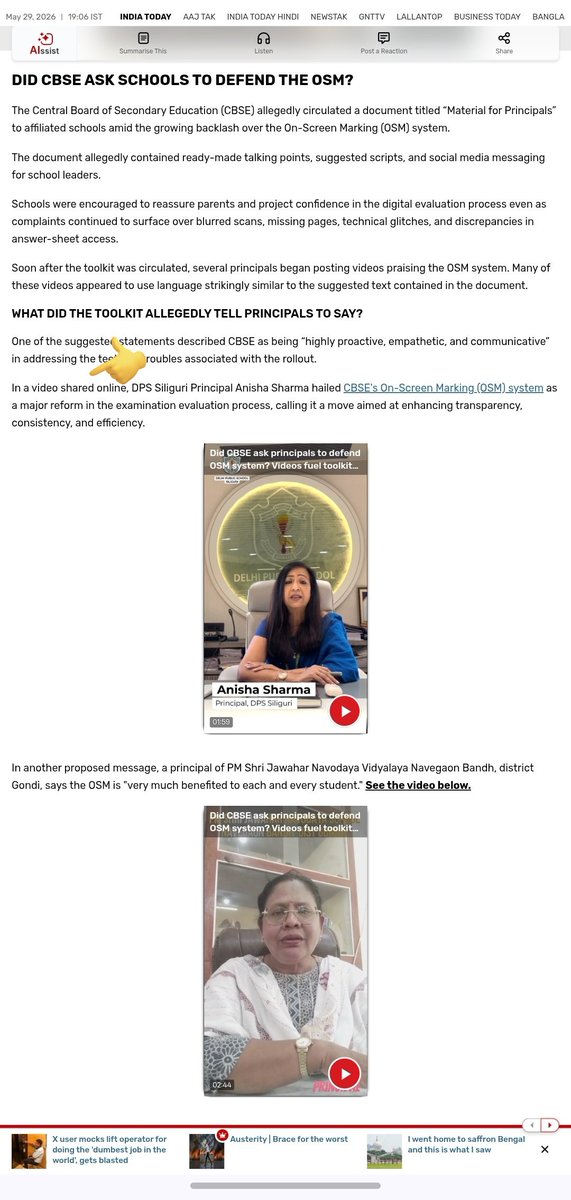
I don’t mind if people don’t credit the hard work we’ve done, because highlighting public issue is far more important. But when Pro Govt Media Channels shamelessly use someone else’s work without even basic acknowledgement, it says a lot about the ethics of both the newsroom and the people running it.
Hello @IndiaToday@aroonpurie. 👋
https://t.co/MbiYjhOZRn