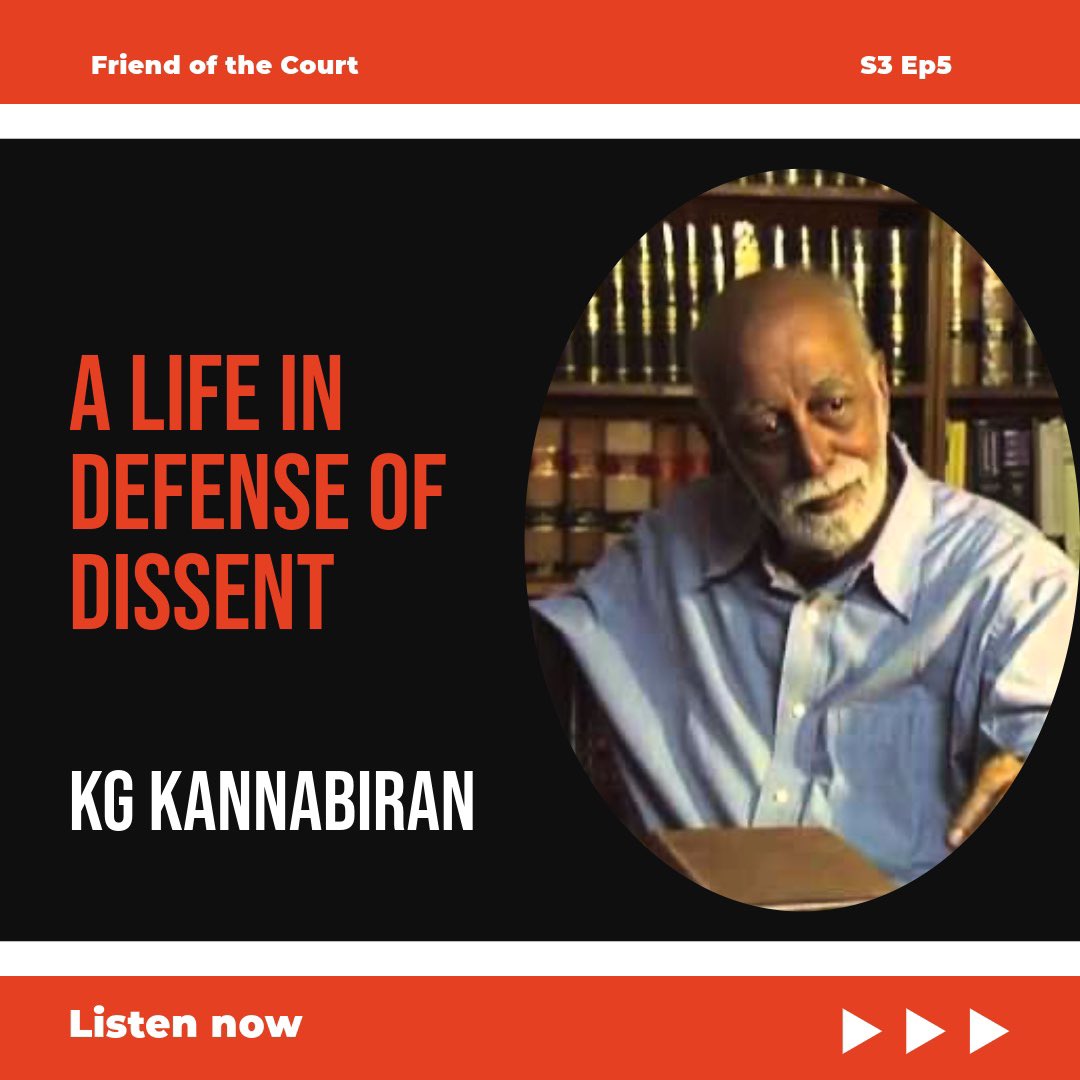
Very good episode of the excellent podcast Friend of the Court on the human rights lawyer KG Kannabiran. Great to hear @KK_Kannabiran share thoughts. A timely reminder of constitutional principles of justice, liberty and the excesses of the state. @vijayburgula
She also made important contributions to the national women's movement, the global human rights discourse, and made radical choices in her personal life. Hear all about her extraordinary life and work narrated by @supriyan, in this episode of FoTC https://t.co/Rv0WujOQHj
It is December 1946. 300-odd members of the Constituent Assembly have gathered to hammer out a constitution for a new nation. After Nehru finishes, one by one, men stand up to speak. At one point, a short, sari-clad woman, pallu thrown over her head, stands up..
One of the most prominent women in public life in the early 20th century, she is the star of our last and final episode of this season of Friend of the Court!
Mehta was a reformer, a freedom fighter, a politician, an educationist, and an Indian representative at the UN.
On April 24, 1973, the Supreme court decided India's most imp constitutional case. Happy basic structure judgement day to you, me and everyone we know! Listen to our @anildivanfound
seven part series on Kesavananda Bharati v State of Kerala here: https://t.co/LIN8iooSfP
Tune in, as @rkarnad takes us through his Sisyphean life, one spent tirelessly working to protect fundamental rights for the working poor, political dissidents and victims of state impunity. https://t.co/Rv0WujPowR
This week's episode of FoTC features a man who dedicated his life to the fight for civil liberties. Dubbed the "Naxal Lawyer", KG Kannabiran's name was synonymous with justice for hundreds of marginalised prisoners. https://t.co/Rv0WujPowR
2/6 Our latest episode is about the first, and one of the most important dissents in our history. In April 1950, the Supreme Court was asked to decide on its first major case involving fundamental rights. By then, the court and the constitution were barely a few months old.
🎙️#newepisode
1/6 History isn't always written through majority judgements. Sometimes the story of a nation unfolds in a more unlikely place: dissenting judgements. https://t.co/Rv0WujOQHj
5/6 His opinion would end up shaping our civil liberties in the decades to come. Tune in to this week's episode of FoTC that uncovers the life and story of the man behind this far-sighted dissent, a man who influenced the way we now enjoy our fundamental rights.
Our constitution is among the few and perhaps the only illustrated one of its kind. In the Friend of the Court podcast, Raghu Karnad as well as Siva Kumar and Naman Ahuja “explore how the constitution came to be illustrated,
1/
https://t.co/MxzZ2LqWvZ
Listen to our latest episode to find out more on this puzzling incident, and the story of the violent revolutionary turned Communist turned Congressman, who has been mostly forgotten today. https://t.co/Rv0WujOQHj
The charter went on to influence our fundamental rights. Though the Karachi charter was credited to Nehru, British intelligence strongly believed MN Roy had a hand in it. That places him at the core of a historical mystery: did he help shape the fundamental rights we enjoy today?