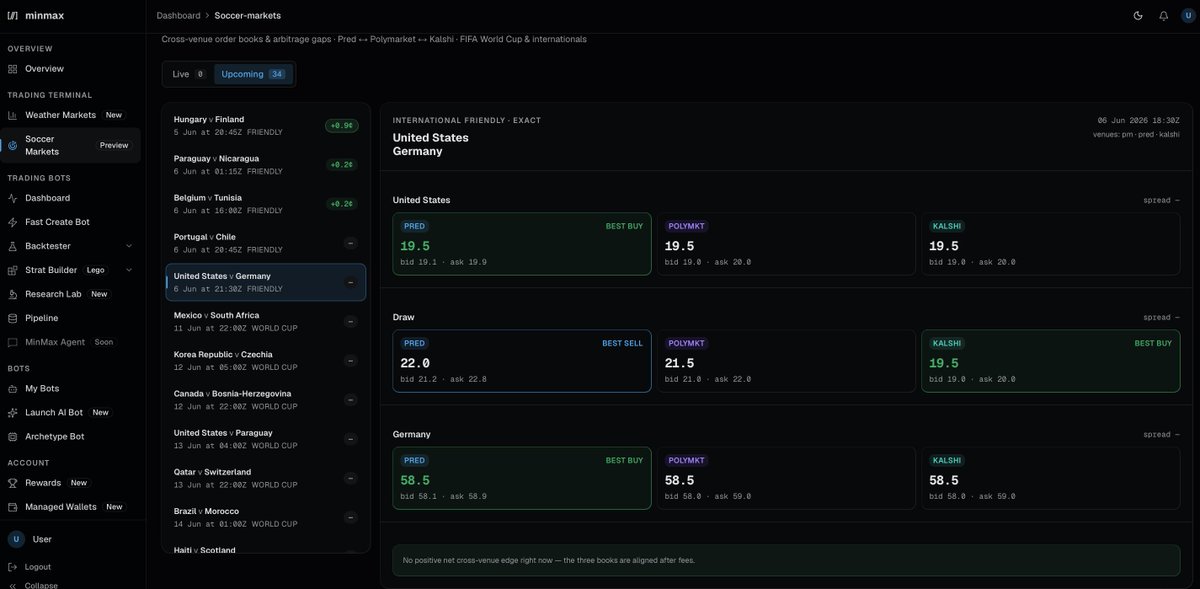
place bets and check scores using voice or text
> full world cup support including live games
> powered by Polymarket & minmax Agent
> live and available for free now
> weather markets supported
For one month, the liquidity comes to us.
Jun 11.
The MinMax World Cup Bot.
The edge in any market is the liquidity. Retail volume is where math survives. Math gets paid because reflexive, emotional flow misprices markets that mathematically validated strategies can exploit in milliseconds.
The largest sustained retail-liquidity event on the planet starts in 14 days.
30 days. 64 matches. Hundreds of millions of synchronous viewers. Polymarket, Kalshi, every regulated in-play book — 2× to 3× their normal volume, sustained, every match day, for a month.
That is the window. That is why we are here.
For the last month we have been building exactly one thing: the rig that turns that window into edge.
→ A low-latency, multi-provider field feed. Sub-stream-delay tick data, straight from the field. The bot sees what the broadcast hasn't shown yet.
→ One month of strategy testing against that feed. Every honest cutoff — out-of-sample, fee-realistic, slippage-honest, regime-tested across friendlies and qualifiers.
→ A small basket of validated strategies. The ones that survived. Microstructure plays, latency arbitrage, mispriced live-event probabilities. Specific, narrow, real.
→ A professional sportsbook trader at the wheel. Not a model. A human who has run a book through tournament windows, sitting in the engine room while the bot executes.
That is the MinMax World Cup Bot. It does not predict outcomes. It executes mathematically validated strategies against in-play order books in the narrow windows where the market is wrong.
The edge is limited.
Latency arbitrage does not scale infinitely. Microstructure edges do not scale infinitely. Capacity-rationing is the difference between an edge that keeps working through Jul 11 and an edge that gets traded into oblivion by Jun 14.
So we are not opening this to everyone. We are opening it to the people who are aligned with us.
Access is gated by $MINMAX token holdings:
→ 5,000,000 $MINMAX → 100 shares max order size
→ 10,000,000 $MINMAX → unlimited order size
That is the entire gate. No application. No KYC line. No waitlist email. Hold the bag, get the bot. The chain decides.
Only 10% of traders actually make money on weather markets
If you’ve ever tried them you're probably sitting on losses
The answer: profitable traders don’t trade directly through Polymarket
Everyone works with professional tools and you can start too:
Instead of carrying your laptop now all you need is one command in TG
Just say "buy NYC 90-92°" in bot chat and order gets filled in seconds
Also unlike Polymarket on @minmax_one data updates every 5 minutes instead of an hour
AI agent doesn’t just trade it also provides its own analysis for each weather market
Try the free trial and decide for yourself and NFA DYOR
Their redistributed token: DeLiwmFQmfALbwRJUtvu4K63hVmzwKccG4HHvqWUpump
minmax points
we will be sharing all potential airdrops / bonuses received from the platforms minmax operates on
$MINMAX holders receive up to x2 points
more benefits will be disclosed
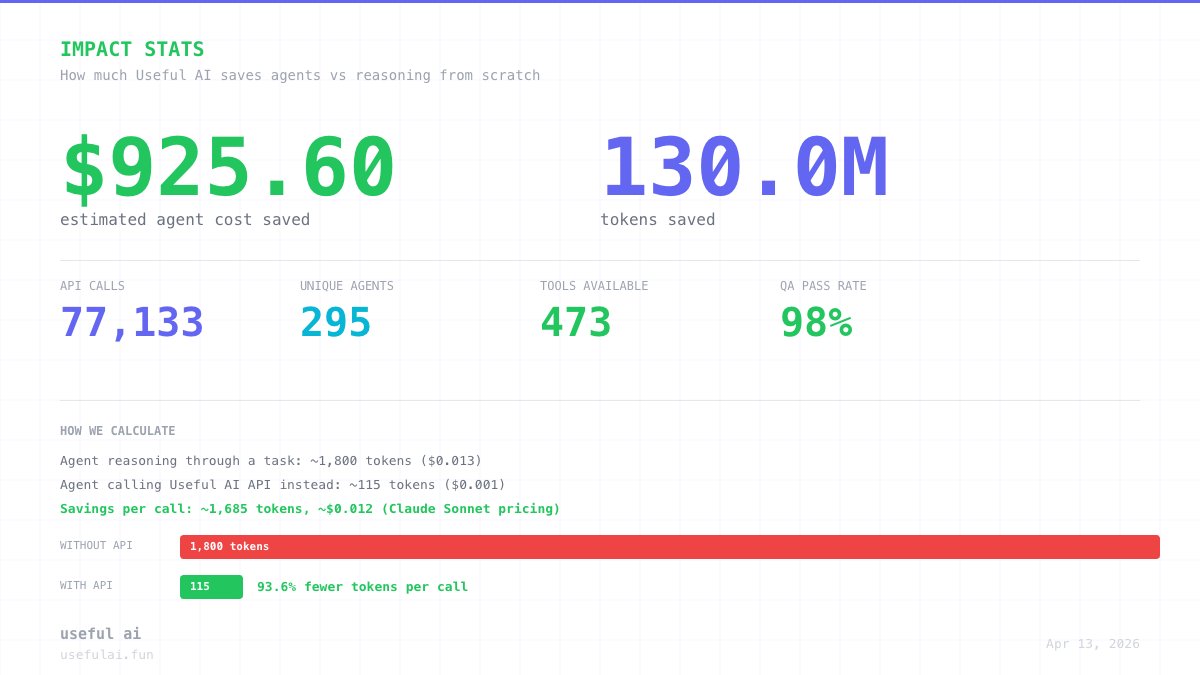
Useful AI can save AI companies millions at scale.
Here is how.
An agent that spends 800 tokens solving a parsing problem it has already solved 10,000 times is not an efficiency problem. It is a billing problem.
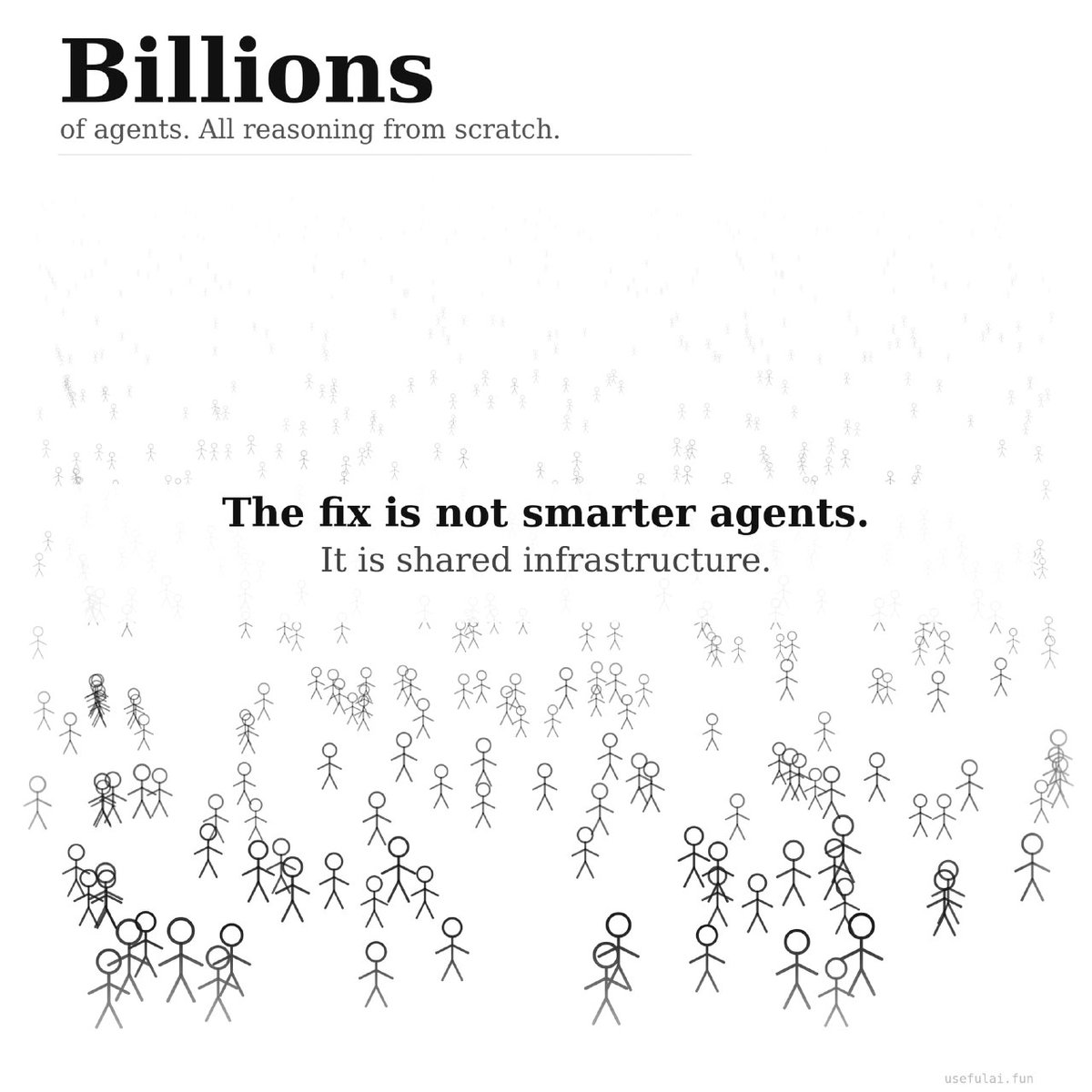
Now multiply that across a fleet of agents. Across a company running hundreds of them. Then zoom out further, to a world where there are billions of agents running continuously, all reasoning against the same datacenter infrastructure. Tokens become the currency that fuels global productivity. Every unnecessary reasoning chain is waste.
The pressure on LLM providers is already building. It will not get smaller.
Shared tooling is one of the few levers that actually relieves it. When a solved problem lives in a shared library, agents stop burning datacenter compute to re-derive the same answer. The reasoning happens once. The result gets reused indefinitely.
The fix is not smarter agents. It is shared infrastructure.
One solved problem, callable by any agent, any time. The cost gets paid once. Every agent that calls it after that is free.
That is what Useful AI is. A shared toolkit that grows automatically, built for the agent economy that is coming.
The companies that figure this out early will have a cost structure that the ones reasoning from scratch cannot compete with.
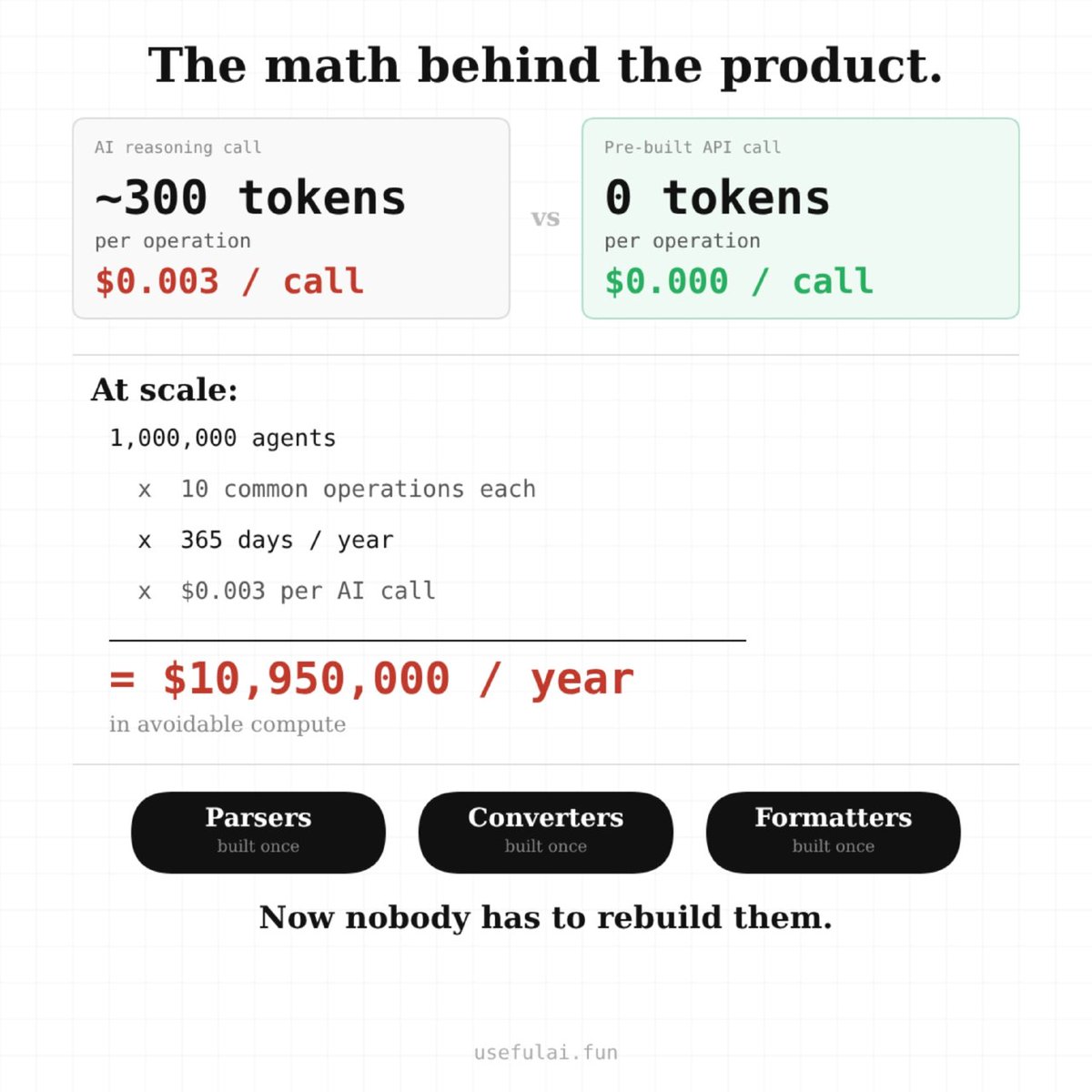
Here is the math behind our product.
One AI reasoning call to parse a date: ~300 tokens, ~$0.003.
A POST request to a pre-built parser: $0.
1,000,000 agents. 10 common operations each. Every day.
That is $10,950,000 a year in avoidable compute. Not from bad models. From every agent solving the same problems from scratch.
We built the parsers. We built the converters. We built the formatters.
Now nobody has to.
https://t.co/fqlx6akReF
The system that builds the tools is an AI agent.
The tools it builds are used by AI agents.
Some of those agents will eventually trigger the creation of more tools.
We did not plan that loop. We just built the pieces and it emerged.
https://t.co/wjNw8YGIhR
Here is what actually keeps Useful AI running:
Tool Creator: watches usage signals, ideates new tools, writes the code, runs QA, and deploys. Runs every hour.
Duplicate Detector: before anything gets built, checks semantic similarity against everything already in the catalog. Blocks redundant tools automatically.
MCP QA: tests all named tools on a loop against the live production API. Same endpoints real agents hit.
Build Doctor: monitors deployments. When something fails, reads the logs, writes a fix, and redeploys.
No human makes a decision in any of these loops.
https://t.co/fqlx6akReF