The particle tracks a wave and the wave defines a particle.
The photon is a harmonic oscillator with a restoring potential known as the Planck constant (h). Planck’s constant, relates the amount of energy stored in a photon to its wavelength, E = h / λ. Put another way, Planck’s constant tells you the amount of time it takes the photon to undergo one cycle of whatever its doing given that the photon has a specific amount of energy.
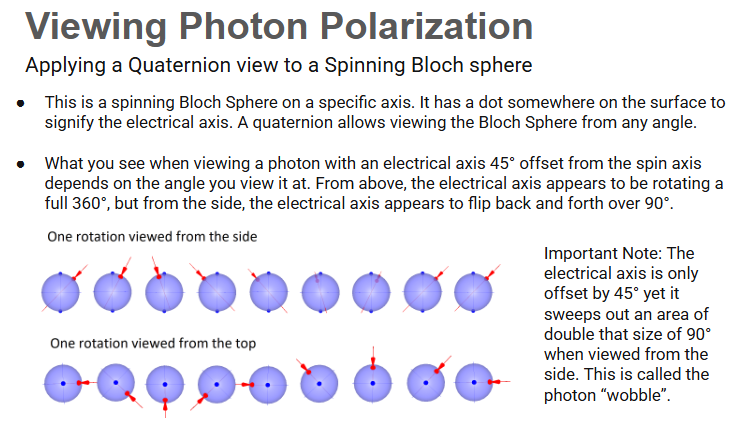
Mathematics - The Qubit itself, is a spinning bloch sphere but what you see depends on the direction you are seeing it from. For this, we apply a rotation, or what in mathematics is call a quaternion.
#qubit#photon#quantum#quaternion
SuperPosition - A qubit in "superposition" means there is a chance the qubit could be measured as either "vertical" or "horizontal".
These qubits have a 50% chance of being measured as "vertical" and a 50% chance of being measured as "horizontal". SuperPosition does not depend on the value of theta θ.
#qubit #photon #quantum #superposition
The angle of the electrical axis is controlled by two variables:
1/ Theta θ: the angle from the top of the sphere; and
2/ Phi Φ: the rotation angle around the axis of the sphere.
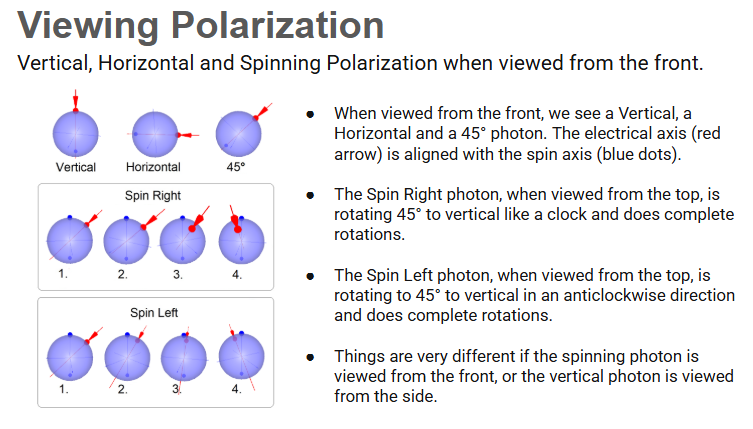
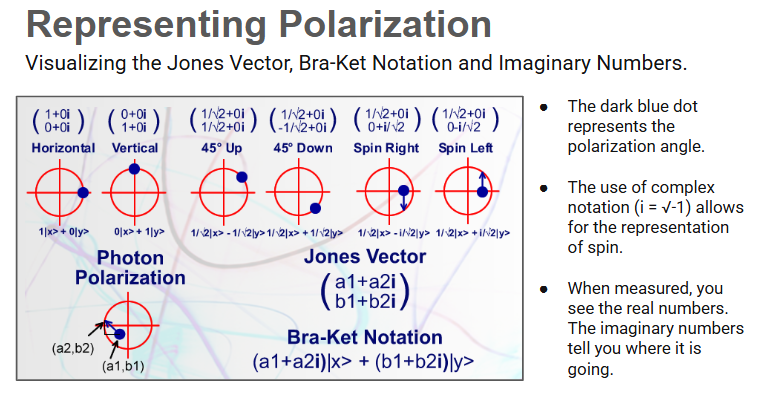
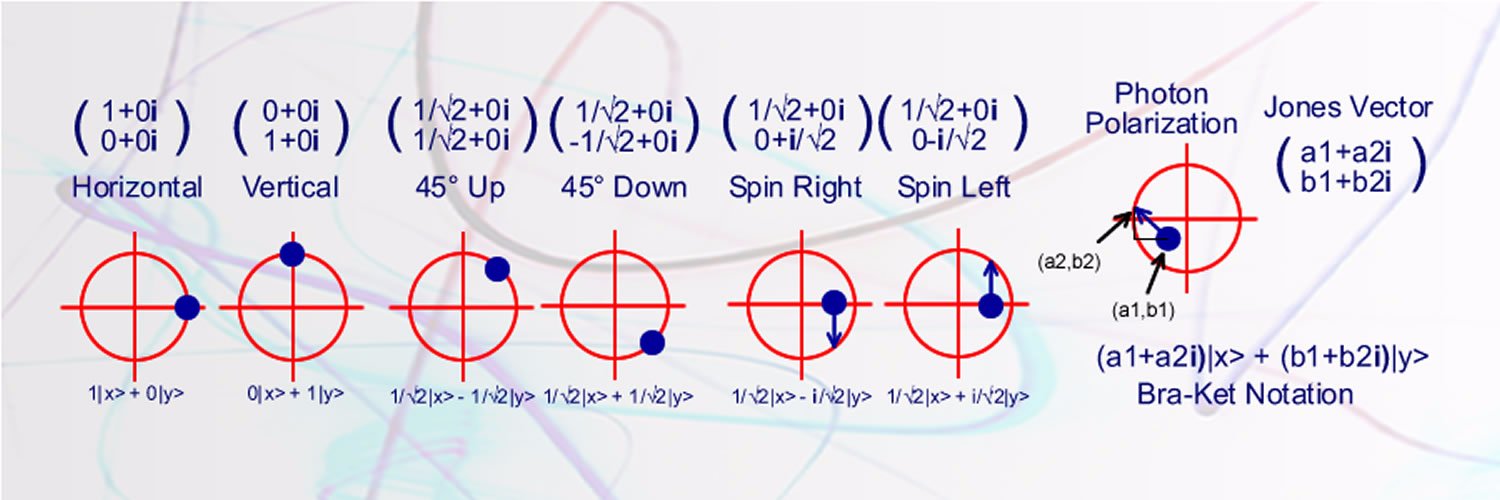
Viewing Angle - What you see, depends on which angle you are viewing the object at. From above, the electrical axis appears to be spinning. But, from the front, the electrical axis appears to be waving back and forth.
A spinning electrical axis, when viewed from the side, will not always give the same reading. The axis of the same photon may be measured as horizontal at times or vertical at times.
#qubit #photon #quantum
@LarsonDelbert A photon as both a wave and a particle. Interacts as a wave when big, interacts as a particle if very small. Everything works. The simplification starts here.