Yeh ladka bahut talented hai.
Kya woh abhi bhi Nainital ki sadkon par kaam kar raha hai?
Main na sirf uski padhai mein madad karna chahta hoon, balki jaadu mein uski dilchaspi ko bhi badhava dena chahta hoon.
Kyon na woh duniya ke behtareen jaadugaron mein se ek bane?
Kya koi mujhe usse aur uske mata-pita se sampark karne mein madad kar sakta hai?
(Video: courtesy @Murti_Nain )
Every single one of the points are a real problem.
But your understanding is broken, let me explain. :)
Norway has 55 lakh people. Total. That’s smaller than the population of Pune. Their entire country has fewer citizens than India’s 25 smallest cities individually. Norway also has 1.2 trillion dollars in sovereign wealth from oil reserves, accumulated over 50 years.
They have $250,000 per citizen sitting in the fund. India has roughly $3,400 per citizen in forex reserves.
Norway is what you get when a small population sits on top of one of the largest per-capita oil discoveries in human history.
The right comparison is other low-income, high-population, post-colonial democracies. Brazil. Indonesia. Nigeria. Bangladesh. Pakistan. Egypt. Mexico. South Africa. Vietnam. Philippines.
Compare on these and India isn’t doing badly. It’s doing better than most.
UPI is the world’s largest real-time payments system.
Aadhaar is the world’s largest biometric identity system.
We absorbed the global pandemic, the Ukraine war, the West Asia conflict, Trump’s tariffs, the Iran war, and a rupee fall without going into recession.
Most of those countries above did. Pakistan went to the IMF 24 times. Sri Lanka collapsed. Bangladesh is unstable. Egypt needed emergency Gulf bailouts. Argentina has 60% inflation. We stayed standing.
India is the only country in human history to add a trillion dollars of GDP every 18 months. We added our first trillion in 2007. Our second in 2017. Our third in 2024. Our fourth coming in 2026.
The problems you mentioned exist in every large, low-income, high-density country on earth.
Mexico City’s pollution is worse than Delhi’s.
Manila’s traffic is worse than Mumbai’s.
Lagos has worse road quality than Delhi.
Jakarta has worse air than Delhi.
Cairo has worse adulteration.
Karachi has more corruption.
Hanoi has higher pollution.
None of these countries are run by Modi. They’re all dealing with the same impossible math.
Industrialising a country of 145 crore people during a global energy transition, with limited natural resources, while keeping democracy intact, is the single hardest governance challenge in human history.
> China did it without democracy.
> South Korea did it with a population one-tenth our size.
> Japan did it with no major religious or linguistic diversity.
> Singapore did it with 50 lakh people total.
Nobody has done it at India’s scale, with our diversity, in democratic conditions.
So when someone asks “why hasn’t Modi built one city like Norway,” the answer is because building one Norway requires not having 144.5 crore other Indians to look after.
Why is the NEET paper not set by AIIMS and instead set by a random assortment of civilians?
I thought the JEE was an amazing benchmark and conducting exams at India scale was a solved replicable problem. Computer based, random order, set by tenured profs at an IIT.
@fooobar What do you personally do? I too live in Bangalore. We in fact met last year at Encore. I find myself getting extremely sweaty after cycling through the subtle elevation changes, my back especially due to the backpack.
In Tamil Nadu, the BJP being in power at the centre has been used by essentially all the parties to demonize them. The DMK made "attack Modi" as their only plank. EdappadiDMK (that is the correct name) would have done the same thing if the Congress had switched over to them. In Tamil, we call this பூச்சாண்டி காட்டுதல் - like my grandmother would tell me as a kid "that tree next to the pond has a ghost that will catch you, so don't go near it" to keep me away from swimming in the pond! Modi is their favorite பூச்சாண்டி.
So when someone parrots the line "we want to keep the BJP out of Tamil Nadu", they are saying "we don't want competition for our cozy duopoly", not some deep principle. The BJP has been in alliance in AP and Pondicherry and those states are doing fine, they are making excellent progress. Yet TN is supposedly "different".
The "difference" was the BJP getting into alliance with these same parties (EDMK or DMK) that want to openly or secretly suppress them in TN.
What is the way ahead? Find good youthful passionate leadership that are willing to fight the good fight long term. Focus on building up the party from the grassroots. Ignore all the பூச்சாண்டி business. Do not align with anyone who claims "TN is different". TN is Bharat. We have to fight this subterranean separatism.
Annamalai was making progress but he needed a lot more time. He was creating a genuine political movement, he invited youth to be active in politics and he had massive engagement.
I would have volunteered for this assignment too (I love building up from zero!) but I am neck deep in tech and Bharat needs deep tech. So not in this life time. To be very clear, I will state my political views (my right to free speech) but I will not be in active politics.
I hope all our educated citizens do engage in this political debate and express their opinions, but let us all do it RESPECTFULLY.
Every crisis has a way of revealing something larger than an immediate fix.
Sometimes the real breakthrough is not managing the crisis better but outgrowing the dependency that caused it in the first place.
As someone once said: “The best solutions don’t just solve problems. They dissolve them.”
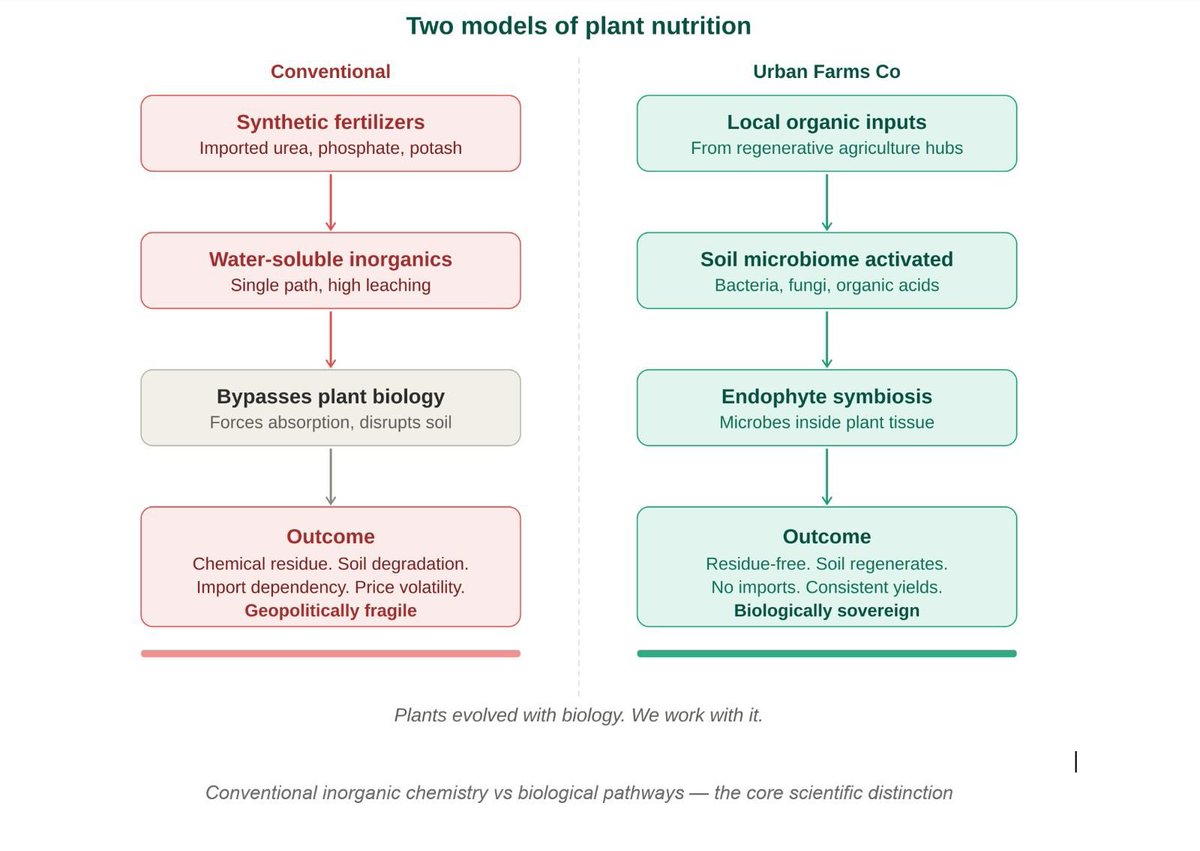
Right now, global fertilizer supply chains are under strain because of the blockage in the Strait of Hormuz. Urea prices are reportedly up sharply. Phosphate supplies are tightening.
And yet, in the middle of all this, about 2,000 Indian farmers have just completed another full season with zero synthetic inputs. Normal yields. Lower costs.
Not a pilot project. Not a theory. They’ve been doing this since 2019.
What struck me most is that 80–90% of the farmers return every season, not out of loyalty to a movement, but because the economics work.
Yields comparable to conventional farming. Lower input costs. And produce that tests residue-free every single time.
A working model. Built right here in India.
This video by @UFCo_India captures a remarkable agricultural breakthrough built on over two decades of work by @naandi_india , the same organisation that first helped create the @arakucoffeein story in Andhra Pradesh.
After seeing the success of regenerative farming with Araku Coffee, Naandi Foundation, which I’m privileged to chair, spun off Urban Farms Co. as a social enterprise with an ambitious goal: to create a nationwide “food grid” of regenerative vegetable farms serving urban India.
Today, Urban Farms Co. & its partner farmers have demonstrated that food can be grown at scale without urea, synthetic fertilisers or pesticides.
They now grow more than 50 varieties of vegetables across states ranging from Himachal Pradesh to Karnataka, Telangana, Maharashtra, Rajasthan & Chhattisgarh, supplying nearly 10,500 tonnes of vegetables per year.
And this is not confined to company-owned farms. Over 1,200 partner farmers are generating sustained profits through regenerative, residue-free agriculture.
Available currently in Delhi NCR, Chandigarh, Mumbai, Pune. On Blinkit as well.
The future of food may not run on imported chemistry.
It may well run on healthier soil, better science & farmer economics that actually work.
Bravo to Vikash, Raheel and Madhur, who are leading this mission at Urban Farms Co. & who took on the challenge of @manoj_naandi to prove that regenerative agriculture can move beyond philanthropy and become truly market-ready.