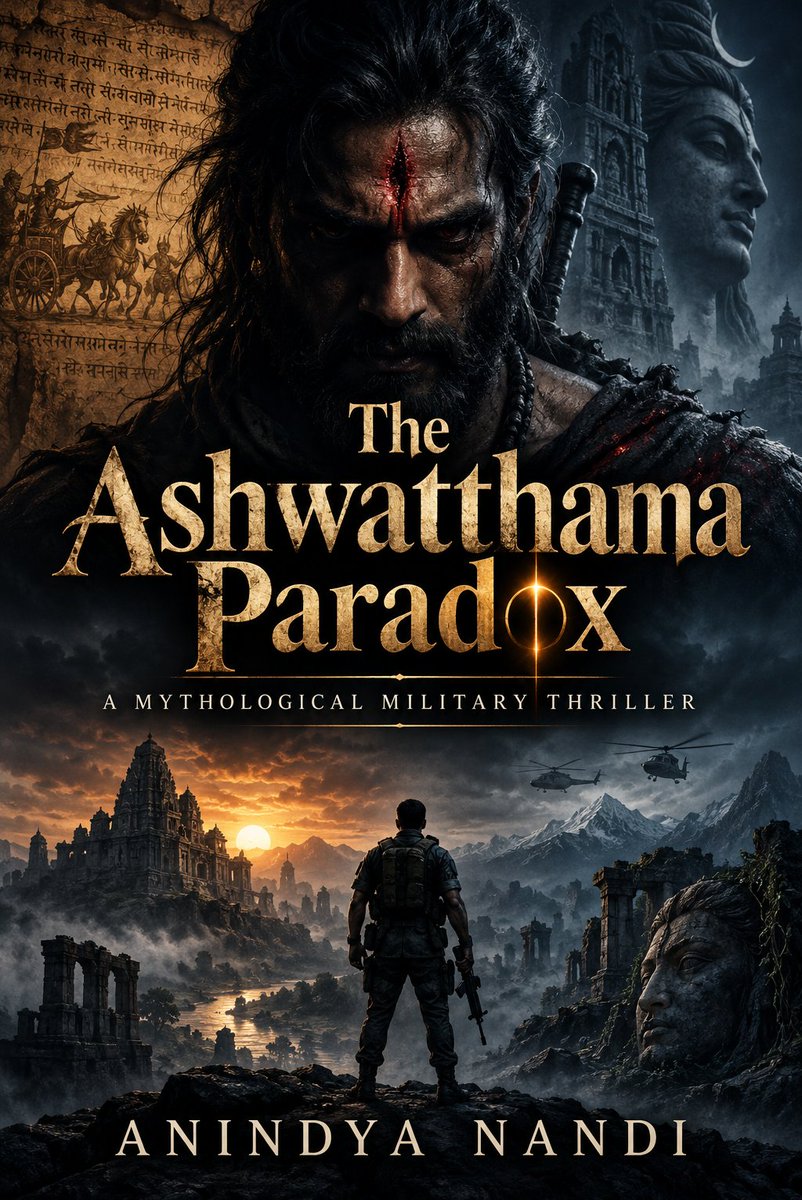
Was Ashwatthama really cursed by Krishna to remain immortal until the end of Kali Yuga?
This is one of those cases where popular mythology and the text people cite are not quite the same thing.
Most of us know the familiar version.
After the Kurukshetra war, Ashwatthama kills the sleeping sons of the Pandavas, later releases the Brahmashiras weapon and directs it toward Uttara’s womb. Krishna saves the Pandava line and curses Ashwatthama to wander the earth, wounded and unable to die, until the end of Kali Yuga.
The first part is broadly rooted in the Mahabharata.
The last phrase needs a caveat.
In the Sauptika Parva, Krishna’s punishment is described as a terrible wandering lasting 3,000 years. Ashwatthama is condemned to isolation, disease and suffering after surrendering the jewel from his forehead.
Later Hindu tradition, however, counts Ashwatthama among the Chiranjeevis, the long-lived or immortal figures believed to endure through the ages.
Over centuries, these two traditions have effectively fused in popular memory.
So is it wrong to call Ashwatthama immortal?
Not in the broader Hindu traditional sense.
But if someone says, ‘The Mahabharata explicitly says Krishna cursed him to live until Kali Yuga ends,’ that statement is more precise than the textual evidence permits.
And this distinction is fascinating because Ashwatthama’s punishment is not really about the number of years.
It is about something darker.
Death normally ends suffering. Krishna’s sentence denies Ashwatthama that escape for an almost unimaginable span of time.
He does not receive immortality as Hanuman receives longevity in devotional tradition. He receives continued existence stripped of honour, companionship and relief.
That is why, when I built The Ashwatthama Paradox, I was interested less in ‘What if an immortal warrior is still alive?’ and more in another question:
https://t.co/vab07XPA1s
What if immortality itself is the punishment?
In the novel, Major Arjun Rathore encounters a modern world obsessed with extracting the secret of eternal life. The Trinity and Vajra Syndicate see immortality as technology to be acquired and weaponised.
Ashwatthama knows what they do not.
Living forever and wanting to live forever are two completely different things.
The manuscript puts it plainly through Ashwatthama: his immortality was ‘a punishment, not a gift’.
That is where mythology becomes a thriller, and the old curse becomes a modern question.
If science offered humanity immortality tomorrow, would we actually understand what we were asking for?
~Anindya
India's IAS was built around the idea of the brilliant generalist administrator. But governing a technologically complex modern economy increasingly demands deep expertise, institutional memory and continuity. The question is not whether India needs the IAS, but what the IAS must become.
https://t.co/Dd5o6ROtof
Millions challenged their removal from Bengal’s electoral rolls, but only 1,607 were restored in time to vote. The controversy is no longer just about deletion, but about whether electoral remedies came too late.
https://t.co/3IoZ2yhWpD
India has allowed 1 million tonnes of duty-free raw sugar imports after prices surged.
At the same time, about 3 million tonnes of sugar have been diverted to ethanol this marketing year.
That does NOT prove ethanol caused the price spike. Hoarding, weather and production matter too.
But it does justify a question: what transparent trigger reduces food-to-fuel diversion when domestic supply tightens?
Energy security matters. So does food-price security.
https://t.co/zHJBodDMw6
Was India's coalition era really an era of "weak governments"?
It depends on what we mean by weak.
If strength means that the Prime Minister can make decisions without consulting partners, then yes, coalition government is structurally weaker.
But if strength means changing the country, the historical record becomes much less convenient.
Consider a few examples.
The Vajpayee-led NDA operated as a coalition. Yet the National Highways Development Project and Golden Quadrilateral became one of independent India's most important infrastructure transformations. NHDP Phase I was approved in December 2000, and the Golden Quadrilateral upgrades began in 2001. The World Bank records that the network covered 5,846 km and that about 80% of the work was completed by the end of 2004.
Telecom liberalisation also accelerated during the coalition period. The Department of Telecommunications records that National Long Distance service was opened to private players in August 2000. Government records also identify the New Telecom Policy of 1999 as a major structural point in the sector's transformation.
Then look at the UPA coalition years.
The Right to Information Act became law in 2005.
The National Rural Employment Guarantee Act was enacted in September 2005 and created a statutory guarantee of up to 100 days of rural wage employment for eligible households.
You can agree or disagree with any of these policies.
That is not the point.
The point is that the simplistic equation that Coalition = paralysis, does not survive history.
Coalitions create problems of their own. Bargaining can become blackmail. Small partners can exercise influence disproportionate to their seats. Decisions can become slower. Governments can collapse.
But there is another side.
A coalition forces the executive to negotiate.
It makes regional interests harder to ignore.
It can prevent one ideological current from controlling every decision.
It can also make reform politically durable because more than one political constituency has ownership of it.
That does not automatically make coalitions better than majority governments.
And majority governments are not automatically authoritarian or incompetent.
The real question is different:
What kind of institutions convert political power into accountable government?
A government that acts quickly but cannot be questioned is not necessarily strong.
A government that negotiates but still governs is not necessarily weak.
That tension is one of the reasons I wrote The Fractured Throne. https://t.co/P0LCvRYN3i
Indian democracy did not merely survive the coalition era.
Much of modern India was built during it.
#TheFracturedThrone #IndianPolitics #PoliticalHistory #CoalitionPolitics #IndianDemocracy #Governance #AtalBihariVajpayee #RTI #PoliticalTheory #HistoryMatters #MythBusting #AnindyaNandi
1/ Provenance: BJP MP Nishikant Dubey in Parliament; FE 24 Mar 2025; clip amplified by @SunnyRajBJP; THE YOUTH graphic. Versions say 1997 or 1998. The year already wobbles.
Viral absolute ("no tax to the government until 1998") = FALSE.
RIL 1996-97 AR: Rs 45 crore direct corporate tax; Rs 2,490 crore taxes and duties. Prior year Rs 2,234 crore. Earlier ARs: tax provisions + huge excise in the 1970s.
https://t.co/u0X0qwiHxC
3/ Who moved on zero-tax companies? MAT was reintroduced in the 1996-97 Budget (Chidambaram) as Section 115JA to tax book-profit companies paying little corporate tax. (Section 115J had first run in 1987, later made inoperative from AY 1991-92.) Reliance's next AR shows the Rs 45 crore direct-tax line.
And the neat 1966→1998 "32yrs" ruler: origin storytelling, not clean corporate history. Present RIL filing: incorporated 8 May 1973 as Mynylon → RTIL 1977 → RIL 1985.
Propaganda method: take one real tax-relief fact, erase the tax-vs-duties distinction, slide the dates, ignore the AR, add Indira + Ambani photos. Arithmetic is not a party worker.
2/ The fragment of truth under the spin: in some years profitable Indian companies, including Reliance, paid little or no corporate income tax because of legal deductions and reliefs (the "zero-tax companies" problem). Reliance's own accounts even note years where no current tax provision was needed because of admissible reliefs.
That is still not "no tax to the government," and it is not proof of a Reliance-specific Congress holiday for 32 years. Unproven.
West Bengal says experienced professors should be transferable to newer universities that need them. That objective is defensible. But giving the government power over where university academics work raises a larger question https://t.co/BkMy8iXn0G
West Bengal's university transfer Bill raises a simple institutional question:
Would you give this power to a government you deeply distrust?
Redistributing experienced faculty can be legitimate.
Compulsory transfer without strong safeguards can also become political leverage.
The answer is transparent criteria, written reasons and independent review.
https://t.co/IxGHAD88s7