last but not least: I also had the chance to be on a panel at @ETHSofiaBG: "Building Under CROPS: What the Ethereum Foundation's Mandate Means for Developers and Institutions," moderated by @VyaraSavova (European Ethereum Institute), alongside @sajidazouarhi (Optimum) and @0xmikemcc (Privacy Pools).
what I talked about
– our team's mission: to understand and create funding mechanisms for the Ethereum ecosystem. I focus on positioning Ethereum as critical infrastructure in the broader open source ecosystem so that we can attract funding from outside crypto: from governments, organisations that support open source, and other funding and grant opportunities
– subtraction as success: the Mandate's goal is for Ethereum to work even if the EF disappeared. from our team's perspective, subtraction succeeds when funding flows into Ethereum public goods from multiple sources, not only or primarily from the Foundation. one entity sitting at the center, even one without revenue, crowds others out. if people know the EF will handle something, they don't step up
– open-weights AI: open weights sit in a grey zone. the models are free to use but you don't know what data trained it. the harder question is verification - how do you know an inference provider is actually running the model it claims to run? I'm exploring how Ethereum can become a trustless coordination layer for open frontier AI, combining payment rails, identity, and the ability for distributed actors to verify claims about one another without a central controlling body
– EU Cyber Resilience Act: compliance is becoming a real challenge for open source. the CRA introduces security and reporting obligations that touch open source projects directly, and the tension is how do you comply without introducing centralised gatekeepers? in this workstream, I'm exploring how Ethereum as an attestation layer can allow open source projects to make verifiable claims about their compliance without relying on a single authority
the rest of the panel
– Sajida spoke about whether CROPS values can travel beyond the Ethereum ecosystem to the broader blockchain space, and where censorship is actually happening today across the stack: builders, relays, RPCs, front ends
– Mike spoke about compliant privacy in practice, and why privacy and censorship resistance matter at the application layer, not as abstract principles but as concrete infrastructure choices
full recording will be available soon
for me personally, I'm glad I could give a sneak peek into the workstreams I'm working on. Ethereum should definitely serve a purpose beyond crypto: for example, becoming infrastructure for trust and verification in the broader open source ecosystem.
Blockchain and tokenization gave open-source projects something they historically lacked: a way to coordinate incentives and value accrual without building a traditional company around them.
That makes open-weight AI models a natural fit for tokenization.
A model can remain openly accessible and community-developed while a token coordinates contributors, funds development, rewards usage and improvement, and captures value created by the ecosystem around it.
In that sense, tokenization can provide open AI with an economic layer that matches its open technical architecture.
I hope someone big enough will explore this in the near term.
Can Europe have supervised markets and financial privacy at the same time? We are heading to Barcelona to answer that question.
@EuEthInstitute Policy Expert @AnjaBlaj will moderate "Privacy onchain: confidential transactions, zero-knowledge proofs and financial privacy" at the European Blockchain Convention next month.
Joining her on stage @GuiDechaux, Marine Krasovska (Head of FinTech Supervision Department, @LatvijasBanka), Rainer Olt (Head of Payment & Settlement Systems Department, @EestiPank), and @ShirlyValge (Partner, Dorchester Partners).
We are glad to be part of this rare line-up. If you are in Barcelona, come meet us.
When — Thursday 17 September, 09:30–10:10
Where — KuCoin EU | Visa Main Stage
Season opener incoming ⚡
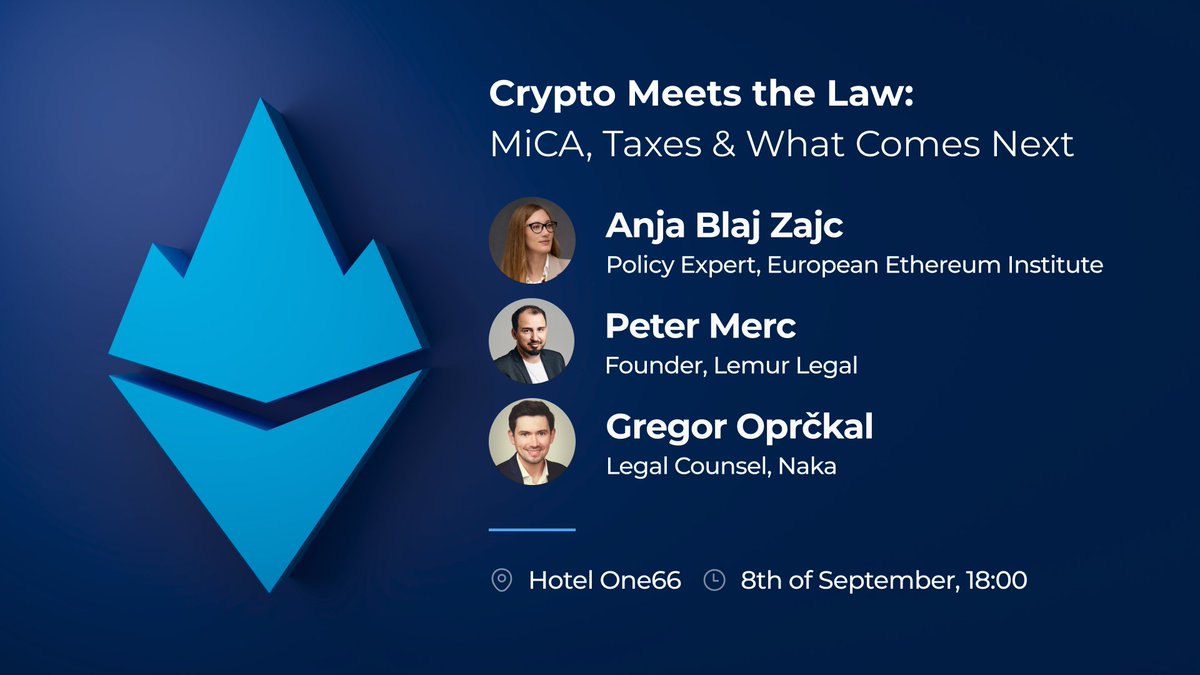
Ethereum Slovenia returns on September 8 and we're starting the 2026/2027 season where the whole ecosystem is looking right now: the law.
How should decentralisation be assessed? Which jurisdiction’s law should apply to decentralised and cross-border blockchain transactions? The final chapter of the European Commission’s targeted MiCA consultation asks both questions, among others.
We're working through them today at 15:00 CET.
https://t.co/MRR2wrIDT8
We’ve got 1 more month till the deadline for MiCA consultation feedback submission:
@EuEthInstitute is bringing together the DeFi community to work through the final chapter of the European Commission’s targeted MiCA consultation and discuss what the proposed approaches could mean in practice for protocols, developers, service providers, and users in Europe.
https://t.co/TKmHUwvawh
Come join!
@milesjennings@a16zcrypto Historically speaking, onchain securities are nothing but a perpetual *dis*intermediation. It has always been about the "Democratisation of Investment." 👀
Still here to build for the little guys, against the Goliaths of the world.
@tw_tter on what Gnosis is at its core: agency, self-empowerment, optionality.
Livestream: Building EU sovereignty with @AnjaBlaj, co-hosted with @EuEthInstitute.
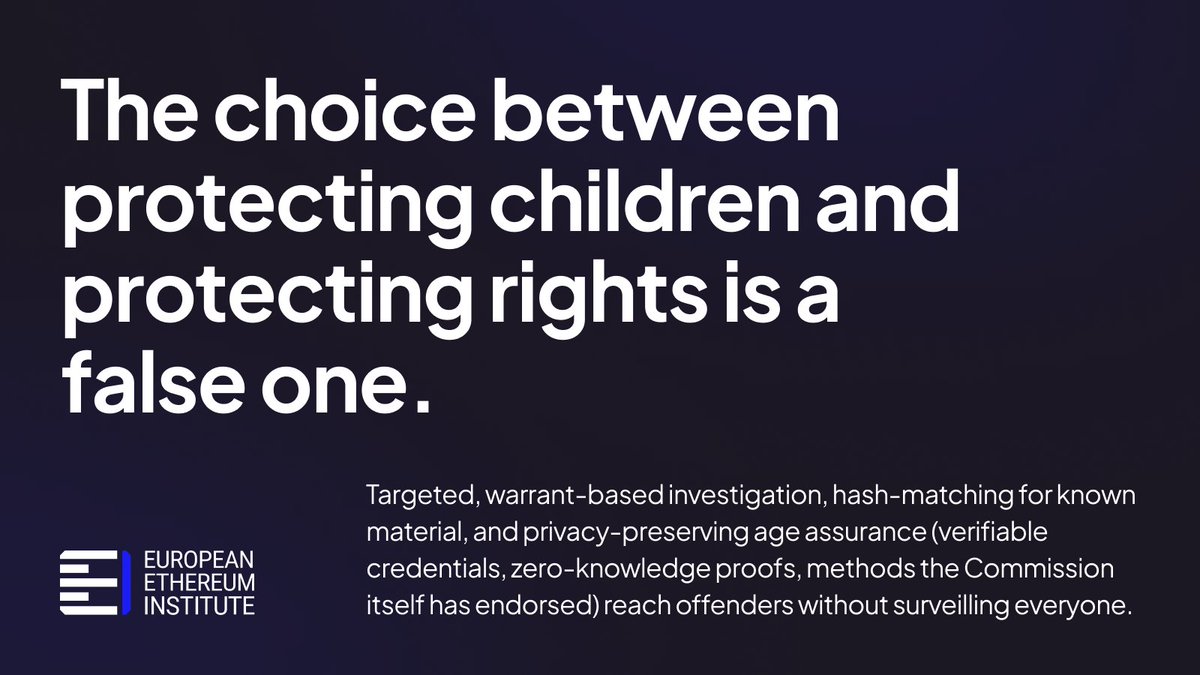
Protecting children online is a goal we share without reservation. The method now on the table, scanning everyone's private messages, is where we disagree.
The CSA Regulation, known as Chat Control, proposes something the EU's own legal order has rejected before: the generalised, indiscriminate monitoring of private communications.
Our position is firm: the CSA Regulation must exclude any obligation to scan private communications, and any requirement, direct or indirect, to undermine encryption. A law that sacrifices the Charter does not secure the children it claims to protect, and it forfeits the EU's standing as a rights-based digital standard-setter.
This file returns to negotiations in the autumn, and we'll be following it closely.
"I came here for the paradigm shift that Ethereum promised."
@tw_tter on the trap of incumbents moving on-chain with the same extractive models: on the face of it we've won. In the spirit of it, we've lost.
Livestream: Building EU sovereignty with @AnjaBlaj, co-hosted with @EuEthInstitute.