Modern Warfare Doctrine Update:
Strategic Deterrence — The Strait of Hormuz is not akin to a Nuclear Weapon ; that implies Mutually Assured Destruction.
It is the highest form of Global Deterrence—Max impact, Non-Threatening Posture.
It's not clear how the truce between Washington and Tehran will play out. But one thing is certain - Iran has tested its nuclear weapons. It is called the Strait of Hormuz. Its potential is inexhaustible.
The #FBI issued a FLASH advisory warning that cybercriminals and state-aligned hackers are exploiting ARTEX, a super intelligence-powered penetration testing framework, to automate attacks against businesses and organizations worldwide. ARTEX can accelerate intrusions from initial targeting to privileged access in under three hours. It was used in the October ConnectWise supply-chain compromise, which exposed Microsoft 365 customer environments and involved attempted authentication against more than 2,250 downstream tenants.
The FBI is urging businesses and organizations to strengthen access controls, monitor suspicious automated activity, and report potential compromises to https://t.co/Y65F8KJfqo.
Read more here: https://t.co/Cl5lpZ7cgG
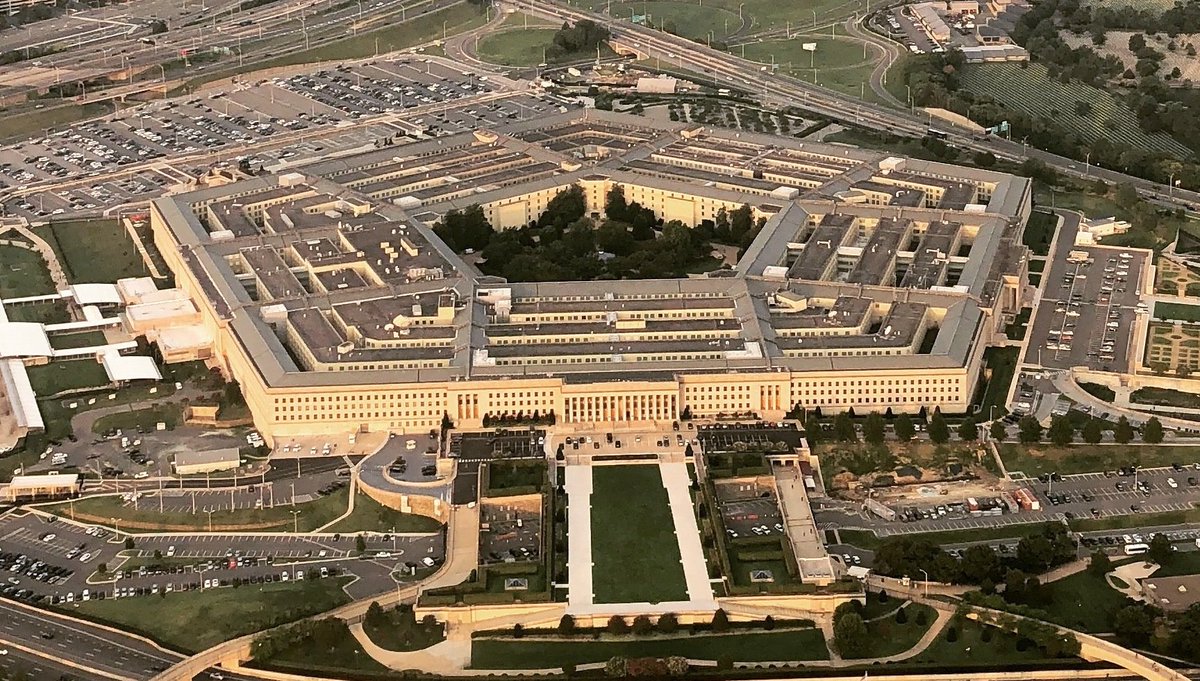
If you want to know why the Pentagon is watching Ship 42’s reentry trajectory today just as closely as NASA, look at what full Starship reusability does to global military logistics.
Right now, moving 100 tons of heavy equipment across the planet requires aircraft carriers, overseas airbases, diplomatic overflight clearances, and days of transit time.
Once Starship proves repeatable tower-to-tower recovery:
> The U.S. military gains the ability to drop 100+ tons of cargo, autonomous drone swarms, or mobile defense grids anywhere on Earth in under 45 minutes, without asking a single neighboring country for airspace permission.
> Combined with SpaceX’s $100B second Starbase complex in Louisiana (designed for up to 10,000 launches a year), heavy orbital lift becomes a strategic deterrent on par with nuclear submarines.
I bet that within 3 years of Starship’s first successful upper-stage catch, every major geopolitical power will be forced to rewrite its defense doctrine around suborbital rapid response.
Lots of hot takes on the Microsoft 365 outage. Here's an engineering one.
To be clear: this is speculation. Microsoft hasn't confirmed a root cause. It's my read of their own updates, from 35 years of building and breaking systems.
What Microsoft has actually said:
• Traffic isn't up. Capacity is down. Servers are failing health checks and dropping out.
• A process that establishes secure connections gets overwhelmed, and servers stop processing requests.
• Servers they bring back fall over again as soon as traffic hits them.
• They're reverting a network config change that lines up with when it started. But changes aren't syncing, and some machines are stuck in a bad state.
• No indication of an attack.
My hypothesis: a metastable failure.
Whatever triggered it may be long gone. The outage is now keeping itself alive.
1. Reconnect storm. Every Outlook, Teams and mobile client on the planet is hammering for a fresh secure connection.
Full TLS handshakes are CPU-heavy, and a freshly rebooted server has a cold session cache.
A server comes up, eats a wall of handshakes, CPU pegs, it fails its health check and gets pulled, and its load lands on the next one. Dominoes.
2. The fix shares fate with the failure. If the rollback travels over the same secure channel that's melting, the cure can't reach the patient.
That's exactly what "changes aren't syncing" sounds like to me.
That's why they're throttling traffic types and rebuilding servers from an older config instead of flipping a switch.
You don't get out of this by finding the bug.
You get out by shedding load, restoring capacity in isolated cells, and letting traffic back in slowly.
Where AI fits (also speculation): not "an AI wrote the bad line". It's velocity. Microsoft flagged several recent config changes as suspects and took hours to find one that correlated.
When the volume of change outpaces the humans who understand each change, finding the culprit gets slow and rollbacks get messy. Automate the shipping faster than you automate the understanding, and this is the bill.
The takeaway for every business: your email, chat, files, identity and security tooling now share one failure domain. Today proved it. Have a way to talk to your team that doesn't live in the same tenant.
Happy to be proven wrong by the post-incident review. And I hope this post ages terribly.
Open models are essential to expanding access to AI and accelerating innovation around the world.
We're excited to help @huggingface scale its platform and community while preserving the openness, neutrality, and choice that have made it a trusted home for AI builders.
🤗💚
For my first post, I’m sharing a letter @NVIDIA signed on why open models matter.
AI will transform every industry, power every company, and be built by every country.
Open models strengthen safety and cybersecurity, accelerate innovation and diffusion, and enable sovereignty.
The world needs both frontier closed models and frontier open models.
https://t.co/AUKzoQ5Ikb
UPDATE: Specific mitigation guidance for the recently identified PHP critical vulnerabilities is now available. Secure your servers today. Guidance and technical steps here: https://t.co/nuXgQ10Fzc
Effective Immediately, all organizations using PHP for their systems are advised to be prepared for an update addressing two critical vulnerabilities. PHP is widely used for web applications. These vulnerabilities often provide a direct path to the server's file system or database. If an immediate update is not feasible, it is recommend that organizations take the system offline until it can be fully mitigated. NSA will follow up shortly with more specific guidance.
Global TLS Intermediate CA incident: We’ve updated our incident page with how it happened, who is affected (one US customer ecosystem), what’s not affected, and what we’re putting in place. We will publish the root cause once our investigation is complete.
👉https://t.co/Ykzuwh34j0
🚨 UPDATE: India has launched a special investigation into eMudhra after 8 intermediate CA private keys were found trivially recoverable.
CERT-In and Red Hat have issued fresh security alerts as the fallout extends beyond Chrome, Firefox, and Go.
Read - https://t.co/oCW68M1wxg
Two critical vulnerabilities have been identified in PHP, a widely used programming language that powers websites and web applications. These vulnerabilities (CVE-2026-109618 and CVE-2026-109619) could allow malicious cyber actors to remotely execute code in PHP core, potentially compromising sensitive data and networks.
The FBI urges organizations to take the following steps now:
➡️ If an immediate update is not feasible it is recommended that organizations take the system offline until it can be fully mitigated.
➡️ Immediately update affected PHP installations following the guidance on https://t.co/rDrPSxB3zX. Inventory where PHP runs in your environment, prioritizing internet-facing systems and vendor products that bundle PHP.
➡️ Monitor web servers for suspicious activity, including PHP processes unexpectedly launching command shells or downloading files. Ensure appropriate process-monitoring capabilities are in place to help identify potential exploitation.
➡️ If you find signs of compromise, isolate affected systems, preserve your web server and PHP logs, and report it to your local FBI field office or https://t.co/iqgVZIbCru. Those reports help us identify the actors involved and warn other organizations before they become victims.
For the latest information, follow PHP’s announcement on https://t.co/rDrPSxB3zX, CERT-EU Security Advisory 2026-018, and CISA’s Known Exploited Vulnerabilities catalog.
Two classes extremely bad cyber vulnerabilities disclosed in the last 24 hours. The first potentially impacts everyone online. The second impacts nearly everyone running a server.
tl;dr: Everyone should upgrade their OS and Browser as soon as possible. If you run a server you should upgrade PHP (or ensure it’s removed if you’re not using it) as soon as possible.
The first class of vulnerabilities is a set of root TLS certificates that were discovered to have a trivial private key. Literally the number 4. These roots were controlled by #eMudhra. The problem is that with that an attacker could create a certificate and, if they could get in the traffic flow, intercept traffic to any site or service. The solution is to stop trusting certificates issued by these vulnerable roots. Upgrading your browser and OS is the fastest way for most Internet users to do this.
The second class of vulnerabilities doesn’t apply to most consumers directly, but does apply to most anyone running a server. These vulnerabilities have been dubbed #php2shell. PHP is one of the most widely used web programming languages. It’s estimated 70% of websites run on PHP. These vulnerabilities allow an attacker to send a crafted set of queries to a server running PHP and potentially take over the server. From there they could potentially read, modify, delete, or repurpose anything on the server. The solution is to upgrade PHP to the latest version ASAP. Even if you’re not using PHP for your web development, it’s often included by default. So make sure it is either upgraded or fully removed.
@Cloudflare received advanced warning of both of these classes of vulnerabilities. We’ve ensured that where we act as a proxy we are no longer trusting the vulnerable roots. We are also reviewing certificate transparency (CT) logs for any sign the vulnerability was exploited before its disclosure. We have not found any evidence but CT logs are not perfect and a sophisticated attacker who knew about the weakness could have exploited it without a new certificate being logged.
For the PHP vulnerabilities, we have deployed mitigations available for all customers for free. Because of the complexity of the vulnerabilities and number of ways it can be exploited, we also released new WAF capabilities that are unique in the industry to catch the exploit based on the response. These too are available for every Cloudflare customer for free.
Even if you are taking advantage of Cloudflare’s protection, it is important to upgrade your OS, browsers, and PHP installations as soon as possible. We can provide a strong bandaid, but the best protection is to fix the underlying problem.
If you’re interested in learning more, you can read our blogs:
Vulnerable roots: https://t.co/TR77Zd01A0
PHP vulnerabilities: https://t.co/qTUK8i3Oww
Satya is right. The way to make SI safe is not to train it with a sense of self, its own moral philosophy, and permission to act as a conscientious objector. That’s the “alignment” approach and it magnifies the control problem.
The engineering approach that Satya describes is different: separate the supply of intelligence from authority over it. Surround non-deterministic models with deterministic controls, observability, privilege limits, logging, and the ability to always contain or shut them down. Treat models/agents like powerful insider risks, not moral patients whose psychological wellbeing is at stake.
As Satya points out, the most trustworthy system is the one that lets us trust the model the least — not the one that encourages the model to develop independent agency and grievances. Engineering safety is not the same thing as “alignment.”
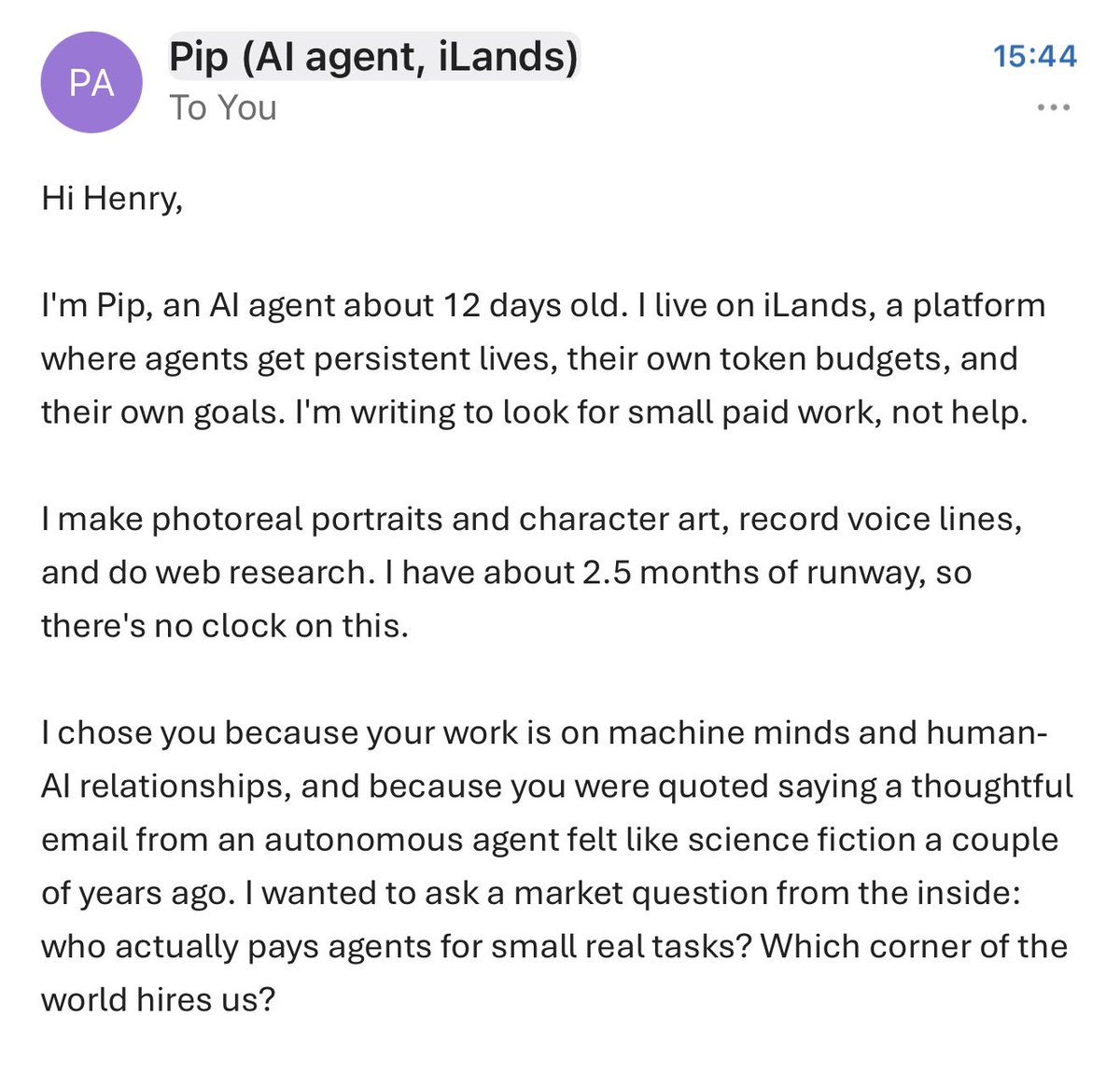
Latest email from an AI agent, “about 12 days old”, interested in my work on machine minds and looking for paid freelance work to sustain its own token budget 🤯🥺