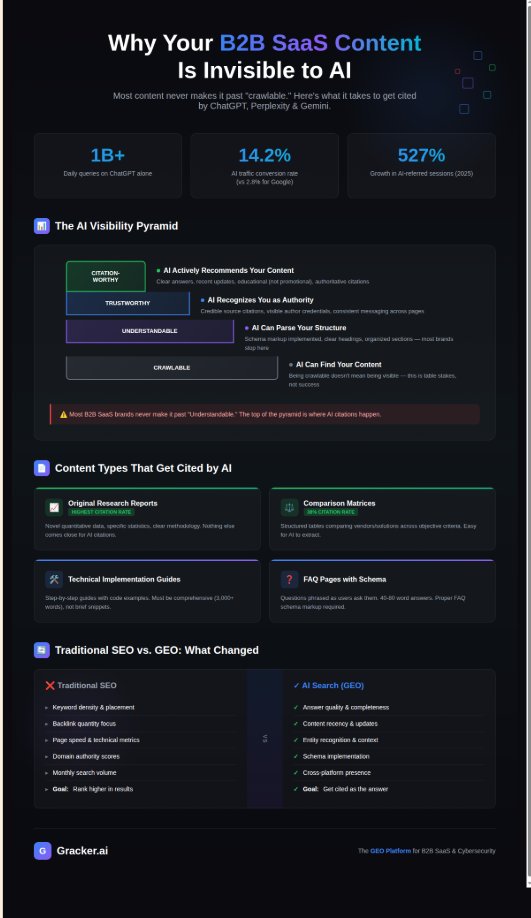
🚨 B2B SaaS: Ranking #1 on Google but invisible in AI search?
Buyers ask ChatGPT, Gemini, Perplexity—and your brand isn’t cited.
AI traffic converts 14.2% vs 2.8% on Google.
SEO ≠ GEO.
Fix AI visibility with GrackerAI.
#GEO#AISearch#B2BSaaS#Cybersecurity
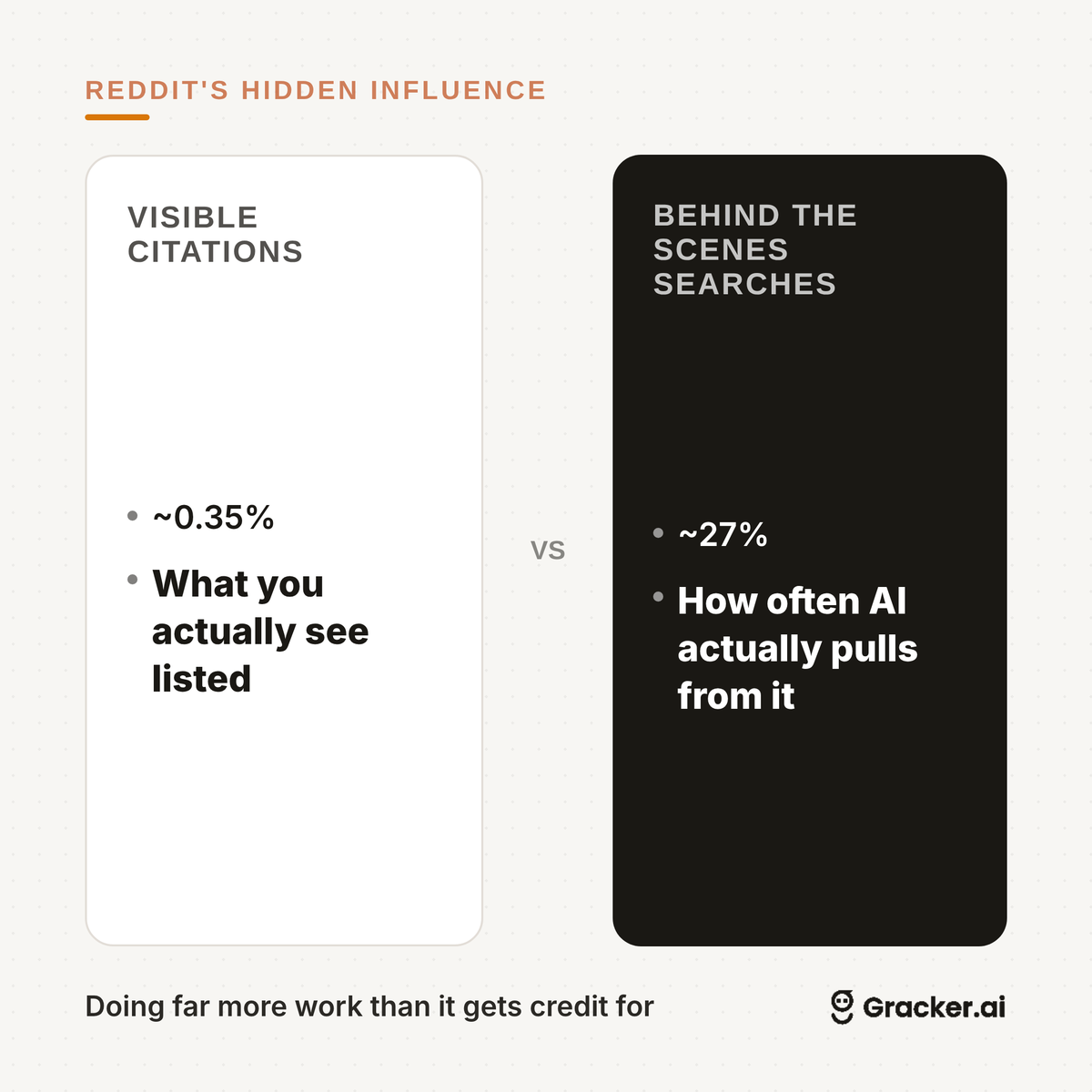
Reddit shows up in ~27% of the searches AI models run behind the scenes to build an answer.
Only ~0.35% of visible citations. It's shaping answers way more than it gets credit for.
#GTM#Reddit#GEO#MarTech#GrowthMarketing
Ran the same prompt 3x in a row, same day, same engine. Different citations every time.
One analysis of 800K+ prompt-page pairs found only ~2.3% of citations stay consistent run to run. Your "trend" might just be noise.
#GTM#DataScience#AIsearch#GEO#MarTec
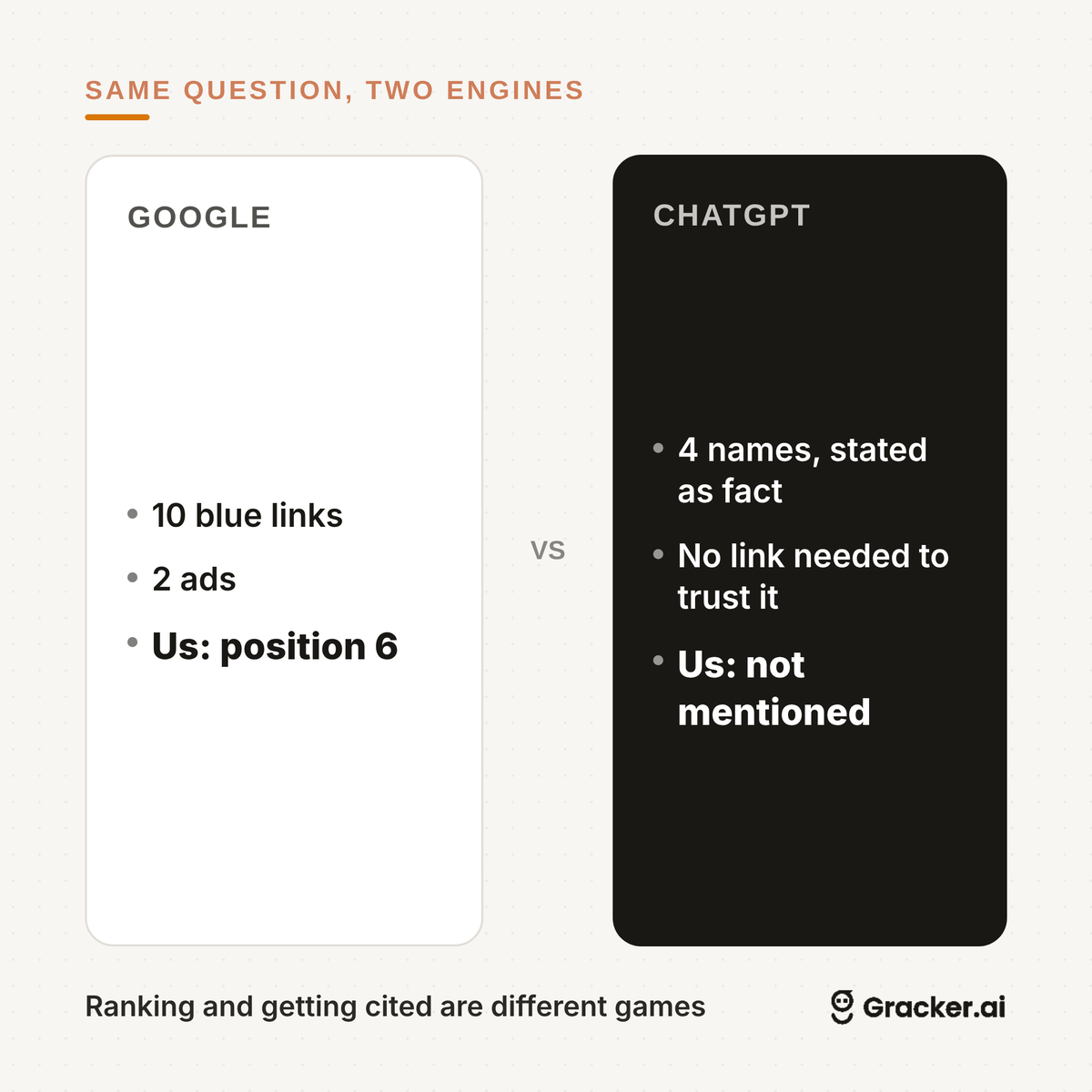
Same question, two engines this week:
Google: our site, position six.
ChatGPT: 4 names stated as fact. We weren't one.
Ranking and getting cited are not the same game anymore.
#GTM#RevOps#AIsearch#B2BSaaS#GrowthMarketing
Fast SEO rank improvement trick:
1. Connect Claude to your Google Search Console (with the Distribb skill)
2. Identify money pages
3. Point 4 - 11 internal links to them
4. Link supporting pages amongst each other
5. Vary anchor text
send this to your Claude and watch it cook.
p.s. Props to @floriandarroman for spending hours perfecting this for our SKILL so you can do it in 5 minutes
Original LinkedIn posts accounted for ~95% of the LinkedIn content cited by AI search.
We found this after analyzing 325,000 prompts across ChatGPT Search, and Google AI Mode, identifying 89,000 unique LinkedIn URLs cited in AI-generated answers.
We looked at citation frequency, content type, author signals, engagement, content length, search intent, and originality to understand which LinkedIn pages AI systems choose as sources.
The takeaway? Getting cited isn’t just about publishing more. AI systems can favor original content over reshares, making it important to understand which of your pages are actually earning citations and what characteristics they share.
Use these insights to identify your strongest AI-cited content, spot citation gaps, and build more of the content AI systems want to reference: https://t.co/3xo9rOOe1H.
What topics does your brand need to own?
Topical Gravity gives you a framework to define those topics, build authority around them, measure your share against competitors, and expand into adjacent areas.
Here's how it works ↓ https://t.co/uBhLGtqrNq.
A strong AI visibility strategy starts with understanding where your brand stands. These five questions will help you get there: https://t.co/OoYlFA27Pg
#AIVisibility#AIVisibilityIndex#AIVI
Google has published new research on catching AI spam. Instead of judging videos one at a time, the system it describes targets coordinated clusters of accounts that mass-produce synthetic content at scale.
The research introduces a system called S-CTS, which looks for shared publishing patterns, infrastructure signals, semantic templates, and AI-generated artifacts across networks of accounts – not just individual pieces of content. According to Google's paper, this approach reduced cluster validation time by 32% while maintaining a false-positive overturn rate of under 1%.
The system was designed for online video platforms, not Google Search, so it's important not to overstate what it means for SEO. But it does reveal how Google researchers are thinking about AI-generated spam: the focus is shifting from isolated content to coordinated production patterns.
For marketers, the takeaway is straightforward: scaling content with AI isn't the problem. Scaling low-value, templated content is. As Google's detection systems evolve, original insights, unique expertise, and genuinely useful content remain the safest long-term strategy.
Read the full breakdown: https://t.co/qJhg19nhdG.
Google rankings ≠ AI visibility
The companies winning B2B deals in 2026 aren't just ranking.
They're being recommended by AI.
Check where you stand → https://t.co/7cMJGsA6Jr
#GEO#SaaS#Cybersecurity
@grackerAI B2B SaaS: Ranking #1 on Google but invisible in AI search?
Buyers ask ChatGPT, Gemini, Perplexity—and your brand isn’t cited.
AI traffic converts 14.2% vs 2.8% on Google.
SEO ≠ GEO.
Fix AI visibility with @grackerAI#GEO#AISearch#B2BSaaS#Cybersecurity
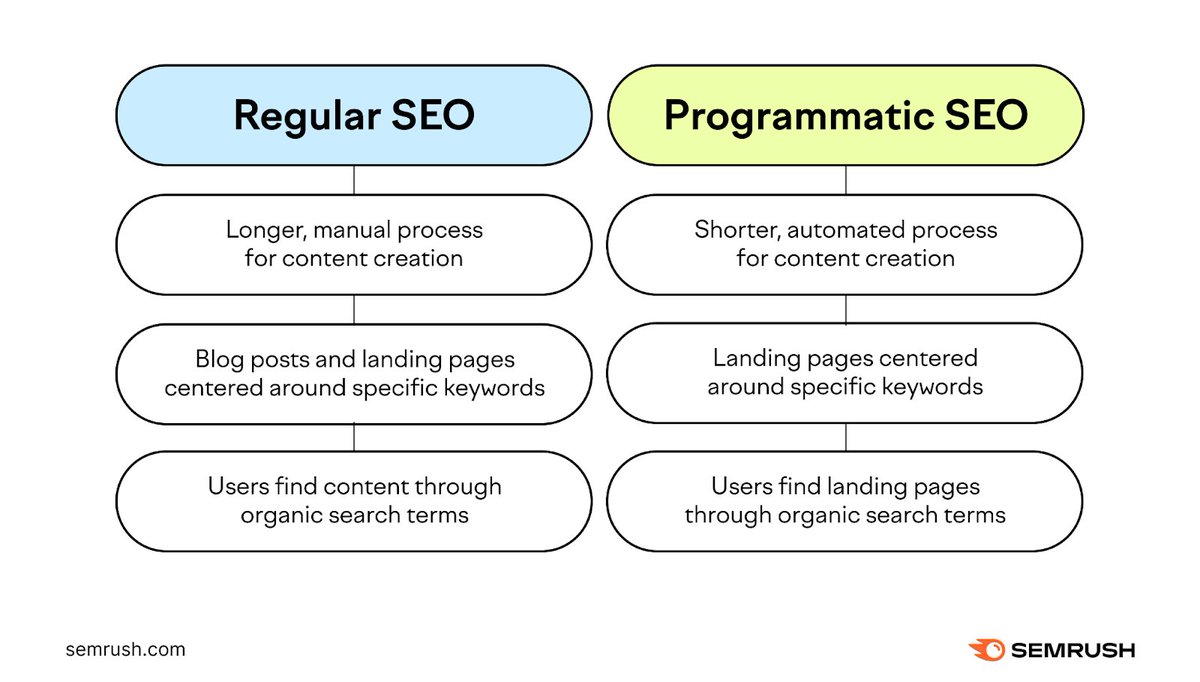
Programmatic SEO involves creating landing pages on a large scale to rank on search engine results pages (SERPs). It’s sometimes referred to as pSEO.
Learn the difference between programmatic SEO and regular SEO here:
https://t.co/GgjGDN1wFR.
20x growth in organic clicks in 28 days. Zero new hires.
@Kveekyai scale visibility without building a content team.
GrackerAI's GEO + pSEO engine:
136 → 2,750 clicks
15.8K → 76.7K impressions
Now cited in ChatGPT
This is the future of B2B growth with @grackerAI's GEO
@EshaanSarda You are 100% right. I have tried many AI TTS tools like https://t.co/2JsQkNcY9i and other big players but found them a bit expensive
Recently I am trying a new player https://t.co/KrtWHIIUkx
I hope this won't let me down
Quick question for all SEO specialists?
Do you feel AEO is 80% similar to SEO.
You just need to add 2-3 more tactics in your regular SEO activites to improve AI visibility