AI isn't only reading your website, it's also reading what everyone else says about you 🧐
Think Reddit threads, G2 reviews, and media mentions. That's where a lot of the citations actually come from.
Wild example: Seer Interactive found that one bad review from 2018 was still changing how every major AI model talked about their brand. Years later. One review!
Most brands have no idea what story AI is telling about them right now.
So it's not that SEO is dead, it's just not the whole picture.
You've got three layers to think about: your own site, how you're building your brand, and what others are saying about you out there.
Getting a handle on all three is where it starts 👇
https://t.co/RkxELzLwqp.
An SEO strategy in 2026 has to account for a search landscape that changed quickly. Search results now mix AI summaries, videos, forum threads, and blue links.
Your buyers are also turning to AI assistants like Gemini, ChatGPT, and Claude for harder questions. Visibility now means showing up across those surfaces and being the one buyers trust, not just ranking on Google.
But the underlying job hasn’t changed: you’re still earning visibility in the places people search.
A working SEO strategy is a set of business decisions, not a to-do list.
This guide walks you through six decisions to build a strategy that works in 2026, with a free workbook to help you put it into practice ↓
https://t.co/NDShKPZ2v8.
Google released a major update to the Universal Commerce Protocol (UCP) in early 2026.
UCP is an open standard that enables AI agents to communicate with ecommerce platforms and complete purchases on behalf of users.
For example, when a user asks Gemini, “Find the best running shoes under $100,” the AI agent can run a search, browse products across retailers, and present relevant options. With user approval, it can then complete the purchase – all enabled by UCP.
The update introduces new capabilities, including cart support and access to product catalogs. Google has also simplified onboarding through Merchant Center to attract more retailers. UCP-powered checkout is currently available to eligible U.S.-based merchants, with global expansion planned throughout 2026.
Here's how to prepare your business now: https://t.co/jTsJo40G9Y.
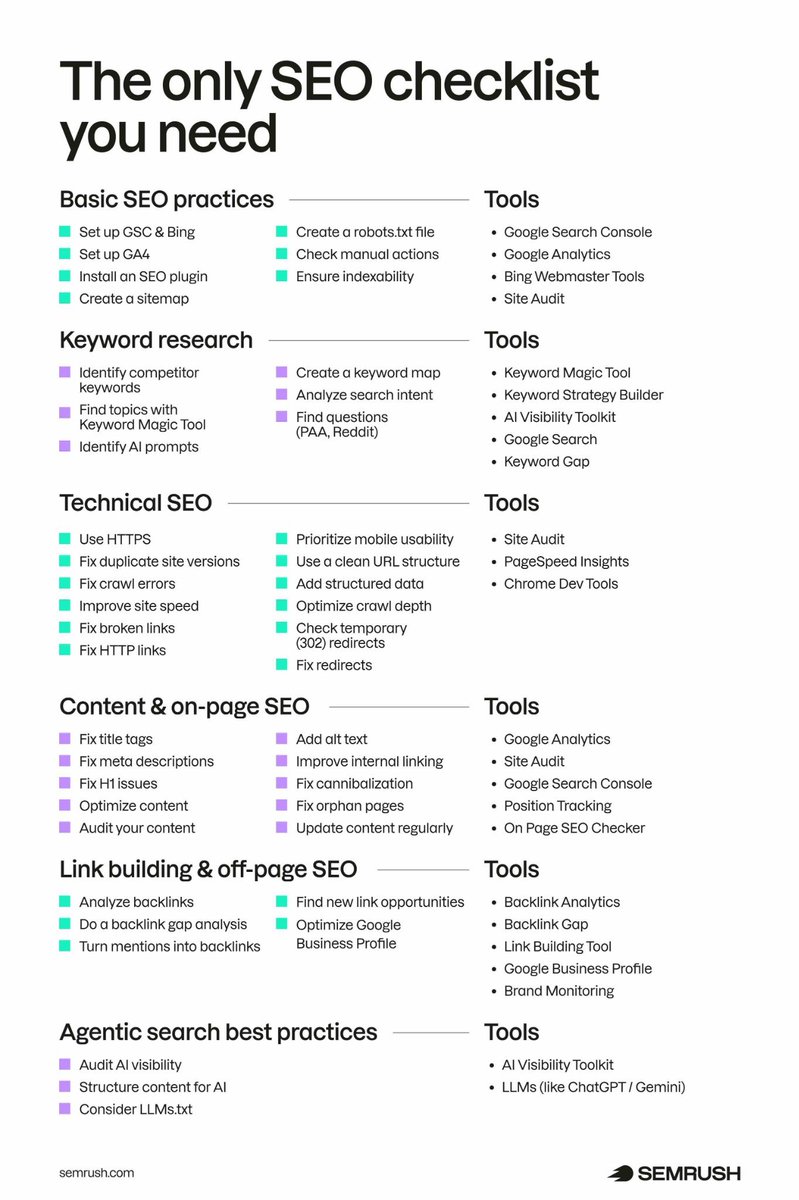
SEO is no longer just about ranking in Google. In 2026, it also means being visible in AI-driven search surfaces like Google’s AI Overviews and ChatGPT.
This SEO checklist covers tasks that can help you gain visibility no matter where your audience is searching 👇
https://t.co/s8Va7gwf7x.
A customer sees your brand recommended in ChatGPT, searches for you on Google, and converts. Your analytics may credit the conversion to organic search.
A three-tier framework can help close the AI attribution gap:
1. Can AI find your site?
2. Are you appearing in AI answers?
3. Is that visibility driving business outcomes?
Watch the breakdown: https://t.co/GieHXXH8dA.
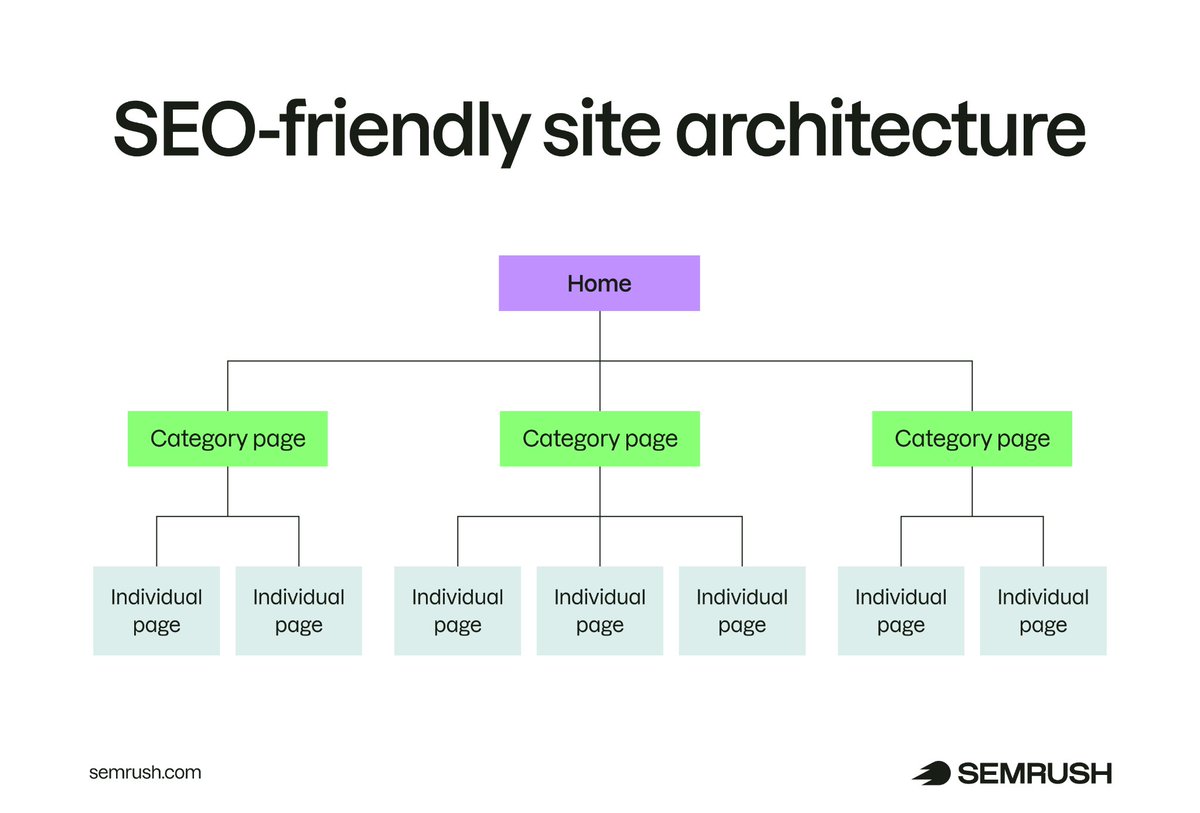
Launching a new website? Build SEO into it from the start.
Learn how to set up your site structure, target the right keywords, create content, earn backlinks, and track your progress with our step-by-step guide: https://t.co/hoWGRcr4Xd.
What should your SEO strategy focus on next?
Combine demand, competition, and current performance with a Semrush MCP workflow to identify the biggest opportunities and turn them into a 90-day execution plan.
Get:
• SEO strengths and weaknesses across your domain
• Opportunity clusters to attack, defend, or target as quick wins
• SERP-ready page recommendations for priority clusters
• A 90-day roadmap ranked by impact and effort
• KPIs, milestones, owners, and first-week actions
• An execution checklist to turn strategy into action
Run the workflow with Semrush MCP: https://t.co/85KStqEEaT.
AI can generate endless content. Brand authority is harder to build.
Learn the 12 signals that influence how AI evaluates and recommends brands, including off-site authority, E-E-A-T, entity signals, and AI-era visibility.
Watch the breakdown 👇
https://t.co/UCgVMslaL1.
We wouldn’t frame schema as a direct feed into LLM context windows. It’s still useful for making entities and page relationships explicit, but current evidence doesn’t show that adding schema alone makes an LLM more likely to cite you. We’d keep it as part of the technical foundation alongside clear, accessible, well-structured content.
We dug into the technical factors correlated with AI citations here:
https://t.co/2UZs8k2Pj8
@ramanpal Good addition. AI visibility gets a lot more useful once you can connect the appearance back to the source that earned it. That gives teams something concrete to learn from and repeat, rather than just watching the visibility number move.
That’s the part marketers have to operationalize now. The fundamentals still create the foundation, but AI visibility adds new questions on top: which platforms are surfacing you, which sources they trust, and whether your brand is being described consistently across those surfaces.
@Vishalaii That’s where the checklist keeps expanding. Rankings still matter, but brands also need to know how that visibility carries across Google AI Overviews, ChatGPT, and other AI surfaces.
Exactly, ranking is only one layer now. The same technical fundamentals still matter for AI visibility too: crawlability, clean structure, schema, and accessibility determine whether the content can be used at all. Then you’re competing on clarity, citations, and broader brand signals on top of that.
9 Best Free SEO Courses in 2026:
1. Semrush SEO Crash Course with Brian Dean
2. HubSpot SEO Certification Course
3. Google SEO Fundamentals by UC Davis
4. Semrush Keyword Research Essentials
5. The SEO Roadmap
6. Content-Led SEO with Brian Dean
7. International SEO with Aleyda Solis
8. Local SEO Course with Rita Cidre
9. Technical SEO Course with Bastian Grimm
https://t.co/FGkaaGCN6C.
@seo_bint_ejamil Yep 👀 We’re tracking citations, not just impressions.
With Semrush Prompt Tracking, you can see which domains and specific URLs AI platforms cite, how often they’re cited, new/lost sources over time, and where competitors are getting cited while you’re not!
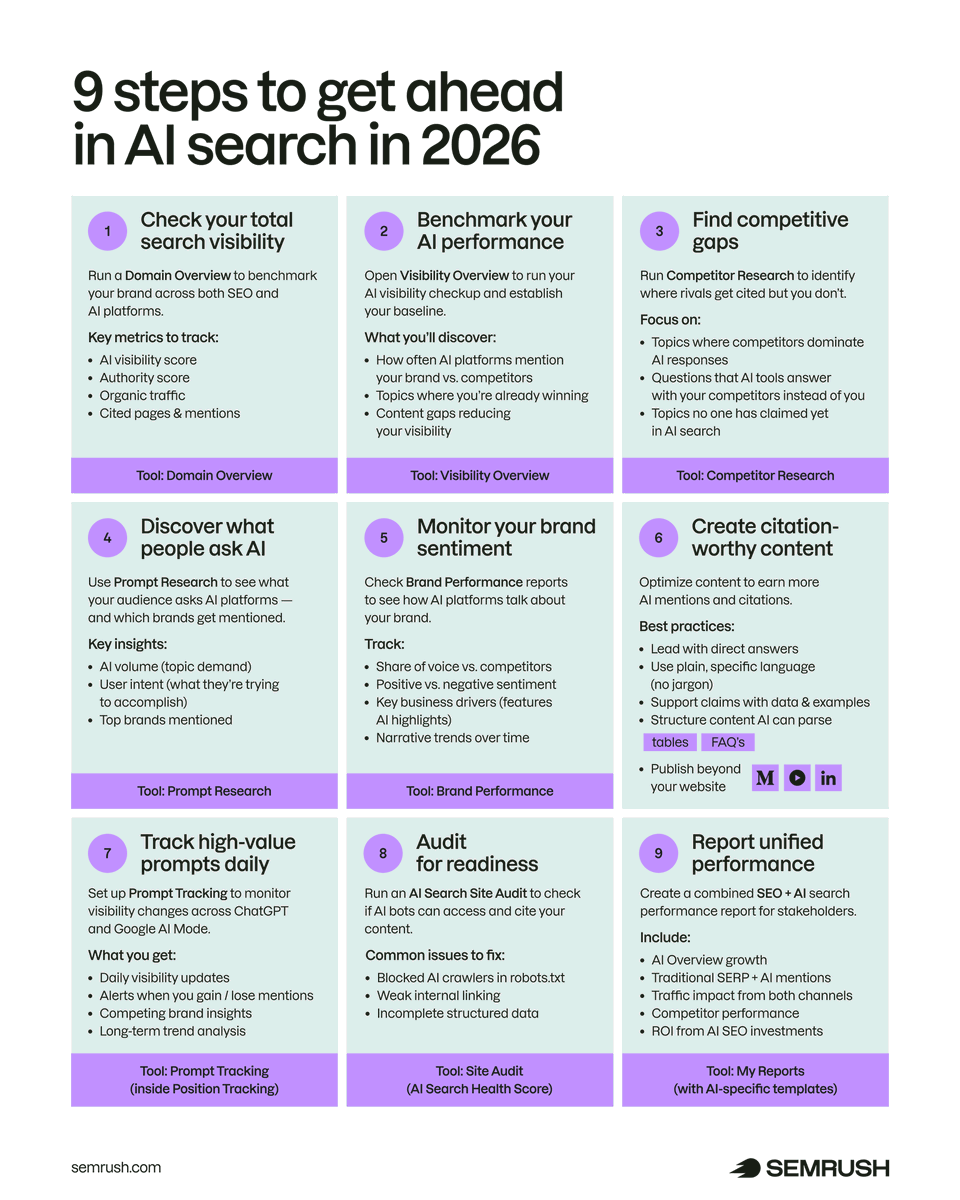
The question every brand faces today: can AI find, trust, and cite them?
This 9-step workflow helps teams answer that question with data, not assumptions. From AI visibility benchmarking to unified SEO + AI reporting, this is how modern search strategy begins 👇
https://t.co/DsSrNmPcBH.
One Semrush article was cited every week for more than 4 months, while another increased Semrush’s share of voice from 15% to 26% in its target topic cluster in the week after publication.
We tested whether building content around category entry points (CEPs), the situations that cause buyers to think about a category, could change how AI systems surfaced Semrush’s work.
Across 1,758 prompts, we tracked citation volume, prompt breadth, model mix, share of voice, and brand mentions across ChatGPT, Google AI Overviews, and Google AI Mode.
Anchoring content to real buyer situations can create stronger, more sustained AI visibility, while giving teams a way to connect specific content with changes in citations, mentions, and share of voice.
https://t.co/pQg5q4eCaJ.