The pre-call brief that takes fifteen minutes.
Before any competitive deal:
▸ Their last pricing change and when
▸ Who they've hired in six months
▸ What their comparison page says about you
▸ Their three most recent reviews
Four facts. Fifteen minutes. Changes the call.
The test: read the item and name what you'd physically do in the next ten minutes. No answer means it's a category. Cut it in half and ask again.
https://t.co/NcJ3sntqjl
The task that's been on your list three weeks isn't hard. It's undefined.
Rewrite the homepage becomes rewrite the H1
Fix our SEO becomes add title tags to six pages
Sort out onboarding becomes rewrite the first screen
Do competitor research becomes read three pricing pages
Cut until it fits an afternoon.
How to read a competitor's ad copy.
Organic copy is what they hope works.
Paid copy is what they've tested and kept.
They pay for every impression, so the message that survives is the one that converts.
Read the ads. Ignore the homepage.
A thirty minute reputation audit.
▸ Search your brand name. Read page two.
▸ Check your review profiles for anything unanswered
▸ Search your name plus "alternative"
▸ Search your name plus "review"
▸ Note what autocomplete suggests
Whatever you find is what a buyer found first.
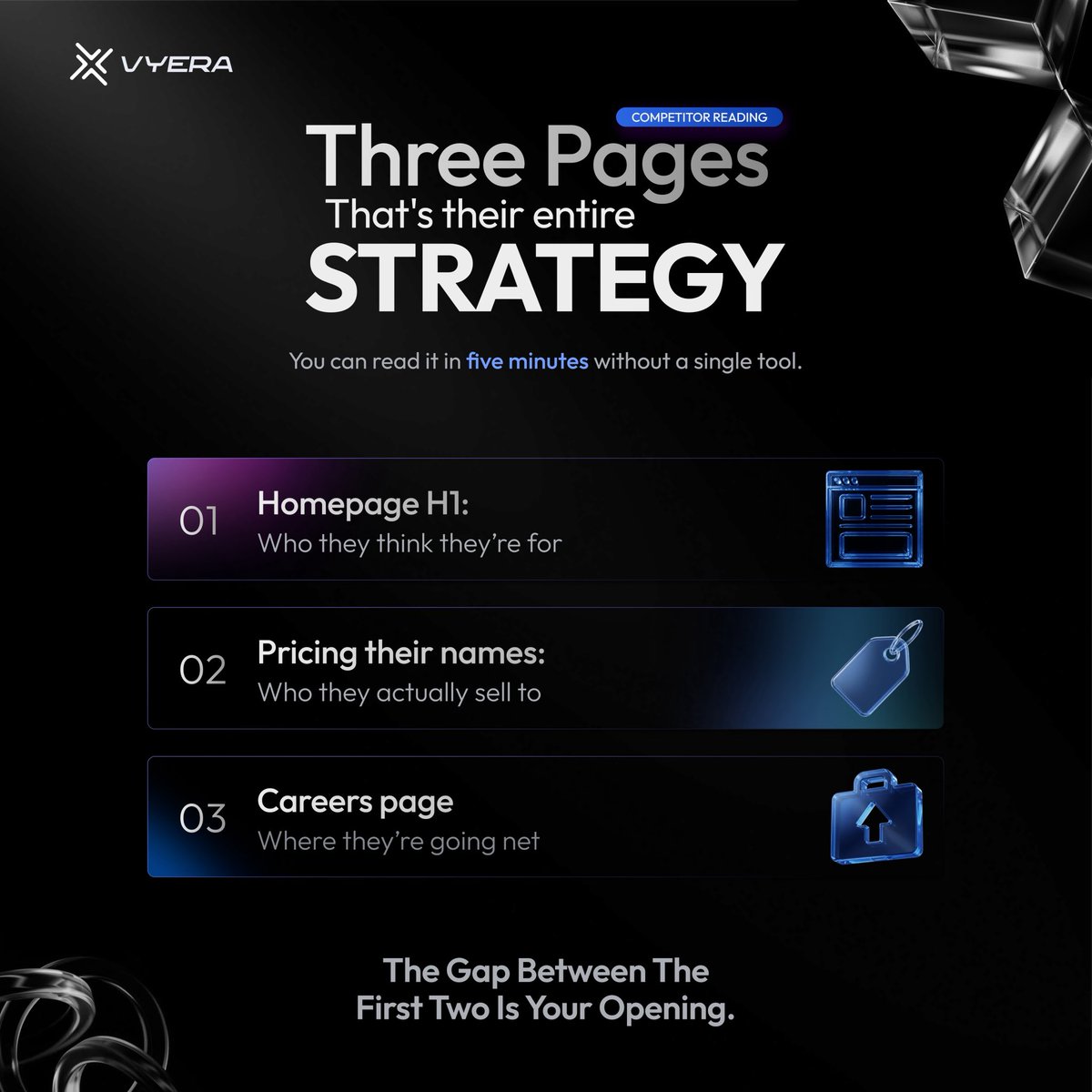
The gap between a company's homepage and its pricing page tells you where to attack.
Homepage H1: who they think they're for Pricing tier names: who they actually sell to Careers page: where they're going next
Five minutes. No tools. They publish all of it.
Publishing your pricing isn't transparency. It's a filter.
Public number → wins self-serve, loses the shaped deal
From £X → wins range, loses whoever assumes the ceiling
Contact sales → wins large and slow, loses anyone in a hurry
Name who yours is designed to turn away.
Twenty minutes a week beats checking competitors daily.
Friday morning. Four pages. Nothing else.
▸ Pricing: any tier, number or name that moved
▸ Changelog: what shipped
▸ Careers: roles opened or quietly pulled
▸ Comparison pages: whether you're named
Daily you see motion. Weekly you see change.
What's been sat on your list for more than three weeks?
It isn't hard. It's undefined.
"Rewrite the homepage" has no first action. "Rewrite the H1" does.
Every hour you spend falls into one of four rows.
Only you can do it → pricing, positioning, hires
You're best at it → closing, partnerships
Anyone could → posting, formatting, chasing
Nobody should → checking, refreshing, re-reading
Rows 3 and 4 usually win the week.
The fastest positioning exercise there is.
List the five words every competitor in your category uses.
Innovative. Powerful. Seamless. Intelligent. Simple.
Now list what none of them say.
That's your ground. Not the feature they're missing. The claim nobody is making.
Your docs page beats your thought leadership.
Gets cited → FAQs, docs, pricing, comparison tables
Rarely cited → the manifesto, the vision post, the founder essay
One answers a question. The other makes an argument.
Engines quote answers.
A check almost nobody runs. Twenty minutes.
Open your server logs. Filter the last 30 days by user agent.
Look for:
▸ GPTBot
▸ ClaudeBot
▸ PerplexityBot
▸ Google-Extended
Four numbers.
A zero means that engine has never read your site.
Marketing splits eight ways in a real team.
Strategy. Competitor intel. Sales enablement. Demand gen. Content. SEO. AI search. Reputation.
Write them out. Mark which ones nobody owns.
Which one came back unowned for you?
The awkward consequence: a page written to be quoted cleanly gets fewer clicks by design.
You can optimise for one or the other. Assuming you can have both is how teams end up with neither.