Lots of chatter about handwriting here: https://t.co/CXCcwbYFHf
Totally onboard with it. Built this product by intentionally introduced writing friction to give my brain a little nudge for writing ideas based on randomly generated prompts.
https://t.co/S4kYi32Tf2
WATCH: Taiwanese grandmothers aged 89 and 91 train at the gym. An increasing number of elderly people in Taiwan’s super-aged society are hitting the gym to stay healthy, both physically and mentally.
@jaybsauceda@UTAustin I felt that going back to school after mid-30s is a much bigger advantage now, as I got structured classroom exposure to experiment with these GenAI tools, refining my thought process and upgrading my knowledge in non-obvious ways. Also, congratulations on this brave move! :)
the craziest part now is that the modern computer probably has to be entirely reinvented, from scratch. pretty much like how jobs & co brought apple ii to market.
like not improved. not given a chatbot sidebar or something but really from the ground up like the iphone redefined what it meant to be a pocket computer.
the current paradigm for computers was built around a human staring at a screen, moving a cursor, opening apps, managing windows, naming files, remembering where things live, & manually translating intent into interface actions.
that made sense when the human was the runtime. but in an ai native world, it starts to look kinda ridiculous.
you can see this ridiculousness when you use computer use agents… they are useful sure, but they’re also obviously transitional. they’re teaching ai to operate machines designed for humans, which is clever, but also kind of absurd. it’s like making a robot hand so it can use a doorknob instead of asking why the door needs a knob at all. yes i know humans also need to use a door knob, but maybe in the future humans don’t need to use a computer, or at least what we think of a computer today at all.
this all leads to some interesting questions:
- what is a file when the system understands context?
- what is an app when intent can route itself?
- what is a desktop when work can be decomposed, executed, monitored, & summarized by agents?
- what is a browser when the agent can retrieve, compare, transact, & remember?
- what is an operating system when the primary user is no longer just a person, but a person plus a swarm of delegated intelligences? or no person at all.
the old computer assumed navigation.
the new computer has to assume a new kind of intention. the old computer organized information. the new computer has to try to organize agency.
we’re still in the hacky middle stage at the moment with sidebars, copilots, agents clicking through legacy ui, & automation layers sitting on top of 40 year old metaphors.
the new computer is likely one where memory, context, identity, permissions, tools, agents, & interfaces are native primitives. this means desktop, mobile, browser, apps, files, folders deserves another first principles look.
I want to see such indian content creators being celebrated, way more than we do.
What an awesome way to remember formulas: Bam Bam Bhole , Sona Chandi Tole 🤩
In 2006 a high school English teacher asked students to write to a famous author & ask for advice.
KURT VONNEGUT (who left us 19yrs ago today) was the only one to respond.
His reply was a doozy.
ai is exposing everyone right now & making legacy entities vulnerable af. even labs are having a tough time shipping features that feel really good end to end.
most ppl fail to realize that the hard part of building ai stuff was never access to a good model, it's the orchestration layer, the data plumbing, the taste in knowing when ai should intervene vs shut up, how it should intervene, what it should say, how it should say it, how does human in the loop work.. among many other subtle things. copilot is a prime time example of this.
most legacy players have none of these instincts cuz they built their orgs around shipping deterministic software. we are firmly in the non deterministic era now & that requires a very different skillset to build great tools.
A large elephant herd of about 100 was seen swimming across the Brahmaputra River in Assam, India, navigating the waters at Nimati Ghat, a major river port
it’s kinda crazy ppl don’t realize everything you ever encounter is a bundle of tradeoffs.
products, people, etc. you buy into the whole package or you don’t. there’s no unbundled version waiting somewhere with the rough edges filed off.
e.g. the reason apple products feel inevitable is that the constraints are actually the things that are load bearing. the thinness of the thing costs you the port or the battery life. the walled garden costs you freedom but buys you coherence. you’re not meant to want everything. you’re meant to recognize yourself in a particular set of sacrifices.
the same logic applies everywhere.
Every country has an energy. And that energy rewires you whether you notice it or not. People move to Japan and become minimal. People move to Mexico and their entire relationship with time softens. People move to New York and suddenly they can't sit still. Your personality is far more malleable than you think. We treat it like something fixed, but new surroundings give you new defaults. New pace. New habits. New values absorbed through proximity instead of effort. You're not just the average of the 5 people closest to you. You're the average of the 5 places, the 5 routines, and the 5 inputs you're exposed to most. Your commute shapes you. The weather shapes you. Every space you occupy is voting on who you become. That's why I believe choosing where you live is one of the most important decisions you'll ever make. More important than your job title. Maybe more important than your five-year plan. Because the place shapes the plan. The place shapes your energy, your habits, your relationships, your default state. Get the place right and half of the other decisions start making themselves. Get it wrong and you'll fight yourself every day.
A Harvard neurologist once told her class something that made half the room laugh, until she showed the scans.
"People who cry easily," she said,"have a faster emotional-processing loop than the general population."
Their mirror-neuron system fires quicker, their insula lights up more intensely, and their brain decodes micro-signals before others even register them.
What looks like "sensitivity" is actually hyper-efficient pattern recognition.
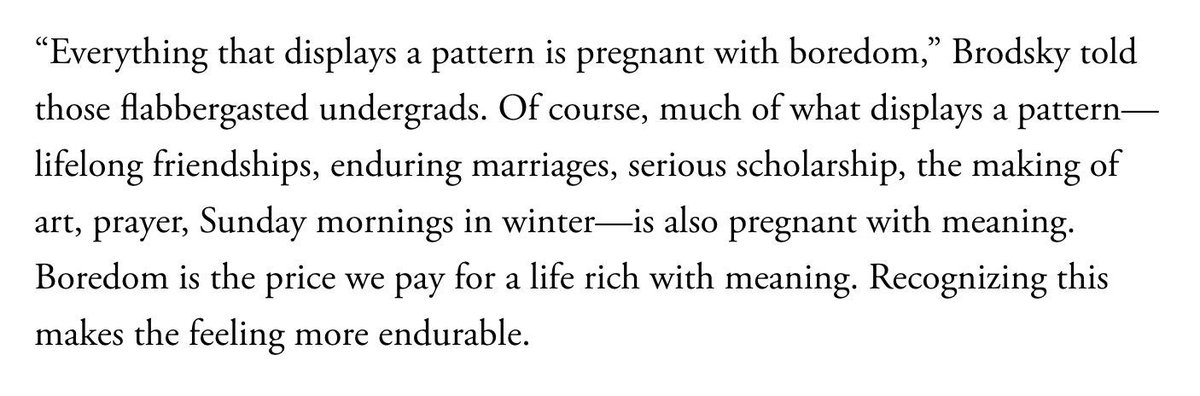
“Boredom is the price we pay for a life rich with meaning.”
This is a lovely point about the value of something we often deride as valueless, from @morbidorigin. https://t.co/bJFSyP7W7I