If I'm starting a company, I'm putting proto defined service and RPC boundaries in place even if I'm linking everything into a single binary. I was against of this idea until lately but experience is proving me wrong.
@SergioRocks Nothing says “I don’t care” more than regularly missed 1:1s with a report.
Best case: manager has too many reports. Change cadence.
Worst case: they don’t understand the job and time for the manager to level up! @lara_hogan can help
https://t.co/TT1x4BKOHg
The incredible thing is that this started bottoms-up: it was not mandated for a long time AFAIK.
Engineers did it because it meant less time spent later clearing up issues. Rules were in place after learning this the hard way.
Wrote more about this: https://t.co/IBFK7sKWvv
Event-driven architecture is kind of mindset. You think what happened, what will happen next and what happened before. EventStorming is very useful here.
Later, you represent this mindset on various levels of architecture (system, application, code) making your solution reactive
People confuse assignment of tasks with planning.
The point of planning is to ensure we are progressing intelligently and transparently toward our goal, yes?
As opposed to making sure everyone has plenty of work to do?
I wrote a blog post about how to build at data team in the form of a story (and it ended up being about 4x longer than I anticipated): https://t.co/AoOQ0RP9Xw
@joneaves One aspect to consider is: how do you plan to access that data? Kafka by itself cannot be queried, so you'll typically have to a materialized view layer for that. By definition, this will be eventually consistent, which needs consideration and weighing against your requirements.
I had to take some time yesterday to explain why, in a data pipeline where you want multiple consumers to use your data, loosely defined schemas are a really bad idea.
Continue to be impressed by the improvements made around #Java garbage collection in recent years. Sub-millisecond max pause times mean GC is a non-issue for vast majority of Java applications; exciting times! #ZGC#Shenandoah
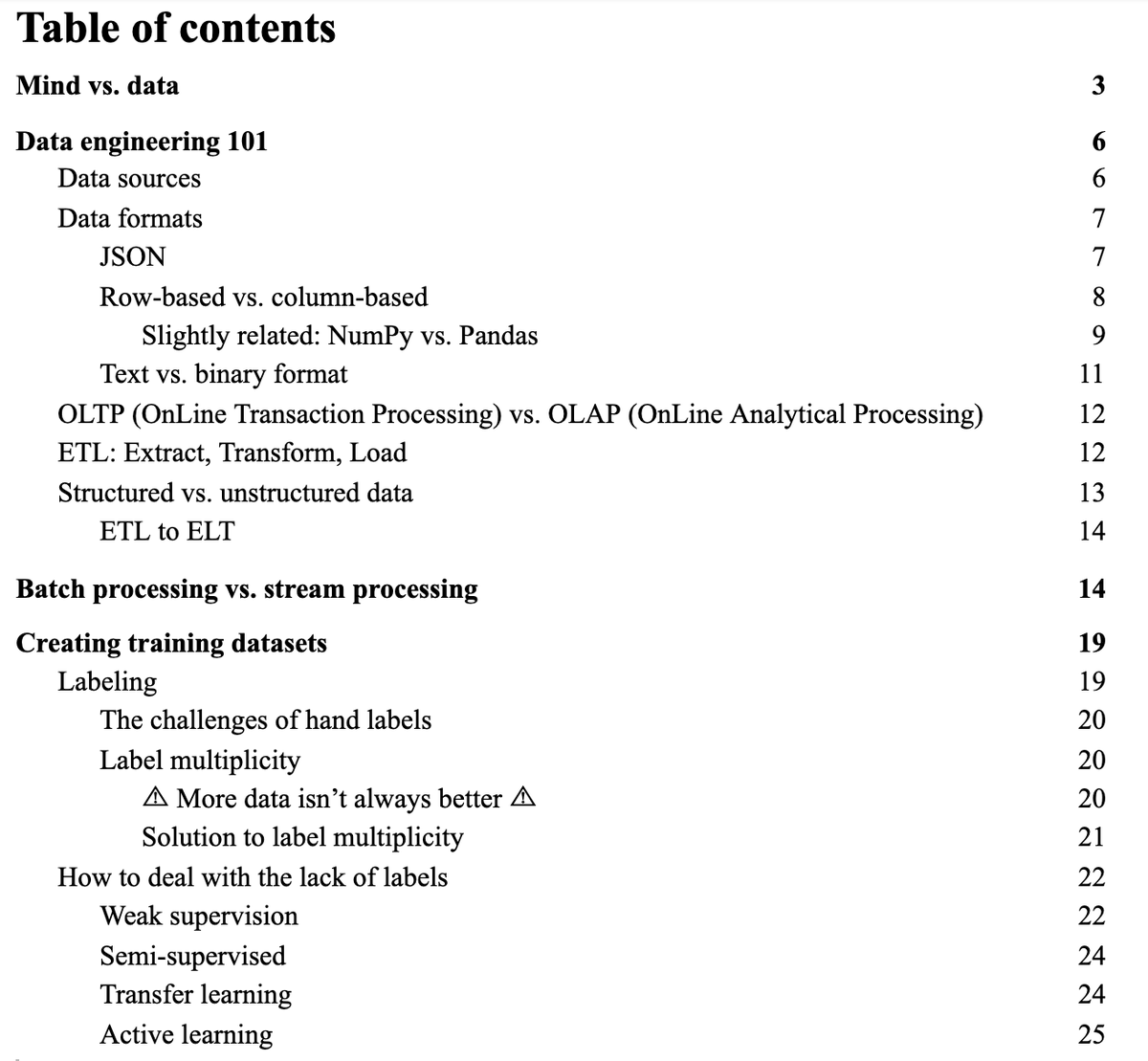
So I wrote a 5400-word lecture note on the basics of data engineering for my students, covering:
* data formats (row- vs. column-based, text vs. binary)
* ETL
* batch processing vs. stream processing
* training datasets
WIP. Feedback much appreciated!
https://t.co/oFdTDSIAin
I'm talking to a lot of people who are over remote work. Many people don't like the isolation, the monotony. It's not good for careers, e.g. promotion.
I am an office person. I want to go back as soon as it's safe. Many people miss the social aspects of the office. We exist.
This is the exact kind of bullshit magical thinking that is literally ruining everything.
There is a smart conversation to be had about distributed workforces and globalized talent markets. This ain't it.
Some software anti-anti-patterns I've learned over time:
- repeating yourself is often okay
- premature abstraction is a bigger problem than premature optimization.
- be less clever
@johncutlefish My main issue with autonomy is that while it provides empowerment to deliver value, it also comes with an entitlement to freely choose most things, even those that disempower other teams. Aspects that require coordination and consistency tend to suffer: security, data, privacy.