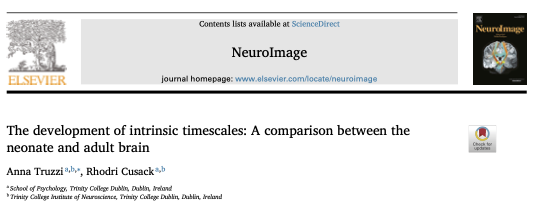
Our paper investigating intrinsic timescales in the neonate brain is finally out!
@rhodricusack@cusacklab
Short overview in the thread, full text here: https://t.co/y8hCEJzWa3
(1/7)
1/7 Does the infant brain have representational structure? 👶🧠In the FOUNDCOG project, we scanned 134 awake infants using fMRI. Published in Nature Neuroscience, our research reveals 2-month-old infants already possess complex visual representations in VVC that align with DNNs.
Meet our first confirmed speakers! 🧠
Global neuroscience leaders will join us at #NSI2025!
🔗 https://t.co/87QPUOi0gJ
🚨Abstract deadline is TODAY at 5PM (Irish time) – don’t miss it!
📝 https://t.co/SlULHLKUaj
A warm welcome to Dr Anna Truzzi who has joined the School of Psychology as a Senior Lecturer. Anna’s research explores how the infant brain integrates information appearing on different timescales in the world.
Read more: https://t.co/mLNEq388g5
#LoveQUB#Welcome#WhoWeAre
Our latest study on marmoset attachment was introduced by The Science News by JST. I am glad so many people are paying attention! https://t.co/GqnzYmkGH3
Studying parent-infant interactions in common marmosets has been an epic journely!
I'm deeply greatful to the other two first authors, @SaoriYN10525 and Kazu Shinozuka, to the co-correspondent author @oneko45, and to the awesome PI and supervisor @kumi_kuroda
The early relationship shapes the #Attachment system of children, the basis of interpersonal attitudes throughout life.
But what kind of parenting shapes secure infant attachment?
Our new study addresses this question!
https://t.co/epkZ9Yb137
WIRI's upcoming event is on a very important topic very close to our hearts: Challenges of Juggling Academia and Motherhood. Tickets are now available
https://t.co/e3j8XhleCb
RT's appreciated
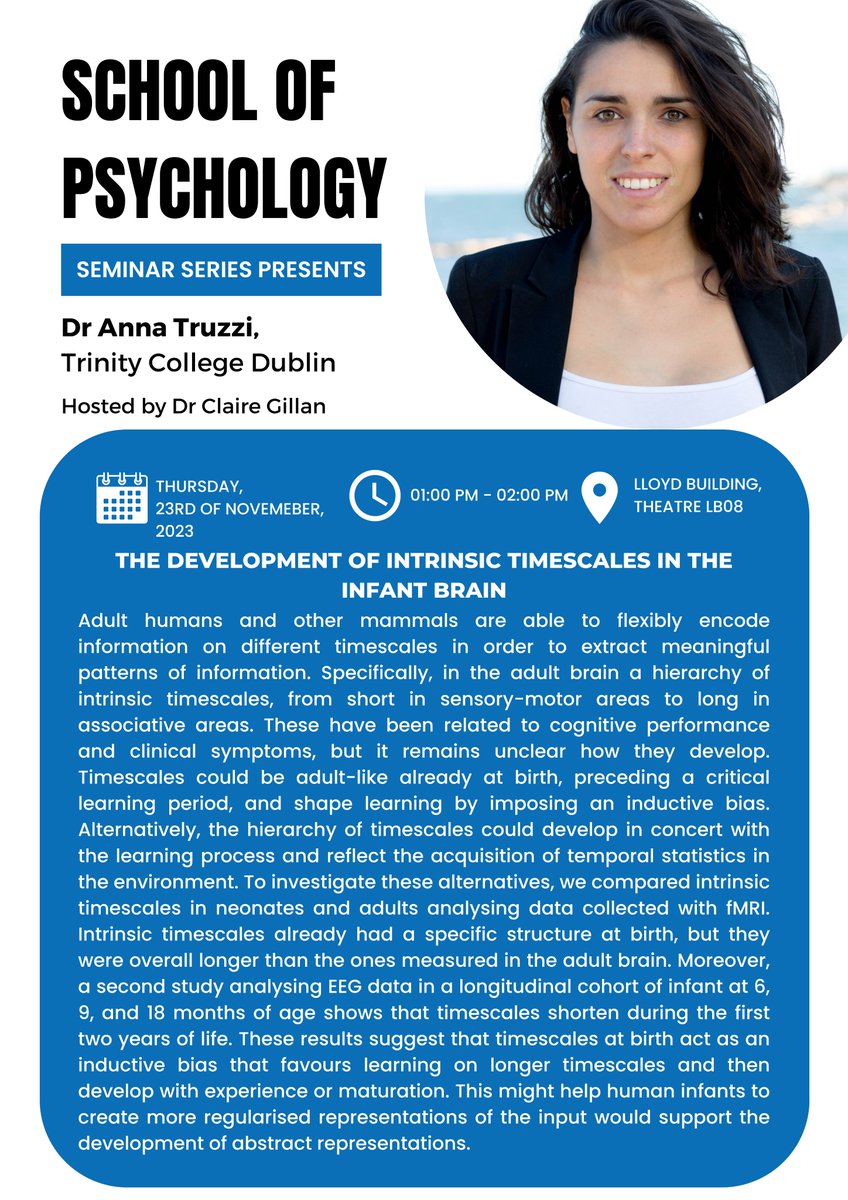
Our next Psychology Seminar is this Thursday at 1pm from the 2023 winner of the postdoc paper prize 🏆Dr @anna_truzzi! Anna will speak about the development of intrinsic timescales in infants and as usual, join for ☕️🥪🧁 afterwards.
Resting state, or sleeping state? We know that wakefulness matters for adult functional brain network organization. In our new paper, we show that wakefulness can also be important in infant fMRI! 1/9 https://t.co/jrFNgLmlU7
Deeply greatful to @PsychologyTCD, @clairegillanTCD, and the evaluating committee for making this possible, as well as to my supervisor and co-author @rhodricusack for his constant help and support in this project!
Congratulations to our Postdoc Research Paper prize winner 🥇Dr @anna_truzzi for her paper with @rhodricusack “The development of intrinsic timescales: A comparison between the neonate and adult brain” published in Neuroimage.
Longer initial timescales could be the result of slower processing caused by the developing myelination and they might help the infant brain to “take it slow” and start by learning more holistic representations less tied to fleeting fast changing details.
7/7
Our paper investigating intrinsic timescales in the neonate brain is finally out!
@rhodricusack@cusacklab
Short overview in the thread, full text here: https://t.co/y8hCEJzWa3
(1/7)
In conclusion, timescales in the neonate brain, even if different from adults, were not uniformly nor randomly distributed, suggesting the early presence of a structure of timescales which could act as an inductive bias and direct learning.
6/7