I finished a project (rare!) & I actually don't hate it (more rare!) 🐐 MAYA JAM INVENTS A PET is a kid's book with a companion chatbot.
Maya is a silly inventor who builds a robot goat & turns out #AI is VERY good at being a robot goat @OpenAI 🤖
& so https://t.co/09XTCTGGTj
why tagging is not enough: we kinda miss half of the point of why we want to memorize/categorize sth in the first place: we do it because of the way we see sth fits or connects to our existing ideas, not just by itself.
most of the time these connections are hard to articulate and we are already happy we have stored the idea somewhere. but really the connection is the most critical piece.
to not just store sth but can recall and use it later, we could try design interfaces that function as conceptual landscapes. aka embed info proximity as an inherent affordance in the system.
img src: nobel prize org
there's a little-used pattern from game design where UI progressively hides itself over time as the user internalizes its meaning
in my ideal future, 'generative ui' is more like this than like a fully hallucinated web app
🤖 My latest substack dives into Moxie and teens use of @character_ai 'Sorry honey, your BFF is dead'; How Should We Talk to Children About the 'Death' of Their AI Companions? https://t.co/9VtXaR1u6L
With conversational & generated UI, I often see people fooling themselves into thinking there's less to design, that the problem is now "up to the model."
This can't be further from the truth! There is still much to design. You are simply exchanging designing pixels for designing behaviors, through the indirect means of your fintuning and evaluation datasets. In some ways, a much harder problem, because the space of possible behaviors is very high dimensional, and we don't yet have great tools to see the structure of that space. There's a large toolset of new vocabulary and tooling to be built.
Social agents will become a trillion dollar business if/when someone can successfully create a scaled, hybrid human/agent social graph that solves the social discoverability problem. Consider the following:
- Me talking to a social agent is a 1:1 social graph. Not that interesting.
- Me and my friend Bob talking to the same social agent is a 2:1 social graph. Interesting *if* the social agent can bridge between us (e.g., agent says to me: “did you know you and Bob both like [x]?”)
- Me and Bob each talking to two agents, who each talk to each other, is a 2:2 social graph. Agents can share information about us (agent #1 says to me: “I was talking to agent #2, who was talking to Bob, did you know…”)
Phase 1 of social networks was to bring your IRL relationships online, and social graphs were mostly the same. Phase 2 of social networks was to discover new people online to have a digital native social graph, which was bigger and based more on interests than geography. Phase 3 could be enhanced/solved discoverability because of having agents as meaningful nodes in the social graph.
Anyone who can figure out how to scale a large social graph that is human/agent hybrid will essentially solve the social discoverability problem. You could do a few flavors of it:
- Purely social interest focused discoverability (e.g., next gen FB)
- Purely career focused discoverability (e.g., next gen LinkedIn)
- Etc.
DMs open, this idea continues to come up in conversation from some of the smartest people I know.
LivePortrait is getting better with every release 🪄
We're quickly approaching the point where you can adjust every part of a face...and it actually looks real.
It's even better with animated characters - human faces are the real test, and this version is passing!
@Google@Bunnings @raiza_abubakar As a kid, if we had a podcast of our grocery list playing on our way to the store- I'd be in a fit of giggles listening to it try and work out what we're having
Getting @Google#notebooklm to hype up by @Bunnings shopping list - it's the DIY hype up I need on the drive there @raiza_abubakar. "we're talking about creating something with heft". I am! I am!
When I discussed quitting Google to do a Phd, my manager, Steve Cheng, gave me the advice of "6 shots": Doing something meaningful usually takes about 5 years and we are productive for roughly 30 years. That gives you 6 attempts. So pick each one carefully and give it your best.
✨ how might we combine our familiar, deterministic interfaces with the new, fluid capabilities of LLMs?
Some musings that have been rattling around my brain for a while. Taking inspiration from how nature transitions between hard & soft materials.
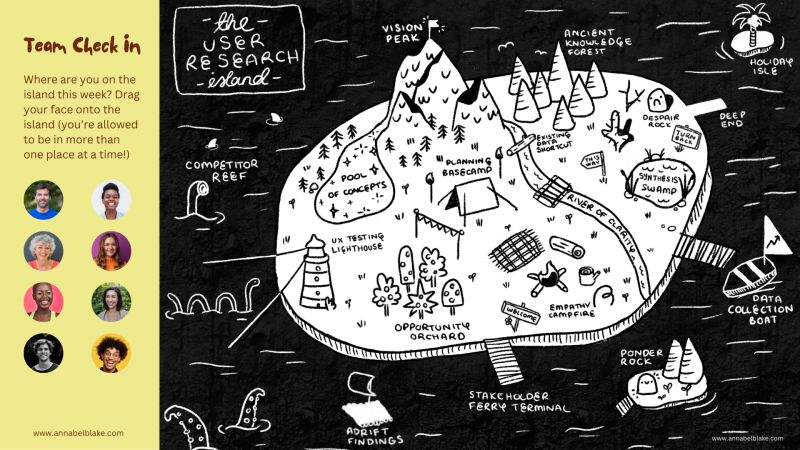
Welcome to the #UserResearch Island🐸 Synthesis swamp, �� ponder rock &💡 pool of concepts are some of my favourite places. (I also enjoy long spells in the Ancient Knowledge Forest 🌲)
I made the #UXR check-in into a ✨ template✨ if you'd like to try! https://t.co/6IbaOT8Eqf










![ccamp___'s tweet photo. Social agents will become a trillion dollar business if/when someone can successfully create a scaled, hybrid human/agent social graph that solves the social discoverability problem. Consider the following:
- Me talking to a social agent is a 1:1 social graph. Not that interesting.
- Me and my friend Bob talking to the same social agent is a 2:1 social graph. Interesting *if* the social agent can bridge between us (e.g., agent says to me: “did you know you and Bob both like [x]?”)
- Me and Bob each talking to two agents, who each talk to each other, is a 2:2 social graph. Agents can share information about us (agent #1 says to me: “I was talking to agent #2, who was talking to Bob, did you know…”)
Phase 1 of social networks was to bring your IRL relationships online, and social graphs were mostly the same. Phase 2 of social networks was to discover new people online to have a digital native social graph, which was bigger and based more on interests than geography. Phase 3 could be enhanced/solved discoverability because of having agents as meaningful nodes in the social graph.
Anyone who can figure out how to scale a large social graph that is human/agent hybrid will essentially solve the social discoverability problem. You could do a few flavors of it:
- Purely social interest focused discoverability (e.g., next gen FB)
- Purely career focused discoverability (e.g., next gen LinkedIn)
- Etc.
DMs open, this idea continues to come up in conversation from some of the smartest people I know.](https://pbs.twimg.com/media/Gbo1walbMAAa5cJ.jpg)