A 100% renewable energy future IS possible.
Portugal just ran exclusively on wind, hydro and solar for six days in a row ⤵️
#EndFossilFuels https://t.co/EzGYPdpvLo
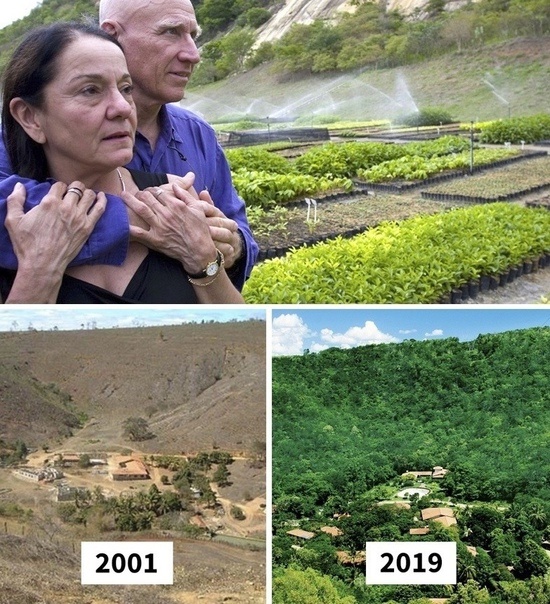
In the early 1990s, Brazilian photojournalist Sebastião Ribeiro Salgado was stationed in Rwanda to cover the genocide, an experience that left him traumatized.
In 1994, upon returning to his home in Minas Gerais, Brazil, Sebastião hoped to find solace in the lush green forest of his childhood. Instead, he discovered that his home had transformed into a dusty, barren land stretching for miles, devoid of any wildlife.
"The land was as sick as I was. Only about 0.5% of the land was covered in trees," he remarked. At this time, his wife, Lélia Deluiz Wanick Salgado, proposed that they embark on the ambitious journey of replanting the entire forest.
Sebastião supported the idea, and together, over the course of the next 20 years, they planted an astonishing 2.7 million trees.
Their efforts resulted in the rejuvenation of 1,500 acres of rainforest, and the site eventually became home to 293 plant species, 172 bird species, and 33 animal species, some of which were on the brink of extinction.
In the West Sahel, farmers recover degraded land and prevent desertification by digging half-moon holes. Also called “zai pits”, the ditches capture scarce rainwater and direct it toward growing plants, helping reforest the edges of the southern Sahara
https://t.co/4pOeT0cKY9
Japan’s iSpace HAKUTO-R lander captured this stunning photo in orbit around our Moon while a solar eclipse was occurring on Earth last week. You can see the Moon’s dark shadow passing above Australia as a dark smudge.
In the early 1990s, Brazilian photojournalist Sebastião Ribeiro Salgado was stationed in Rwanda to cover the genocide, an experience that left him traumatized.
In 1994, upon returning to his home in Minas Gerais, Brazil, Sebastião hoped to find solace in the lush green forest of his childhood. Instead, he discovered that his home had transformed into a dusty, barren land stretching for miles, devoid of any wildlife.
"The land was as sick as I was. Only about 0.5% of the land was covered in trees," he remarked.
At this time, his wife, Lélia Deluiz Wanick Salgado, proposed that they embark on the ambitious journey of replanting the entire forest. Sebastião supported the idea, and together, over the course of the next 20 years, they planted an astonishing 2.7 million trees.
Their efforts resulted in the rejuvenation of 1,500 acres of rainforest, and the site eventually became home to 293 plant species, 172 bird species, and 33 animal species, some of which were on the brink of extinction.