I was learning about the economies of nations in class yesterday and just muttered, “Crazy Twitter people.”
I spoke about it months ago and got insulted by half-witted humans here. Hearing my international module professors validate the same argument, particularly in the context of emerging market economies, made me realise that I really need to stop arguing on Twitter.
It’s doing myself a disservice. You’re right, I’m wrong. EOD. 🙏
Hmmm toooooo bullish, expect it to decline at the back of lower base, but remain within 14% levels.
On a month on month basis, it’s expected to increase further due to a decline on the Fx exchange rate MoM and the power outrage forcing businesses to rely more on alts.
Nigeria’s consumer price index (CPI), which measures headline inflation, is expected to decline for the fifth month in October, driven by sustained swings in global energy costs and a stable exchange rate.
https://t.co/bKpyDheQVo
#NigeriaInflation#CPI
@Hacklordy Well.. you can use credit default swaps contracts from Bloomberg, that’s for me tho, my guys uses I think consensus from all houses and compute theirs but Bloomberg swap contracts are my go to.. they reflect current pricing of a country’s default risk and all that
@Hacklordy 2/2
Probably debt concerns are due to acquisitions, one off but equity still intact and say any refinancing update by the company that’s feasible, it’s all factored to the ERP.
We prefer it to Damodaran coz his isnt always updated real time, not that we don’t use it sometimes
The Fed Is Fighting the Wrong Inflation. Warsh needs to show leadership!
Warsh wants to scrap forward guidance and dot plots while leaving Fed officials free to broadcast their policy preferences. That does not end forward guidance. It hands the microphone to hawks and disgruntled colleagues, allowing their pronouncements to shape expectations.
Reckless comments from Fed officials need to stop!
The result is neither coherent communication nor disciplined policymaking. A central bank should distinguish a fading supply shock from persistent demand pressure, not let its loudest voices dictate the response.
October’s CPI rose 0.4 per cent, down from 0.6 per cent, the trend matters. Core was 0.3% unchanged from previous month.
Governor Waller is floating a half-point December increase. A tenth above expectations, and out comes the sledgehammer. That’s reckless!!
Yet services accounted for nearly 90 per cent of core inflation, with shelter contributing half of core services. Owners’ equivalent rent, an estimate, not a payment homeowners make, dominated shelter rent.
Housing scarcity is not a wage-price spiral. Higher rates can aggravate it by raising construction costs and locking homeowners into existing mortgages. The supposed cure risks feeding the disease.
Meanwhile, the energy shock is unwinding. West Texas crude has fallen more than 20 per cent from late October; wholesale gasoline is down 27 per cent since September. One-year inflation swaps are below 2 per cent.
Six-month annualised core CPI is 2.7 per cent; Dallas trimmed-mean PCE is 2.4 per cent. Third-quarter productivity rose 3.6 per cent annualised, while unit labour costs fell 0.7 per cent.
These figures demand judgment, not reflexive tightening. Raising rates into easing energy prices and falling labour costs would risk turning a temporary inflation shock into recession.
Fed desk read
December hike odds swung from about 83% on Wednesday to 68% Friday morning, then back up to 77.5% by Friday’s close. The path for 2027 also firmed, with March now at 40% and the peak rate near 4.35%. One week, three different stories about the Fed. Gold still finished up 5%, but CPI next week will decide whether December is a done deal or still up for grabs. $GC_F
Don’t Strangle the Supply-Side Recovery
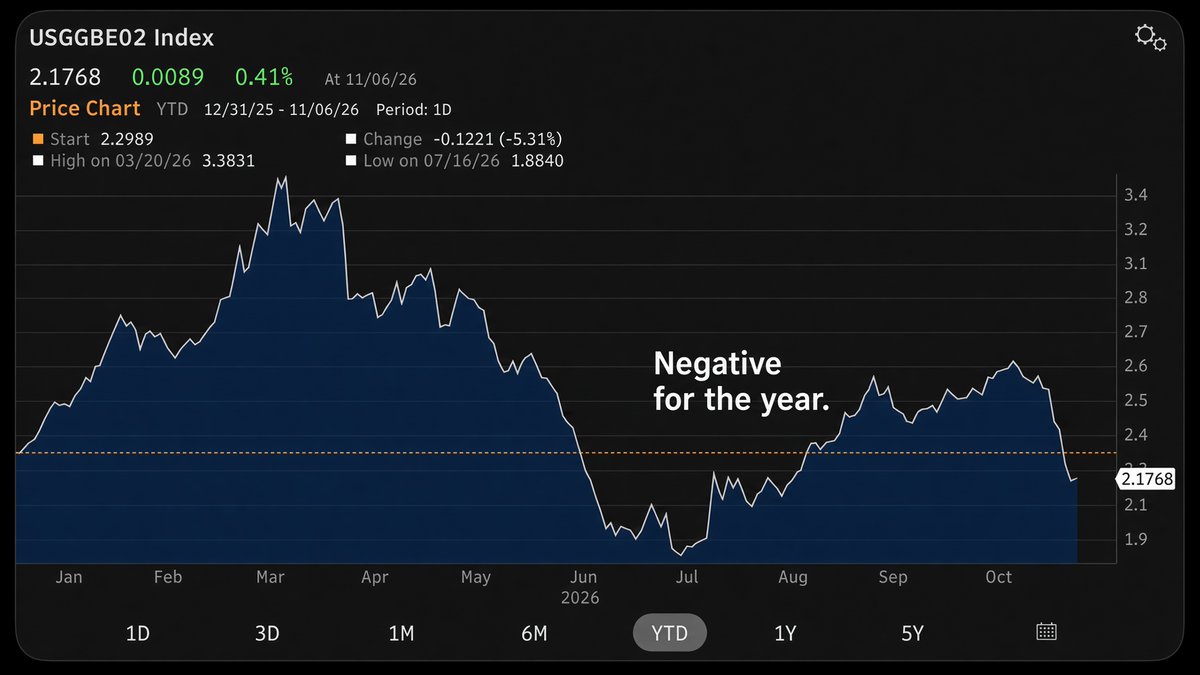
The case for another Federal Reserve rate increase is crumbling. Gasoline prices are falling. Some DRAM spot prices are retreating. Two-year inflation breakevens have dropped 20 basis points in three days to 2.18%. Yet the tightening debate remains trapped in yesterday’s inflation.
That is how policy mistakes happen.
Tariffs and chip shortages raise the price level. They do not automatically create permanently higher inflation. Once those increases enter the comparison base, their contribution to annual inflation fades.
A product that rises from $100 to $110 records ten percent inflation. If it stays at $110 a year later, inflation is zero. No rate increase is needed to make that arithmetic work.
As 2026’s price spikes roll out of the annual comparison in 2027, base effects will pull inflation lower, without another Fed hike.
Now add actual price declines. Gasoline and parts of the memory market are reversing earlier increases. Disinflation is not merely approaching. It is underway.
The bigger story is productivity. Strong productivity growth, falling unit labour costs and a strong jobs market describe an economy expanding its capacity, not simply overheating. Businesses can produce more, support higher wages and contain costs simultaneously.
These are the green shoots Trump’s supply-side agenda is designed to cultivate: stronger investment, greater productive capacity and non-inflationary growth. The test of that agenda is sustained improvement in output and costs, not whether every strong jobs report triggers another inflation scare.
Employment growth is not the enemy of price stability. Weak productivity is. Treating every sign of economic strength as excessive demand risks strangling the supply expansion that makes growth sustainable.
The bond market is delivering its own warning. Two-year breakevens approaching 2% undermine the argument that inflation expectations are becoming unmoored. In fact they’re negative for the year.
The Fed must explain what another hike would fix. Higher borrowing costs cannot repeal tariffs or manufacture chips. They can crush investment just as productive capacity begins delivering results.
Those demanding tighter policy carry the burden of proof.
Do not punish stronger supply for looking like stronger demand.
Treasury’s $95 Billion Buyback Plan Leaves Door Open to More
Treasury plans to buy back up to $95 billion of debt over the next three months, versus the $63 billion ceiling initially announced in August. The wording also leaves room for more: Treasury says it is evaluating “possible enhancements,” including “changes to maximum purchase amounts” and operation frequency. That signals flexibility to expand the program—not a commitment to exceed $95 billion
https://t.co/pxdrFSZJ9B
Respectfully, I agree with one thing. Both sides of the equation matter.
But a +1/-1 scoreboard only works if each item starts from the same place and carries the same weight. These don't. Let me go through them.
1. Fuel subsidy removal
The cost of living is a -1. Agreed. It hurt.
But the cost did not disappear when the subsidy was there. It was financed by borrowing and pushed to the next government. So the question is not only what the savings turned into. It is also what the old system was turning into.
You count the pain of removal. You do not count the pain of keeping it. That is half a ledger.
—————
2. Foreign exchange market
Interest rates are not an FX policy. The MPC sets them as the monetary policy rate (MPR), the rate banks price loans from. And it has started to move.
In September, the CBN cut the MPR from 26.5% to 23%. It cited easing inflation to 15.39%, a stable exchange rate, and reserves of about $55bn.
So a stable FX market made the cut possible. You listed it as the cause of the problem. That's why the problem is easing.
Also, businesses paid for the old FX system. Multiple rates. Dollars you could not get at any price. You counted today's cost of borrowing. You did not count that one. Which was cheaper?
You asked what progress there is beyond stabilising the rate. Net reserves, what the CBN owns after what it owes, went from about $4bn in 2023 to $34.8bn in 2025.
—————
3. Oil and gas
An IOC selling an onshore asset is not Nigeria losing barrels.
Shell sold its onshore business to Renaissance, a group of Nigerian companies. Eni's NAOC went to Oando. The oil is still in the ground, and Nigerians are producing it. Your own +1 says local operators are ramping up. The -1 is the same barrels with a different owner.
Meanwhile, the same companies are putting money offshore. Shell took a final investment decision, the point where a company commits the money, on the $5bn Bonga North project in December 2024. ExxonMobil is committing $1bn to Usan, its first drilling campaign here since 2016. TotalEnergies decided on Ubeta in 2024 and says Ima is next. Together, those two could add about 140,000 barrels a day.
TotalEnergies' own Victor Bandele credited the incentives introduced in 2023 and 2024.
Output was 1.53m barrels a day in September, excluding condensate. That is above the OPEC quota for the fifth month running.
Would a company leaving a bad environment commit $5bn to it?
—————
4. Government revenue
Debt servicing is a -1. Agreed. But it is not a reform cost.
The stock was inherited. The N22.7 trillion the CBN lent the government under Ways and Means was converted to debt in May 2023, at Buhari's request, for 40 years at 9%.
You put revenue as a +1 and debt service as a -1 as if they are separate lines. They are the same line. Revenue is what shrinks the burden.
In the first half of 2026, federal revenue was N6.2tn, up from N3.6tn a year earlier. That is 72% up. Interest payments rose 38%. Revenue is growing nearly twice as fast as the interest bill.
—————
Now the scoreboard itself.
You say some costs are transitional and some benefits take years. Then asking for the net score today is asking for the result before the work is done. You cannot concede the timeline and demand the verdict.
You are aiming at people who say the reforms were painless. Who are they? No name, no quote. Nobody serious says nothing hurt. The claim is that these things had not been done before, and that they are working. That claim is still standing.
You asked us to look at outcomes. I agree. None of your -1s came with a number.
Net reserves from about $4bn to $34.8bn. Inflation at 15.39%. The MPR cut to 23%. A current account surplus in 2024 and 2025, meaning more dollars came in than went out.
And a +1 and a -1 only cancel if they weigh the same and last the same time. A subsidy bill that grew every year is not the same size as an adjustment. Inherited debt is not the same as created debt. Equal marks do not make equal weights.