While there’s too much waste, recyclers who could turn #textilewaste back to new textiles, can’t access what they need - large volume of same waste, sorted by fibre composition. But garment factories say it’s not their problem, waste traders can take it. How to solve the puzzle?
While there’s too much waste, recyclers who could turn #textilewaste back to new textiles, can’t access what they need - large volume of same waste, sorted by fibre composition. But garment factories say it’s not their problem, waste traders can take it. How to solve the puzzle?
With too much #textilewaste on one side and the emerging recycling industry on the other, question is how does which waste reach the best recycling. If the supply chains aren’t there or efficient enough then recycling can’t scale. #wastehandling sector is the key!
@ASamdanee But the other side of the same topic - when you can’t trace the #textilewaste, you also can’t know what part of it gets used and how and some part of it (for many reasons) ends up in such landfills or incineration.
While there’s too much waste, recyclers who could turn #textilewaste back to new textiles, can’t access what they need - large volume of same waste, sorted by fibre composition. But garment factories say it’s not their problem, waste traders can take it. How to solve the puzzle?
@ASamdanee Yes, exactly! This is one of the myths here in Europe that fabric becomes instant waste when you can’t use it, but in countries like BD there is actually a huge market for it for many use cases. So it’s important to think twice before you call something waste.
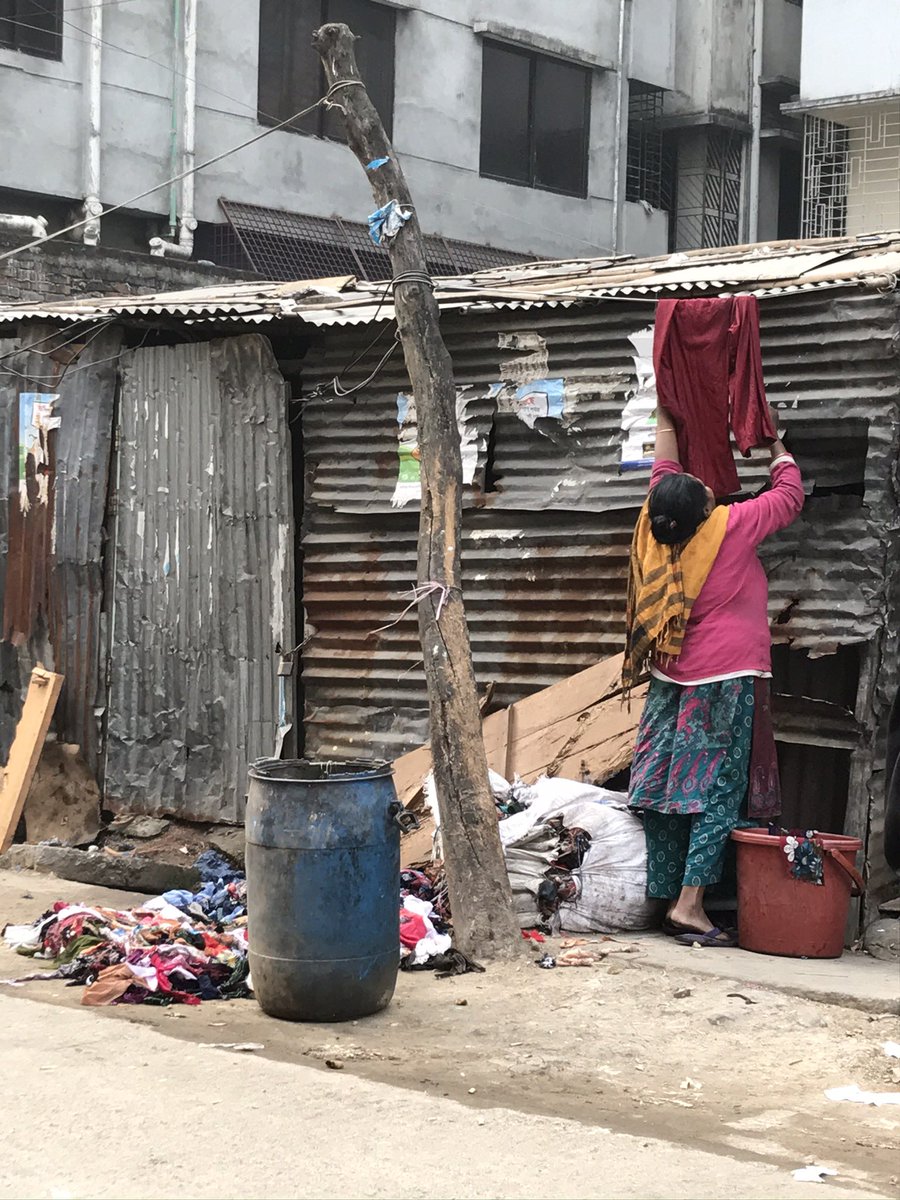
A lady in the morning hanging laundry to dry while the bags of #textilewaste that has been delivered as fuel for the stove for cooking has fell apart next to her. All textile waste has market value in Asia, question is how much of it finds a better use. #textilerecycling
#textilerecycling back to new textile can today be done in few ways. Most common is mechanical shredding #textilewaste to fibre and spinning it to yarns again. While the fibre length is now shorter, waste fibre needs to be mixed with virgin cotton or polyester for yarn strength.
Just to comment some more on this photo - I was amazed to realise that these ladies were sorting black from black. To my eye, everything looked the same, but they managed to differentiate 4-5 different shades while not having too much light in that warehouse.
Waste management traditionally operates by the brokering model - buy cheap, sell high. To protect their business, #textilewaste traders don’t want #transparency of where the waste came from or where it’s going to. It’s “making gold out of shit” - manually sorting the better bits
@freultwah Huvitav, kas on tehtud mingeid küsitlusi - kui palju on põhjuseks see, et inimesed ei usalda ühistransporti, sest pole sellega ise ammu sõitnud ja kuidas siis saab lapse sinna lubada, üksi ka veel. Oma hämminguks avastasin, et mu vanemad on aastate jooksul nii mõtlema hakanud.
When I started visiting garment factories in China and Bangladesh in 2016, I was overwhelmed with how clothes are made - 200 lays of fabric getting sawn to pieces. You would’t normally pay attention to the bits that fall in the bin - not much waste, right? #circulartextiles
We know that our clothes, once worn out, end up landfilled or incinerated. But today the techologies for recycling >80% of any textile is already invented and some are scaling industrial production. What is missing is the supply chain to prepare the waste for #textile#recycling
“Do you believe in circular economy?” was a question asked from my team member last week. “It’s not the matter of faith - we are doing it!” was his reply. Indeed, most people need to “believe” because it’s so complex, systemic and early stage that it’s difficult to see evidence.
I’ve never really used Twitter, and in general, never spoken up much. But from now l’ll start making a post each day/week to share what I’ve learned on our 8-year journey of turning fashion industry circular and what circular economy really means ‘cause there’s so much to share.
My father taught me since childhood that if you want to discuss something with a russian so that he’d listen, you need to start by yelling and attacking to gain his respect. I tried few times - it works! Anyone tried yelling at Putin?