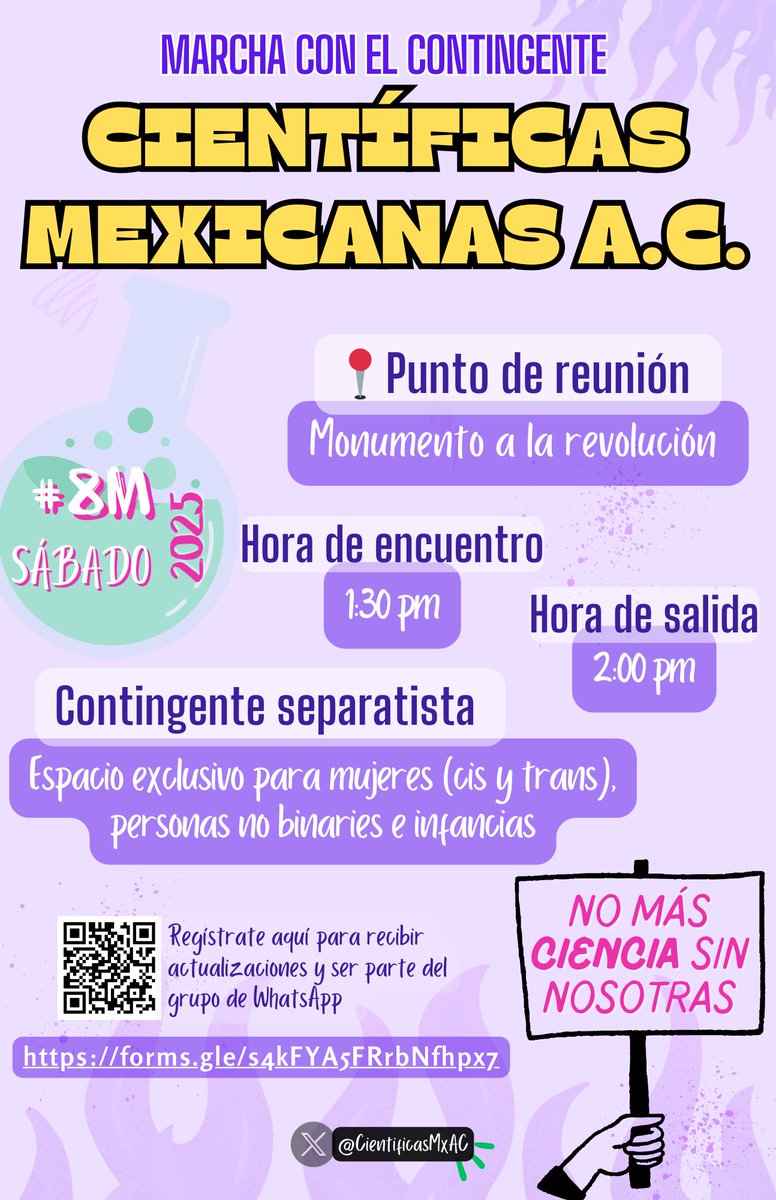
🚨 ¡Marcha con Científicas Mexicanas A.C. este #8M2025!
Monumento a la Revolución📍
13:30 Reunión
14:00 Salida
💜 Contingente separatista para mujeres (cis y trans), personas no binarias e infancias 💜
📝 Regístrate aquí : https://t.co/kpMKbqlDeS
#NuncaMásCienciaSinNosotras
Hoy #DíaInternacionaldelaMujerylaNiñaenlaCiencia, compartimos los sentipensares de científicas
💜 El #11F nos enorgullece, pero también nos enfrenta a desafíos
Seguimos trabajando por un mejor futuro para las científicas del mañana
📷 Mira y cuéntanos: ¿Cómo vives esta fecha?
From #LatinXChem, we celebrate the talent and perseverance of women and girls in science. To all of our researchers, your contribution is invaluable. There is still a long way to go to close the gender gap in STEM, but every girl who dreams of science brings us one step closer.
De poco sirven los protocolos de género y las defensorías universitarias si las relaciones de poder que sostienen la violencia académica siguen intactas. Sin sanciones para los agresores y sin reparación para las víctimas, la denuncia se convierte en trámite y el abuso, en norma.
Some words of wisdom from this year's chemistry laureate David Baker, whose work has made it possible to design new proteins from scratch.
Read more and join us on tomorrow 8 December to hear his Nobel Prize lecture: https://t.co/10fEOSEDEr
@jotoldo@LatinXChem the three Cartesian components of the dipole moment of the complex must match the three Cartesian components of the dipole moment of the frozen complex. This corresponds to the observable, a one-directional charge transfer between fragments. :)
🤗Excited to present: The dipole moment and charge transfer in the Hydrogen Bond, at @LatinXChem#LatinXChem24#LatinXChemComp#Comp143 We use measurable dipole moments to accurately quantify charge transfer, providing a detailed assessment of its impact on the interaction energy
@jotoldo@LatinXChem Thanks for your question! We have shown that the charge-transfer process can be described using the dipole moment as a reference. Therefore, the energy of the charge transfer-free complex can be obtained by minimizing the energy of the complex subject to three constraints: ...
@rgraucrespo @LatinXChem Dr. Javier Carmona-Espíndola is currently working on an energy decomposition analysis using observables, which will provide a more comprehensive understanding of hydrogen bonds! :D
@rgraucrespo @LatinXChem Thank for your observations! We agree with your point. Until now, our main focus has been to test this new methodology for obtaining charge transfer through an observable like the dipole moment. However, ...
@rgraucrespo @LatinXChem In this charge transfer-free energy, the very small contribution of charge transfer that may be present in higher order terms is neglected. :)
@rgraucrespo @LatinXChem the dipole moment of the complex are the same as the three Cartesian components of the dipole moment of the frozen complex, which corresponds to the observable, one directional charge transfer between the fragments.