आ॑चा॒र्यो मृ॒त्युः
~ Atharvaveda
Translation: Acharya is the Death.
Meaning: A teacher is the giver of a student's second birth, for through knowledge hence they bring an end to the student's former self.
@stelo_verda प्राकृत के अंतर्गत केवल संस्कृत से प्राकृत का जो आपभ्रंशिक मेल है उसी का दर्शन कराना योग्य है। प्राकृत भाषाएं कैसे संस्कृत से उद्भूत हुई तथा कौनसे राज्यों में कैसे प्रकार के विकार आयें उन्हीं के लिए प्राकृत विषय हो।
@stelo_verda भाषा पृथक ��िषय बनाकर उसमें संस्कृत-प्राकृत तथा आंग्ल सिखानी चाहिए। प्राकृत भाषाएं सदा से परिवर्तनशील रहीं हैं, उनका उपयोग गांवों-घरों में परस्पर संवाद के लिए करना योग्य है। परन्तु मातृभाषा का विशेष व्याकरण सिखाना व्यर्थ है।
@AASIshravas@TheEmissaryCo Letting any wayward practice to happen under the diguise of ''liberty to practice''? The so called 'intrusion' you spoke of is way ancient and also happily ratified; those who oppose this have always been preoccupied by foreign thoughts.
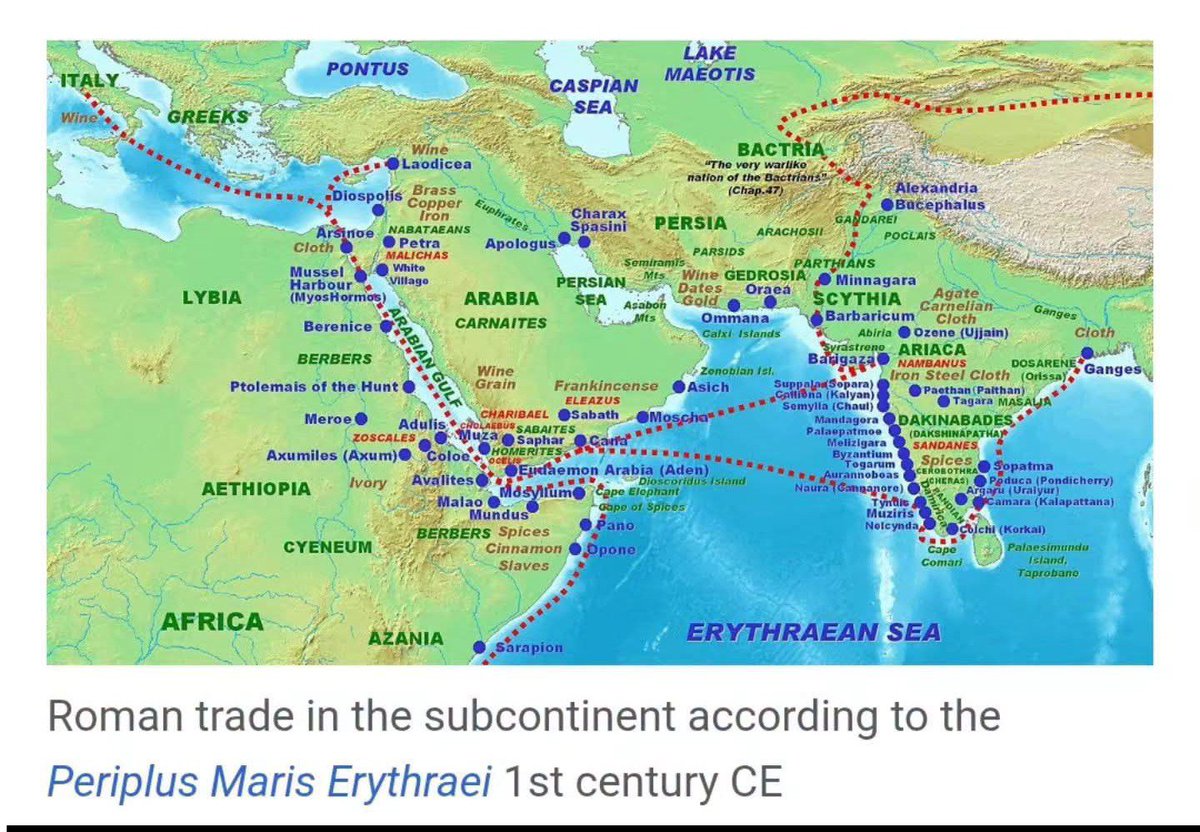
"India takes 50 million sesterces from our Empire every year." — Pliny the Elder, writing in Natural History, lamented that Rome's appetite for Indian luxury goods was draining the empire's wealth....
Nearly 2,000 years ago, the Roman Empire maintained an extensive maritime trade network with India through the Red Sea and across the Indian Ocean.
After Roman sailors learned to take advantage of the seasonal monsoon winds, direct voyages became faster, safer, and more predictable, dramatically expanding trade. Roman merchants imported black pepper, pearls, ivory, gemstones, fine cotton textiles, and other luxury goods from India, while exporting wine, glassware, coral, metals, and silverware.
Because Roman exports did not fully offset the value of these imports, merchants frequently paid the difference with gold and silver coins. Archaeologists have uncovered thousands of Roman coins, amphorae, and other artifacts at ancient trading sites across India, confirming the remarkable scale of Indo-Roman commerce.
Pliny's remarks are among the earliest surviving written criticisms of a persistent trade imbalance and the outflow of precious metals to pay for imported luxury goods.
#archaeohistories
@AgentSaffron Says an illiterate in both. If one deduces the maximum level of proficiency with minimum possible efforts then no language can compete with Sanskrit. One doesn't need to go to Ashtadhyayi for all that. Apart ft, Ashtadhyayi not being a grammar-only text is still that short.
@cbkwgl Telugu grammar even has अचुलू and हलुलू which are borrowed from अच् and हल् of Sanskrit. Abundant vocab is borrowed. But 'closeness' means relation, by origin or development.
@cbkwgl It is obvious that the Loka will consider certain language to be closer to X, evaluating lexically.
Other instance being Urdu.
To state the closeness, one must first state the parameter.+