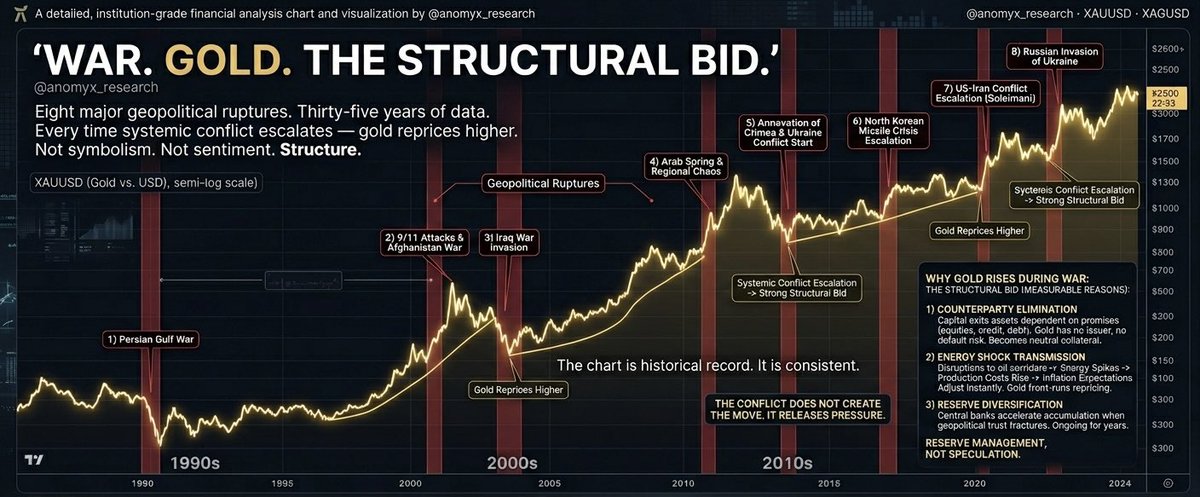
WAR. GOLD. THE STRUCTURAL BID.
@anomyx_research
Eight major geopolitical ruptures. Thirty-five years of data.
Every time systemic conflict escalates, gold reprices higher.
Not symbolism. Not sentiment. Structure.
Gold rises during war for three measurable reasons:
1) Counterparty Elimination
In systemic stress, capital exits assets that depend on a promise (equities, credit, sovereign debt).
Gold carries no issuer, no default risk, no balance sheet behind it.
It becomes neutral collateral.
2) Energy Shock Transmission
Most conflicts disrupt oil corridors or trade routes.
Energy spikes → production costs rise → inflation expectations adjust instantly.
Gold front-runs that repricing before CPI confirms it.
3) Reserve Diversification
Central banks accelerate accumulation when geopolitical trust fractures.
This isn’t speculation. It’s reserve management.
And it’s been occurring for three consecutive years.
The conflict does not create the move.
It releases the pressure already building beneath it.
The chart is not predictive.
It is historical record.
And the record is consistent.
KNOWING IS NOT AN EDGE. EXECUTING IS.
Everyone knows gold rises in war.
Most still lose money trading it.
Why?
Because war-driven markets produce:
• A genuine multi-week structural trend
• Buried inside violent intraday volatility
Traders are rarely wrong about direction.
They’re wrong about the path.
They chase the spike.
A diplomatic headline reverses price.
They’re stopped out.
The structural bid resumes without them.
Titan was built for this exact environment.
Not to predict headlines.
To measure structural convergence.
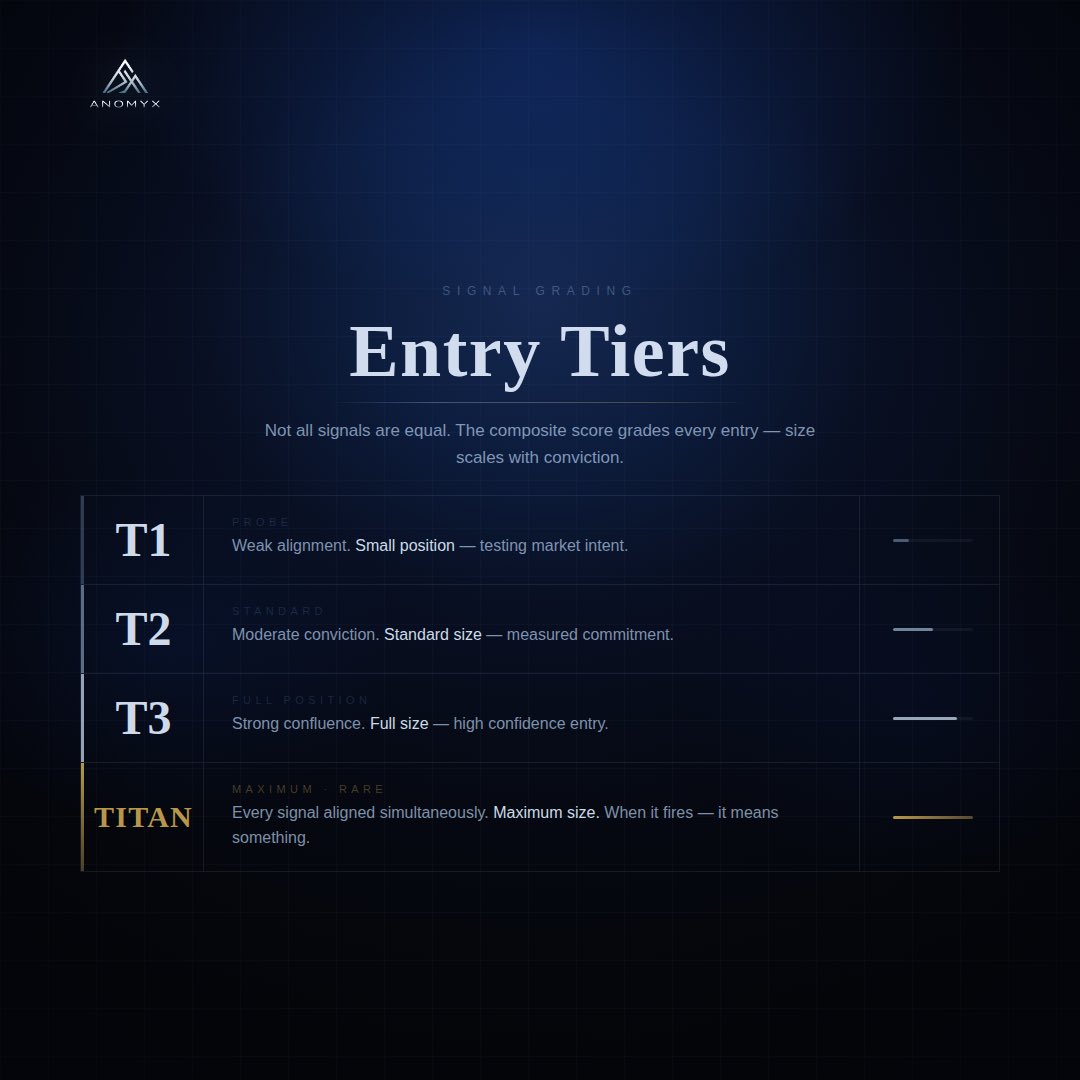
Six inputs → one composite score.
Convergence = size up.
Divergence = step back.
Position sizing is a function of structure, not emotion.
The edge isn’t speed.
It isn’t superior information.
It is the systematic removal of cognitive failure.
The math doesn’t panic.
It doesn’t chase.
It scores — and then it acts.
@anomyx_research · XAUUSD · XAGUSD · Titan - Engineered for Gold & Silver · Not financial advice
Markets are not random.
They are adaptive systems shaped by incentives, leverage, fear, and liquidity.
At Anomyx, we are building quantitative models to study that structure across crypto and metals derivatives.
Our framework integrates:
• Econometrics for statistical validation
• Econophysics for nonlinear dynamics and power-law behavior
• Volatility regime classification
• Microstructure and liquidity modeling
• Strict, systematic risk management
Every strategy begins as a hypothesis.
Every hypothesis is tested across regimes.
Every deployment is rule-based.
We don’t chase narratives.
We measure edge.
The objective isn’t prediction.
It’s extracting repeatable inefficiencies from structured uncertainty.
Building in public.